Deutschland 07056-9398-0 | Internationale Rufnummer ++49 (0) 7056-9398-0 | Willkommen auf unserer neuen Website! Haben Sie einen Fehler oder ein Problem entdeckt? Bitte melden Sie es hier.



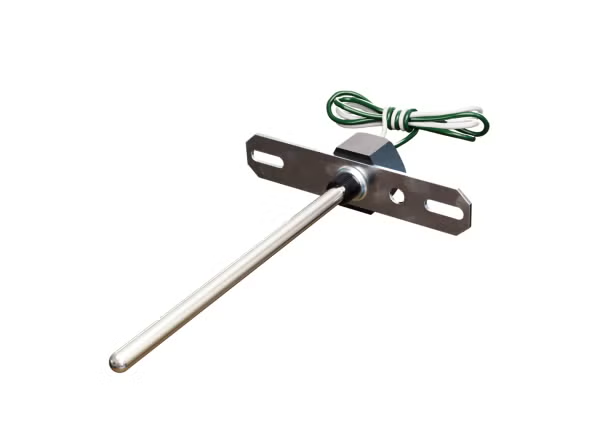
RTD-Duct-No-Box
Platin-RTD-Kanal ohne Gehäuse
- Dachgeräte
- Überwachung der Zuluft-/Abluft-/Rücklauf-/Mischlufttemperaturen
RTD-Duct-No-Box
Von


Produktübersicht
- Genauigkeit +/- 0,06 % Klasse A
- Genauigkeit Detail (Toleranzformel: +/- °C = (0,15 °C + (0,002 *
- Legierungsmaterial (-) Kupfer
- Legierungsmaterial (+) Kupfer
- Zulassungen DIN EN 60751(IEC 751)
- Elektrischer Anschluss Pigtail-Kabel
- Armatur Polyamid 66 (Hochleistungsnylon)
- Anzahl der Messpunkte 1
- Betriebsstrom 5 mA
- Betriebsfeuchtigkeit 10 bis 95 % rF, nicht kondensierend
- Betriebstemperatur, max. 115 °C
- Betriebstemperatur, min. -40 °C
- Ausgangsdetails Sensor-Ausgang bei 0 °C (32 °F): A/100-xW-DO Serie: 100 Ohm Nennwert
- Sondendurchmesser 0.25 in
- Reaktionszeit 8 sunden nominal
- Selbstheizungseffekt 7 mW / °C
- Serien-ID RTD-Duct-No-Box
- Mantelwerkstoff Edelstahl 304
- Stabilität +/- 0,03 % nach 1000 Stunden bei 300 °C (572 °F)
- Lagertemperatur, max. 85 °C
- Lagertemperatur, min. -40 °C
- Temperaturkoeffizient DIN EN 60751(IEC 751)
- Temperaturmessbereich -40 bis 115 °C
- Drahtstärke 22 AWG
Supported Applications
The ACI Platinum Duct without Box (-DO) series is a single-point temperature sensor designed for use with electronic controllers in commercial heating and cooling building management systems. It is intended for duct applications, where it reports a single, well-mixed air temperature back to a controller or PLC.
Unlike the enclosed members of the ACI Duct family, the -DO configuration mounts by flange only, with no junction box, so the sensing element passes through the duct wall on a compact mounting flange sealed by a foam pad. The flange is fitted to the duct through a 3/8" hole. For representative air temperature, the probe is placed several duct segments downstream of bends and obstructions and mounted on the top or sides of the duct rather than the bottom, where moisture could collect. The sensor uses a 1/4" diameter stainless steel sensing element with two 14 or 24 inch, 22 AWG Etched Teflon colored lead wires whose colors differentiate the sensor types.
Operating Conditions & Performance
The sensing element is a platinum RTD with a PTC (positive temperature coefficient) curve and a single sensing point. Its operating range is -40 to 115°C (-40 to 239°F), with an ambient and storage range of -40 to 85°C (-40 to 185°F) and an operating humidity range of 10 to 95% RH, non-condensing.
The element follows DIN EN 60751 (IEC 751) with a temperature coefficient of 3850 ppm/°C and a Class A base tolerance of ±0.06% (tolerance formula ±°C = 0.15°C + 0.002 * |t|). Expressed at discrete points, the accuracy is:
- ±0.23°C (±0.414°F) at -40°C (-40°F)
- ±0.15°C (±0.27°F) at 0°C (32°F)
- ±0.38°C (±0.69°F) at 115°C (239°F)
Sensor output at 0°C (32°F) is 100 Ohms nominal for the A/100 versions and 1000 Ohms nominal for the A/1K versions. Response time for a 63% step change is 8 Seconds nominal, and long-term sensor stability is ±0.03% after 1000 Hours at 300°C (572°F). Self-heating and maximum operating current are 7 mW/°C in still air at 5 mA for the 100 Ohm RTD and 4 mW/°C in still air at 3 mA for the 1K Ohm RTD.
The stainless steel probe measures 0.250" (6.35 mm) in diameter, and the mounting flange body is 3.88" (98.60mm) high by 1.13" (28.74mm) wide with a 0.98" (24.89mm) flange width. Wetted and structural materials include 304 Stainless Steel for the probe, a Polyamide 66 (high-performance nylon) flange, and a Neoprene/EPDM/SBR polymer seal. The plastic flange is rated UL94-HB, and the series carries CE, RoHS2, and WEEE compliance.
Configuration Options
Variants share the same platinum RTD sensing principle but differ along several independent axes that change electrical behavior, installation, and traceability:
- Element resistance — A/100 (100 Ohms nominal at 0°C) versus A/1K (1000 Ohms nominal at 0°C), matching the controller input curve.
- Wire count — 2W two-wire (non-polarity sensitive) versus 3W three-wire (polarity sensitive). The third wire compensates for external lead resistance, so the 3W option should be ordered when the sensor feeds a 3-wire transmitter or sensor configuration on a building management system or PLC.
- Probe length — insertion lengths of 4", 6", 8", 12", and 18" to suit different duct depths.
- Lead-wire and cable options — standard 14" or 24" Etched Teflon leads, with optional plenum-rated CL2P cables in 6', 10', and 20' lengths.
- Traceability — an optional NIST calibration certificate can be added.
- Low-temperature option — Low Temperature (LT) -DO variants extend the measurable range to -198 to 150°C (-324 to 302°F) for cryogenic and low-temperature duct service.
As lead length and cable jacket options are added, the assembled weight rises accordingly, while the underlying flange, probe, and element remain common across the resistance and wire-count choices.
Key Product Differences
Models are built from the custom-ordering structure A/ Sensor Series - Model Series (100 = 100 Ohm Platinum RTD or 1K = 1K Ohm Platinum RTD) - Number of Wires (2W or 3W) - Configuration (DO = Duct without Box, mounting flange only) - Probe Length - Lead Wire Options - NIST. The standard two-wire lineup includes:
- 100 Ohm platinum RTD — A/100-2W-DO-4", A/100-2W-DO-6", A/100-2W-DO-8", A/100-2W-DO-12", and A/100-2W-DO-18", supplied with 14" or 24" Brown/Brown leads.
- 1K Ohm platinum RTD — A/1K-2W-DO-4", A/1K-2W-DO-6", A/1K-2W-DO-8", A/1K-2W-DO-12", and A/1K-2W-DO-18", supplied with 14" or 24" Black/Black leads.
Three-wire versions are ordered by substituting 3W for 2W in the same structure, and any length can be combined with the CL2P plenum-cable options and with the NIST certificate. The Low Temperature series is designated by inserting LT into the code (for example, the A/1K-3W-LT-DO probe family) for extended low-temperature duct measurement.
PDFs & Handbücher