Deutschland 07056-9398-0 | Internationale Rufnummer ++49 (0) 7056-9398-0 | Willkommen auf unserer neuen Website! Haben Sie einen Fehler oder ein Problem entdeckt? Bitte melden Sie es hier.



Nickel-Flexible-Ave
Nickel Flexible Mittelwertbildung
- Der flexible Mittelungssensor misst an mehreren Punkten, um einen besseren Durchschnitt der Kanalluft zu erzielen als ein Ein-Punkt-Kanalsensor.
- Das Produkt verwendet einen 1-K-Ohm-Platin-RTD mit Klasse-A-Toleranz, DIN-EN-60751-Referenz und einem Temperaturkoeffizienten von 3850 ppm pro Grad Celsius.
- Die Serie A/1K-2W-FA ist als zweiadrig und nicht polaritätsempfindlich aufgeführt, wobei die Steuerungsverkabelung an analoge Eingangsleitungen angeschlossen ist.
- Der flexible Sensor verwendet ein raucharmes PVC-Kabel der Klasse CL2P oder CMP mit einem Nennkabeldurchmesser von 0,170 Zoll und doppelwandigem, selbstklebendem Schrumpfschlauch an den Sensorelementen.
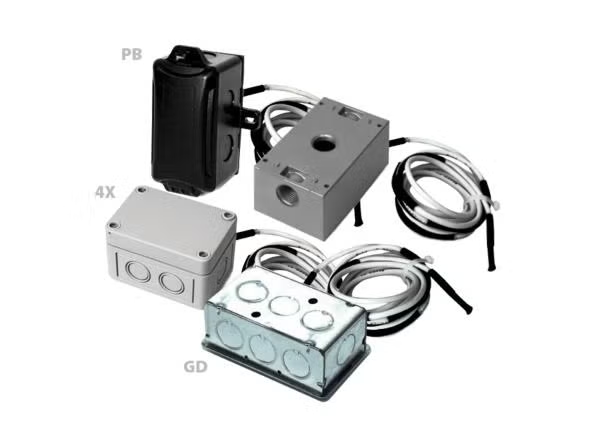
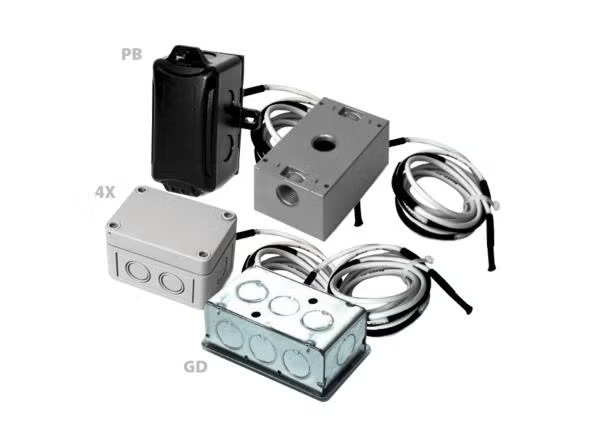
- Bei der Bestellung können verzinkte, Kunststoff- und Aluminium-Anschlusskästen sowie NEMA-4X-Gehäuse für unterschiedliche Montage- und Schutzanforderungen ausgewählt werden.
- Die flexible Mittelwertbildung ist auf einen Betrieb bei 0 bis 75 °C, 10 bis 90 % nicht kondensierende Luftfeuchtigkeit und Anwendungen beschränkt, die keine Beständigkeit gegen UV-Strahlung, Chemikalien oder hohe Luftfeuchtigkeit erfordern.
- Verwenden Sie den Sensor über große Kanalabschnitte von Lüftungsgeräten, in denen die Schichtung eine Einzelpunktmessung weniger repräsentativ macht.
- Verwenden Sie die flexible Mittelwertbildung in Dach-HLK-Kanälen, wenn die Betriebstemperatur und -feuchtigkeit innerhalb der Grenzen des flexiblen Sensors bleiben.
- Verwenden Sie ein kreuz und quer verlaufendes Kanalmuster, um gemischte Luftströme zu mitteln und Fehler durch heiße und kalte Schichten zu reduzieren.
- Platzieren Sie das Mittelungselement stromabwärts des Lüfterauslasses, wo der Luftstrom über den Kanalquerschnitt gleichmäßiger ist.
- Verwenden Sie den Sensor, wenn die Rücklaufkanaltemperatur einen breiten repräsentativen Durchschnitt anstelle einer lokalen Punktmessung erfordert.
- Anwendungen, bei denen eine gemittelte Lufttemperaturrückmeldung eine genauere HLK-Steuerung unterstützen kann.
Nickel-Flexible-Ave
Von


Produktübersicht
- Genauigkeit 70 °F (21,1 °C): +/- 1 %
- Legierungsmaterial (-) Kupfer
- Legierungsmaterial (+) Kupfer
- Zulassungen Din 43760
- Kabeldurchmesser 0.17 in
- Kabelmaterial PVC
- Elektrischer Anschluss Pigtail-Kabel
- Gehäuse-Nennwerte NEMA Typ 4X
- Armatur Polyamid 66 (Hochleistungsnylon)
- Isolierung Geätztes Teflon (PTFE) Farbige Leitungen
- Isolationsfarbe Rot
- Betriebsstrom 5 mA
- Betriebsfeuchtigkeit 10 bis 95 % rF, nicht kondensierend
- Betriebstemperatur, max. 250 °C
- Betriebstemperatur, min. -40 °C
- Ausgangsdetails 1000 Ohm Nennwert
- Reaktionszeit 15 Sekunden nominal
- Selbstheizungseffekt 0,3 °C/mW
- Serien-ID Nickel-Flexible-Ave
- Mantelwerkstoff Edelstahl 304
- Stabilität +/- 0,05 % nach 1000 Stunden bei 150ºC (302ºF)
- Lagertemperatur, max. 75 °C
- Lagertemperatur, min. -20 °C
- Temperaturmessbereich -40 bis 250 °C
- Temperatursensor-Typ 1 kOhm Nickel-Widerstandsthermometer
- Rohrlänge 4.5 in
- Drahtstärke 22 AWG
Supported Applications
The ACI Nickel Flexible Averaging Series is a multi-point temperature sensor designed for use with electronic controllers in commercial heating and cooling building management systems. The series provides an average temperature reading of air inside ducts, offering improved accuracy compared to single-point sensors. Documented applications include Air Handlers, Roof Top Units, Mixed Air/Discharge/Supply Air Temperature Monitoring, Data Centers, and Hospitals.
Installation requires the entire length of the sensor coil to be placed completely inside the duct with no part exposed to exterior air. When installing near air-handling units, place the sensor downstream from the fan discharge. The flexible averaging sensors are limited to applications where operating temperatures do not exceed 0 to 75°C (32 to 158°F) and where high humidity, chemical resistance, or UV Light Air Treatment Systems are not required; Copper Averaging must be used if UV lights are installed in the duct.
Operating Conditions & Performance
The series utilizes a Nickel RTD (PTC - Positive Temperature Coefficient) sensor element conforming to Din 43760 with a temperature coefficient of 6370 ppm/°C. The operating and storage temperature range is 0 to 75°C (32 to 158°F), while the storage temperature range extends from -20 to 75°C (-4 to 167°F). Operating humidity must remain between 10 to 90% RH, non-condensing.
Accuracy varies by sensor length and test temperature:
- 8' and 12' Lengths: +/- 0.23°C (+/- 0.40°F) @ 21.1°C (70°F); +/- 1.59°C (+/- 1.06°F) @ 54.4°C (130°F)
- 24' and 50' Lengths: +/- 0.24°C (+/- 0.42°F) @ 21.1°C (70°F); +/- 0.61°C (+/- 1.09°F) @ 54.4°C (130°F)
Additional performance specifications include a response time of 15 Seconds nominal for a 63% step change, sensor stability of +/- 0.05% after 1000 Hours @ 150°C (302°F), and self-heating of 0.3°C/mW in still air with a maximum operating current of 5 mA.
Configuration Options
The series is configured as an averaging sensor with sensing points determined by the probe length: four sensing points for 8' and 12' lengths, and nine sensing points for 24' and 50' lengths. The flexible plenum-rated cable features a Low Smoke PVC jacket (CL2P or CMP Plenum Rated Cable) with a nominal diameter of 0.170" (4.32mm). Electrical connections consist of an 18 AWG sensing element with two 12 inch 22 AWG Etched Teflon colored lead wires.
Available enclosure options include:
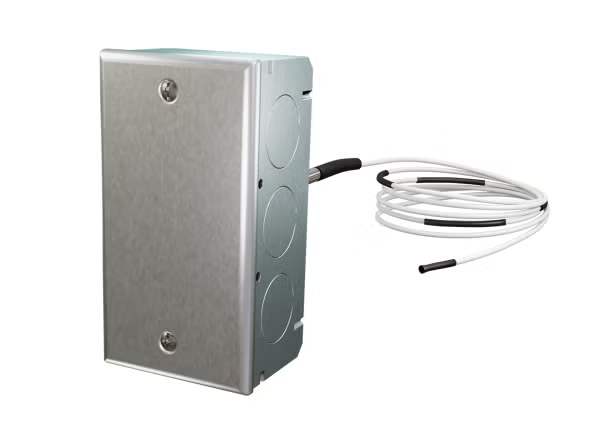
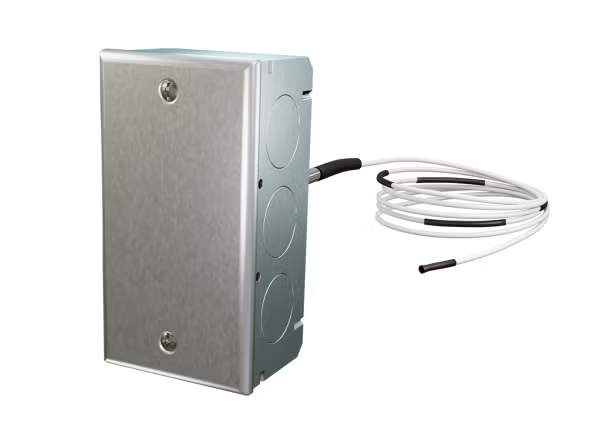
- -GD Enclosure: Galvanized Steel, NEMA 1 (IP10)
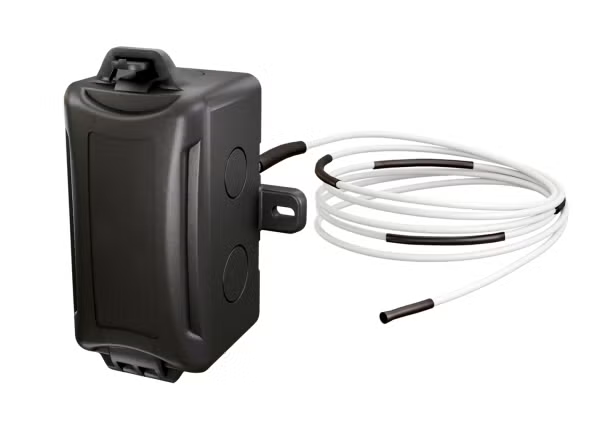
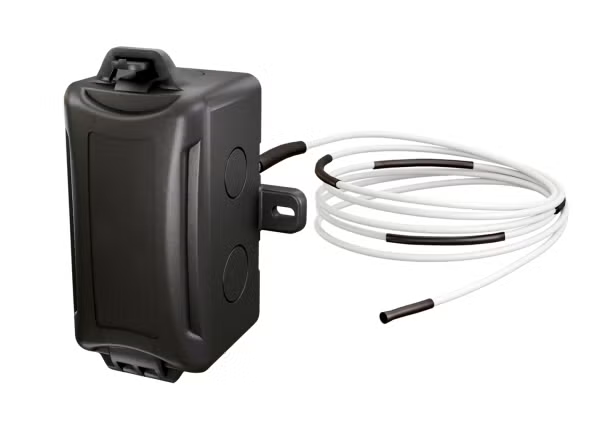
- -PB Enclosure: ABS Plastic, UL94-HB, Plenum Rated
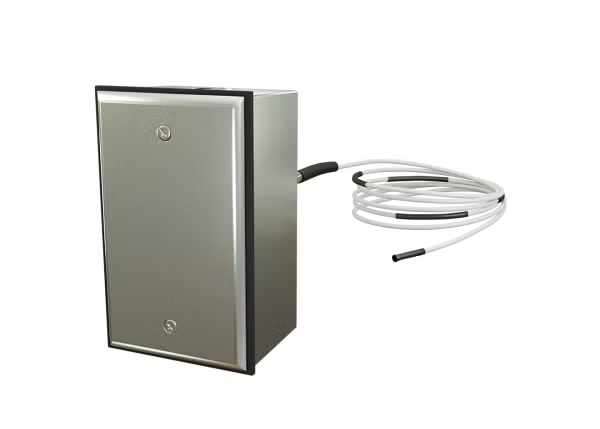
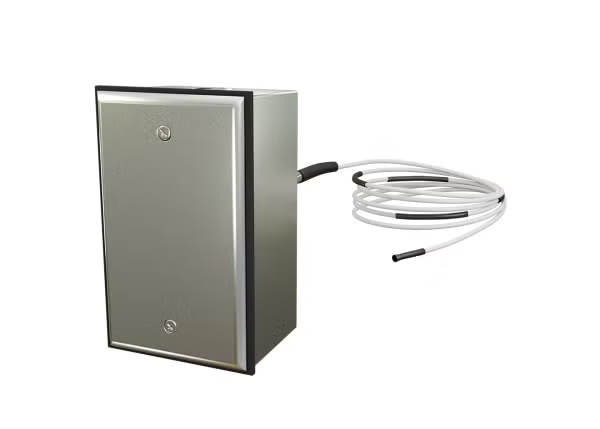
- -BB Enclosure: Aluminum, NEMA 3R (IP 14)
- -4X Enclosure: Polystyrene Plastic, UL94-V2, NEMA 4X (IP 66)
The sensor output is 1000 Ohms nominal with Red/Red lead wire colors. Optional accessories include copper capillary mounting clips and universal plastic mounting clips.
Key Product Differences
Variants within the Nickel Flexible Averaging series are distinguished by probe length (8', 12', 24', or 50') and enclosure type (-GD, -PB, -BB, or -4X). The model number structure follows the format A/1K-NI-FA-[Length]-[Enclosure], with an optional NIST Certificate suffix. For example, a 12-foot sensor in a Galvanized enclosure is designated as A/1K-NI-FA-12'-GD.
While the broader ACI Averaging Series includes Copper and other thermistor options (A/1.8K, A/3K, Platinum), this specific series code covers only the Nickel RTD Flexible configuration with 1 KΩ nominal output at 21.1°C (70°F). The flexible variant is distinct from copper tubing sensors in material composition (Low Smoke PVC vs. Copper) and application constraints regarding UV exposure.
PDFs & Handbücher