Deutschland 07056-9398-0 | Internationale Rufnummer ++49 (0) 7056-9398-0 | Willkommen auf unserer neuen Website! Haben Sie einen Fehler oder ein Problem entdeckt? Bitte melden Sie es hier.



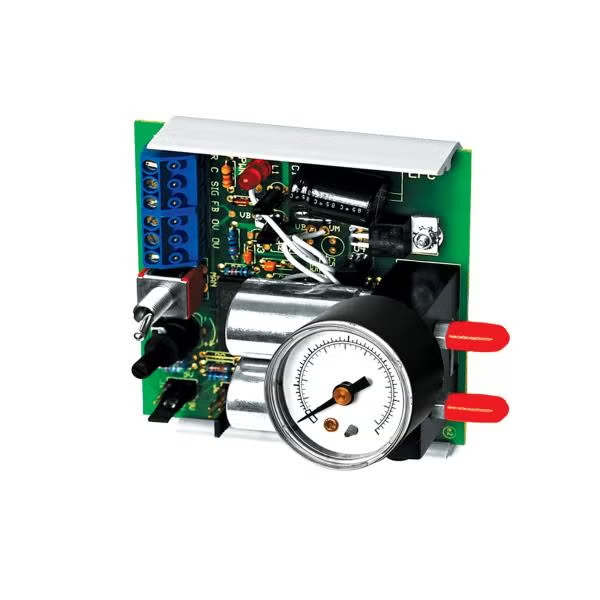
Series-EPC
Analog-Pneumatik-Ausgangstransducer für 22 bis 25 psig Luftversorgungsdruck
- Wandelt analoge Steuerung in pneumatischen Ausgang um: Wandler der EPC-Serie wandeln Spannungs- oder Stromeingangssignale in proportionalen Abzweigleitungsdruck für pneumatische Steuerungssysteme um.
- Flexible Eingangsbereiche: Über Steckbrücke wählbare Eingänge unterstützen Signale von 0–5 VDC, 0–10 VDC, 0–15 VDC und 0–20 mA für eine einfache Integration mit DDC-Steuerungen.
- Wählbarer pneumatischer Ausgang: Die Ausgangsdruckbereiche sind per Jumper wählbar für 0–10 psig, 0–15 psig oder 0–20 psig, wobei eine Feldkalibrierung bis zu 20 psig verfügbar ist.
- Ideal für die pneumatische HLK-Steuerung: Entwickelt für 3-Wege-Mischventile, Kühlerbelastung, Pilotstellungsregler, pneumatische Ventil- und Klappenstellantriebe, Lüfterflügelsteuerung, DDC-Steuerung, VAV-Boxen und Anwendungen über der Decke.
- Integrierte Druckrückmeldung: Ein 0–5-VDC-Rückmeldesignal zeigt den resultierenden Abzweigleitungsdruck für die Überwachung, Verifizierung und Sichtbarkeit des Regelkreises an.
- Manuelle Übersteuerungsfunktion: Mit dem Hand-/Auto-Schalter und dem Übersteuerungspotentiometer können Techniker den pneumatischen Ausgang während der Einrichtung oder Fehlerbehebung lokal variieren.
- Mehrere Betriebsmodelle: Wählen Sie EPC-Modelle mit konstanter Entlüftung, EPC2-Modelle mit Zweigdruckhaltung, EPC2LG-Modelle mit hohem Durchfluss oder ausfallsichere EPC2FS-Versionen, die bei Stromausfall entlüften.
- Schalttafelfreundliche Installation: Elektrische Klemmen an einem Ende und pneumatische Anschlüsse am anderen Ende vereinfachen die Verkabelung und Verrohrung in Schalttafeln.
- Zuverlässiges Feldpaket: Integrierte Filterung, abnehmbare Messingarmaturen, optionale Modelle mit Manometer und Stahlgehäuse, RoHS2/WEEE-Konformität und die zweijährige Garantie von ACI unterstützen den langfristigen Einsatz.
Series-EPC
Von


Produktübersicht
- Genauigkeit Detail Ausgangsdruckgenauigkeit: 1 % Raumtemperatur
- Luftzufuhrdruck, max. 25 psi
- Luftzufuhrdruck, min. 22 psi
- Zulassungen RoHS2, WEEE
- Auto-/Manuell-Funktion Manueller / automatischer Überbrückungsschalter: MAN-Funktion = Ausgang kann variiert werden
- Elektrischer Anschluss Schraubklemme
- Gehäusematerial Stahl
- Filter Ausgestattet mit integriertem 80-100 µm Filter im Stutzen (Teilenr. PN004), außer bei EPC2LG, das mit einem externen 5 µm Inline-Filter (PN021) geliefert wird.
- Impedanz Eingang Eingangssignalquelle (@ Impedanz): 0-5 Vdc @ unendlich Ω
- Eingangstyp Analog
- Material PVC
- Betriebsfeuchtigkeit 10 bis 95 % rF, nicht kondensierend
- Betriebstemperatur, max. 120 °F
- Betriebstemperatur, min. 35 °F
- Ausgangsleistung Hinweis Ausgangsbereich des Rückmeldesignals: 0-5 Vdc = Ausgangsspanne
- Ausgangsdruckbereich 0 bis 10 psi, 0 bis 15 psi, 0 bis 20 psi
- Druck Hinweis Ausgangsdruckbereich – per Jumper wählbar: 0-10 psig (0-68,95 kPa), 0-15 psig (0-103,43 kPa) oder 0-20 psig (137,9 kPa); Messdruckbereich (Messgeräte-Modelle): 0-30 psig (0-200 kPa)
- Serien-ID Series-EPC
- Lagertemperatur, max. 150 °F
- Lagertemperatur, min. -20 °F
- Versorgungsstrom 200 mA
- Versorgungsspannung 24 VAC/VDC
- Anzugsmoment 0,5 Nm (Minimum); 0,6 Nm (Maximum)
- Rohrgröße 1/4 Zoll Außendurchmesser x 1/8 Zoll Zollnendurchmesser
- Drahtstärke 26 bis 16 AWG
Supported Applications
The ACI Series EPC functions as an electric-to-pneumatic transducer, converting analog input signals into proportional pneumatic outputs. These units modulate control valves to regulate branch line pressure according to a set point determined by the input signal. The series is designed for panel mounting with electrical terminals on one end and pneumatic connections on the other.
Operating Conditions & Performance
The Series EPC operates within an ambient temperature range of 35 to 120°F (1.7 to 48.9°C) and a humidity rating of 10 to 95% non-condensing. Storage is supported from -20 to 150°F (-28.9 to 65.5°C). The unit requires an air supply pressure between a minimum of 22 psig (151.69 kPa) and a maximum of 25 psig (172.369 kPa).
Output accuracy is specified as 1% at room temperature or 2% full scale across the operating temperature range. Output pressure ranges are jumper selectable for 0-10 psi (0-68.95 kPa), 0-15 psig (0-103.43 kPa), or 0-20 psig (137.9 kPa). Field calibration is possible up to a maximum of 0 to 20 psig (0-138 kPa).
Power requirements are 24 VAC (+/-10%), 50/60 Hz, or 24 VDC (+10% / -5%). Supply current is limited to a maximum of 500 mAAC and 200 mADC. The series accepts input signals of 0-5 VDC @ infinite Ω, 0-10 VDC @ infinite Ω, 0-15 VDC @ infinite Ω, or 0-20 mA / 250Ω.
Configuration Options
The series offers multiple configurations regarding housing, filtration, and fail-safe behavior:
- Housing Options: Standard models feature a painted steel housing with a mounting flange for sheet metal screws. Enclosed variants (EPC2GB, EPC2GFSB) are available in a steel box.
- Filtration: Most units include an integral-in-barb 80-100 micron filter (Part # PN004). The EPC2LG model is furnished with an external 5 micron in-line filter (PN021).
- Gauges: Models designated with a 'G' include a gauge. Gauge pressure range for these models is 0-30 psig (0-200 kPa) with accuracy of ±2.5% Midscale or ±3.5% Full Scale.
- DIN Rail Mounting: A DIN Rail Adapter Kit is available as an accessory option.
Key Product Differences
The Series EPC includes distinct operational behaviors based on the model variant, particularly regarding air consumption and power failure response:
- EPC / EPCG (Constant Bleed): These models utilize a constant bleed interface. The branch exhaust response time is determined by the 0.007" bleed orifice size and pressure differentials. Upon power loss, these units continue to bleed through the orifice until branch pressure reaches zero psig.
- EPC2 / EPC2G (Maintain Pressure): These models incorporate two valves (one controls exhaust) and do not bleed air at set point. They provide 2300 SCIM supply and exhaust flow, with response times similar to the load rate rather than limited by an internal restrictor. If power fails, branch line pressure remains constant assuming no leaks.
- EPC2FS / EPC2GFS (Fail-Safe): These models share specifications with the EPC2 but feature a 3-way branch valve that exhausts branch line air upon power failure to zero psig. Exhaust flow on power loss is rated at 1600 SCIM.
- EPC2LG (High Flow / Filtered): Operates as the EPC2 but includes an external 5 micron filter and high-flow characteristics.
- EPC2GB / EPC2GFSB: These are enclosed in a steel housing. The EPC2GB maintains branch pressure on power loss, while the EPC2GFSB exhausts to zero psig (0 kPa) upon power failure.
PDFs & Handbücher