






Resin transfer molding is a closed-mold manufacturing process used to produce high-strength composite components with consistent quality and dimensional accuracy. The process is widely used in aerospace, marine, wind energy, and industrial manufacturing, especially where lightweight, durable parts are required. During the resin transfer molding process, liquid resin is injected into a sealed mold containing a dry fiber reinforcement, where it thoroughly impregnates the material before curing into a finished composite part.
Successful resin transfer molding depends on carefully controlling multiple process variables, including resin temperature and flow rate. The epoxy resin must be heated enough to reduce its viscosity and allow it to flow uniformly throughout the mold, but temperatures that are too high can accelerate curing or negatively affect resin properties. Likewise, maintaining a controlled flow rate helps ensure complete mold filling while minimizing the risk of air entrapment, dry spots, and other manufacturing defects.
What is Resin Transfer Molding?
Resin transfer molding is a closed-mold composite manufacturing process used to produce strong, lightweight components with consistent quality and dimensional accuracy. During the process, a liquid thermoset resin—most commonly epoxy—is injected into a sealed mold containing a dry fiber reinforcement. The resin fully impregnates the reinforcement before curing into a rigid composite structure.
The resin transfer molding process generally consists of six primary stages:
- Mold Preparation: The mold is cleaned, prepared, and treated with a release agent to facilitate removal of the finished part after curing
- Fiber Reinforcement Placement: A dry fiber preform or reinforcement is positioned within the mold cavity
- Mold Closing and Sealing: The mold is closed and securely clamped to create a sealed cavity for resin injection
- Resin Injection: Conditioned epoxy resin is injected into the mold under controlled conditions, allowing it to flow through and fully impregnate the fiber reinforcement
- Curing : The resin cures inside the closed mold, forming the finished composite structure/li>
- Demolding and Finishing: The completed part is removed from the mold, followed by any necessary trimming, machining, or finishing operations
Why Temperature Control is Critical
During resin transfer molding, epoxy resin must be maintained within a specific temperature range to achieve the proper viscosity for injection. As resin temperature increases, its viscosity decreases, allowing it to flow more easily through the mold and fully impregnate the fiber reinforcement. If the resin temperature is too low, increased viscosity can restrict flow, making it more difficult to fill complex mold geometries and increasing the potential for incomplete wet-out or dry areas within the composite
Excessively high resin temperatures present a different set of challenges. Elevated temperatures can accelerate the curing reaction, reducing the available processing time before the resin begins to harden. Depending on the resin system, excessive heat may also affect material properties or create inconsistencies in the finished part. Maintaining the proper processing temperature helps provide uniform resin flow throughout the molding cycle while supporting consistent composite quality.
Why Flow Control Matters
While temperature determines resin viscosity, flow control governs how the resin moves through the mold during injection. Maintaining an appropriate flow rate helps ensure that the resin evenly fills the mold cavity and completely saturates the fiber reinforcement before curing begins.
If the resin is injected too quickly, turbulence and air entrapment may occur, increasing the likelihood of voids or other defects within the finished composite. Conversely, flow rates that are too low can lengthen fill times and, in some applications, allow portions of the resin to begin curing before the mold is completely filled. Carefully controlling resin flow helps optimize the molding process while reducing variability between production runs.
Monitoring and Process Automation
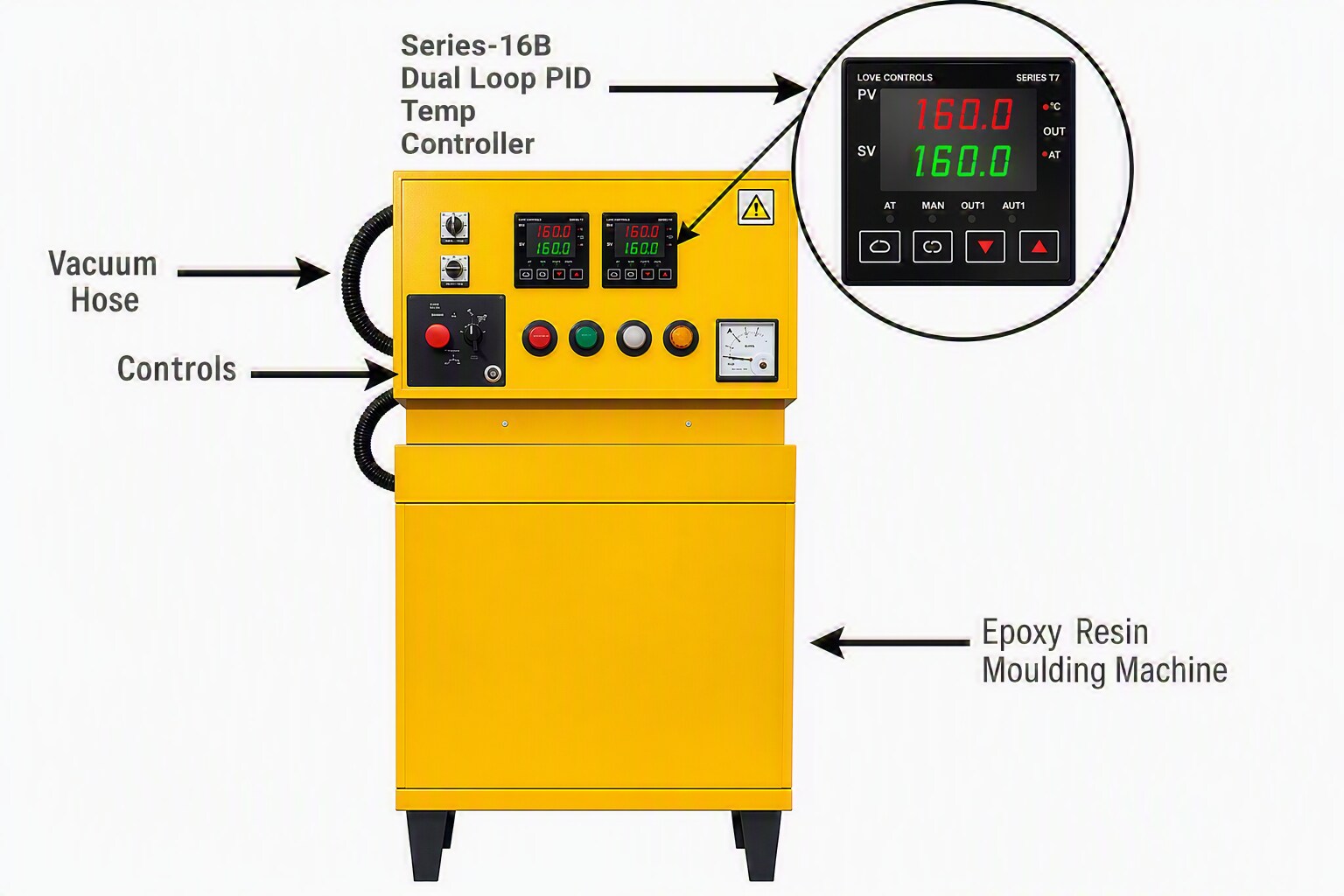
Modern resin transfer molding systems often combine temperature and flow measurement with automated process control to improve manufacturing consistency and reduce operator intervention. Temperature controllers regulate resin heating to maintain the desired processing temperature, while flow instrumentation continuously monitors resin delivery during injection. Together, these devices help maintain stable processing conditions throughout the molding cycle.
Innovative Solutions from DwyerOmega
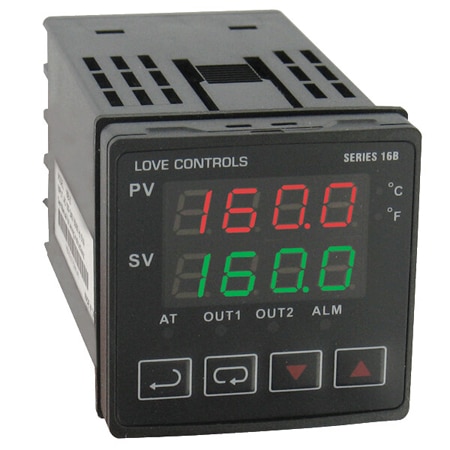
Series 16B Dual Loop PID Temperature Controller
The Series 16B Dual Loop PID Temperature Controller is designed for precise temperature and process control in industrial applications that require stable operation and flexible control strategies. With universal input compatibility, dual control outputs, and integrated communications, it can be used as a standalone controller or incorporated into larger automation systems. Built-in PID control and ramp/soak programming help maintain consistent process conditions while reducing manual intervention.
Key Features:
- Universal input compatible with thermocouples, RTDs, and process transmitter signals
- Dual control outputs for independent heating/cooling or other dual-loop control applications
- PID, ON/OFF, self-tuning, and manual control modes to suit a wide range of processes
- Support for up to 64 ramp/soak program actions for applications requiring controlled temperature profiles
- Dual LED displays that simultaneously show process value and setpoint for easy monitoring
- Two configurable alarm outputs with multiple alarm functions for improved process safety
- Standard RS-485 communications for integration with PLCs, HMIs, and SCADA systems
- Selectable engineering units (°F/°C), configurable resolution, and security functions for added flexibility
FDT-25W Wall Mount Ultrasonic Flow Meter
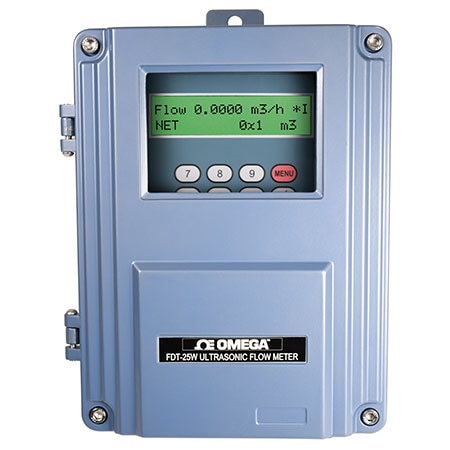
The FDT-25W Wall Mount Ultrasonic Flow Meter provides accurate, non-invasive liquid flow measurement without interrupting the process. Its clamp-on ultrasonic transducers mount to the outside of the pipe, eliminating the need for pipe cutting, system shutdowns, or direct contact with the process fluid. This makes the FDT-25W an excellent solution for retrofits, preventive maintenance, and applications where minimizing downtime is critical.
Key Features:
- Clamp-on ultrasonic design for quick installation without cutting pipes or interrupting operation
- Transit-time measurement technology delivers ±1% accuracy and 0.2% repeatability for reliable flow monitoring
- Measures bidirectional flow in pipe sizes ranging from ¾ in. to 240 in. (DN15 to DN6000)
- Compatible with a wide variety of metallic, plastic, and rubber piping
- Multiple transducer mounting configurations (V, W, and Z methods) to accommodate different pipe sizes and application requirements
- Standard 4-20 mA analog output, RS-485 communications, pulse/totalizer outputs, and built-in data logging for integration with control and monitoring systems
- Non-contact measurement eliminates pressure loss, moving parts, and sensor fouling, helping reduce maintenance requirements

What Is A Stepper Motor & Controllers? – Omega Engineering Introduction to Stepper Motors
