


Many facilities still rely on proven 4–20 mA and 0–10 V analog sensors for critical measurements. While these signals remain widely supported, integrating them into modern digital architectures can introduce unnecessary complexity, particularly as systems scale or require more granular diagnostics.
The IF-IOL Series IO-Link® Converter is designed to bridge that gap. By converting legacy analog signals into IO-Link® process data, the IF-IOL Series enables existing sensors to participate in a standardized, bidirectional digital communication framework without requiring sensor replacement or extensive rewiring.
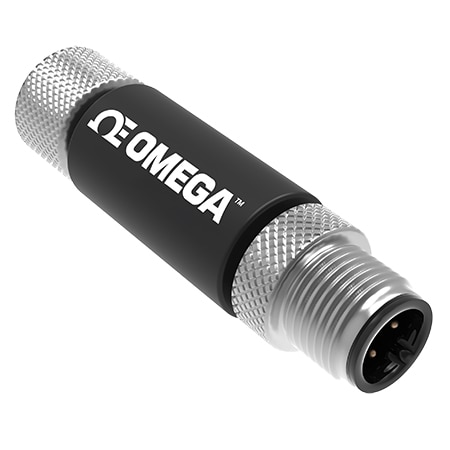
Converting Analog Signals to IO-Link® Process Data
The IF-IOL Series accepts industry-standard 4–20 mA or 0–10 V output signals from analog sensors and converts them into IO-Link® -compatible digital data. This allows those sensors to connect directly to an IO-Link master, creating a point-to-point digital signal path from the measurement device to the control or monitoring system.
Because all signal conversion occurs inside the converter, no additional hardware or protocol translators are required. This simplifies system architecture while maintaining compatibility with established sensor technologies.
IF‑IOL Series Model Comparison
The IF‑IOL Series consists of two compact IO‑Link converters designed to accommodate either current or voltage analog signals, allowing engineers to select the model that best aligns with their system architecture. Both models operate over a wide temperature range from –40 °C to +70 °C and offer protection against common industrial electrical faults, supporting reliable performance in demanding automation environments.
| Model | Input Signal Type | Input Range | Input Impedance | Accuracy | Typical Use Case | Compatible Sensor Example |
|---|---|---|---|---|---|---|
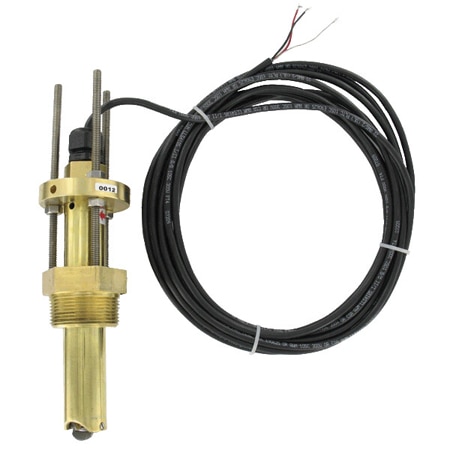
| IF‑IOL‑001 | Current | 4–20 mA | 450 Ω | ±0.5 % | Current‑loop sensors and industrial transmitters |
|
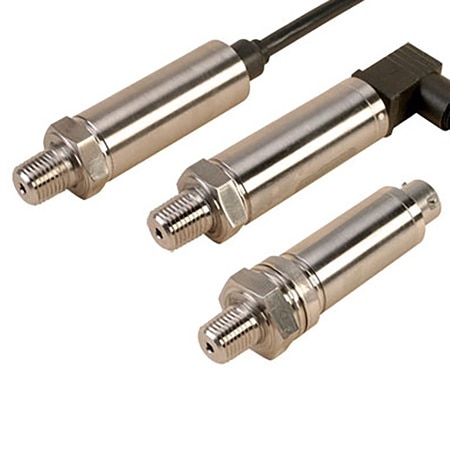
| IF‑IOL‑002 | Voltage | 0–10 Vdc | 14.3 kΩ | ±0.5 % | Voltage‑output devices and PLC analog outputs |
|
What is IO-Link®?
IO-Link® is a point-to-point communication link between a master device and a sensor and/or light. It can be used to automatically parameterize sensors or lights and to transmit process data. For the latest IO-Link protocol and specifications, check out www.io-link.com.
Practical Advantages of Upgrading to IO-Link®
While IO-Link® is often associated with new sensor deployments, the IF-IOL Series makes it practical to extend these benefits to existing analog devices. Even if a system currently operates without IO-Link, adopting it can still make sense, particularly when future expansion is expected, reducing opportunities for manual error is a priority, or standardizing and automating repeatable processes is required.
Scalability
Some projects are large from inception, or have the potential to evolve from original plans - both cases require equipment of scalable nature. The IO-Link Converter is a key piece in scaling system controls for environmental and process sensors. In data center environments, system expansion often means adding rack rows, cooling zones, or monitoring points. With IO-Link® , additional devices can be connected using available IO-Link master ports or by expanding the IO-Link® network, rather than reprogramming or re-terminating every controller I/O point. The IF-IOL Series allows legacy analog sensors to participate in this scalable architecture.
Streamlined Commissioning
Traditional analog systems require individual signal terminations at the controller, increasing wiring effort and the potential for errors. By digitizing sensor data at the source and aggregating it through an IO-Link® master, the IF-IOL Series helps reduce installation complexity.
IO-Link communication also supports automatically recognizing a newly connected IF-IOL device by referencing its already-known configuration, eliminating manual entry. These capabilities can simplify system checkout and validation by reducing steps, particularly in larger installations with many measurement points.
Standardized Digital Integration
Once converted, sensor data is transmitted from the IF-IOL Series to an IO-Link® master, where it can be integrated into PLC, BAS, or DCIM platforms. This helps avoid the need for custom handling of unique software for each sensor type, creating a consistent data structure for centralized monitoring, diagnostics, and control, even when the underlying sensors use different analog output types.
Flexible Installation with Integrated Connectivity
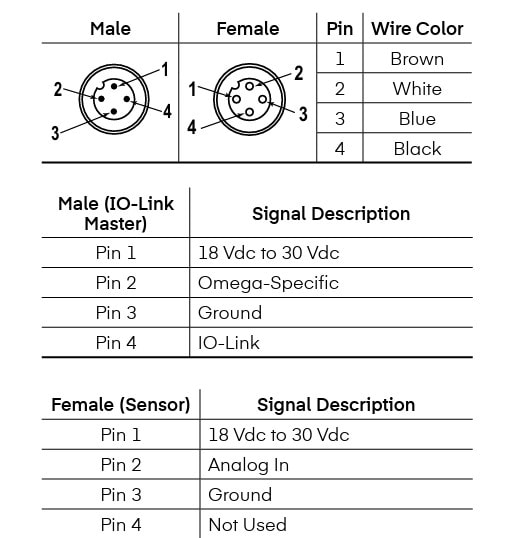
Each IF-IOL Series converter features integral M12 connectors, supporting multiple installation approaches. The unit can be mounted directly to a sensor or installed in-line anywhere along the signal loop, depending on application requirements and available space.
This flexibility is particularly useful in retrofit projects, where cabinet space may be limited and reconfiguring existing wiring is undesirable. By staying within the sensor signal path, the converter minimizes system disruption while enabling a digital upgrade.
Designed for Industrial Environments
The IF-IOL Series is built for demanding operating conditions. The compact housing meets IP65, IP67, and IP68 environmental ratings, supporting use in areas exposed to moisture, dust, or washdown conditions.
Integrated LED status indicators provide immediate visual feedback for:
- Power status
- IO-Link® communication
- Analog signal activity
Signal Quality and Measurement Performance
Maintaining measurement integrity during signal conversion is critical, particularly in control and monitoring applications. The IF-IOL Series delivers:
- 13- and 14-bit resolution, depending on the configuration
- ± 0.5 % measurement precision
Extending the Value of Existing Sensors
The IF-IOL Series IO-Link® Converter from DwyerOmega provides a practical path for modernizing measurement systems without replacing reliable analog sensors. By enabling IO-Link® connectivity, it supports scalable system design, simplifies commissioning, and improves digital integration while preserving the value of installed instrumentation.
Data Acquisition: DAQ System Introduction to Data Acquisition Systems
Remote Process Monitoring and Control Introduction to Remote Monitoring