


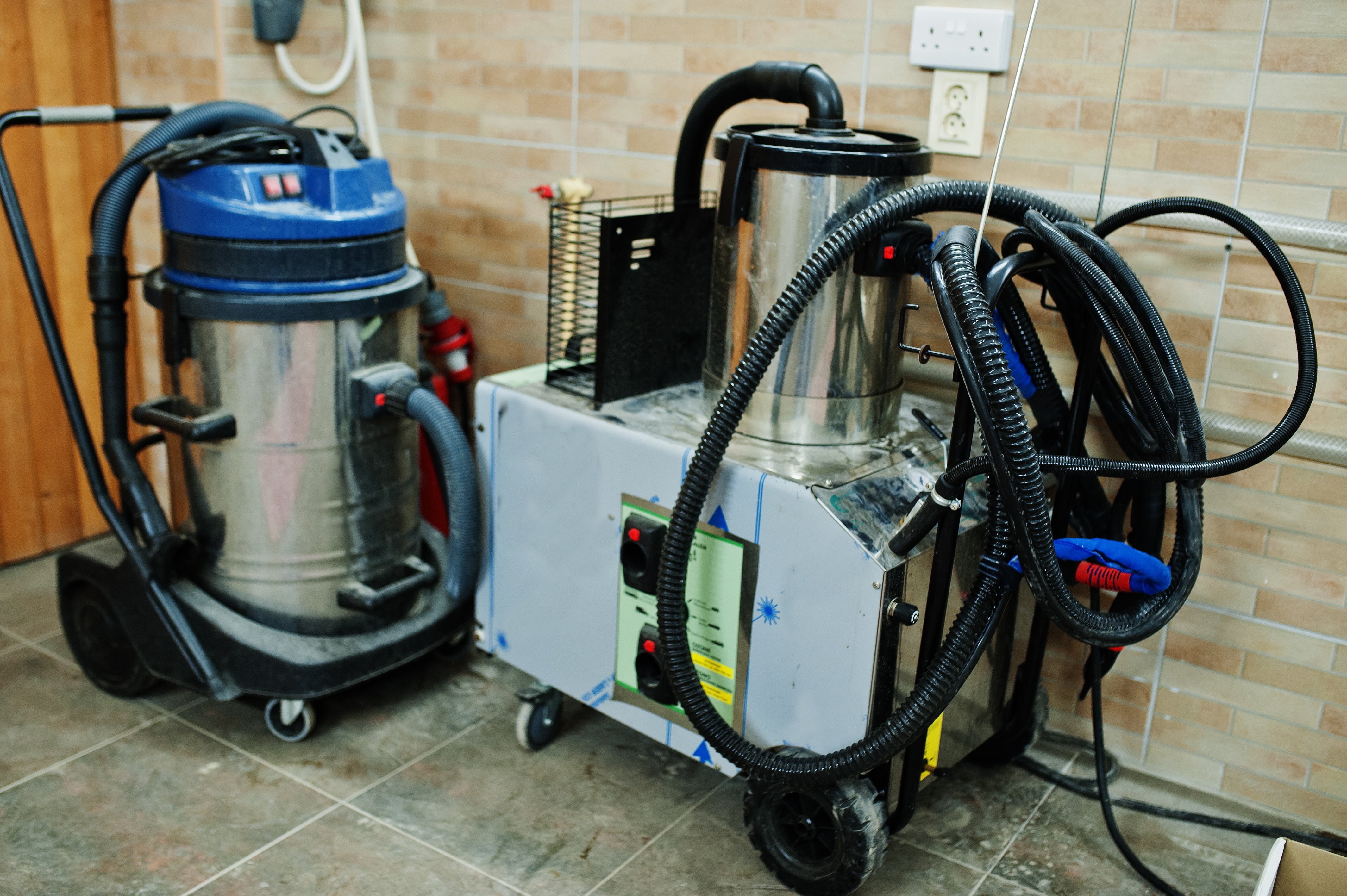
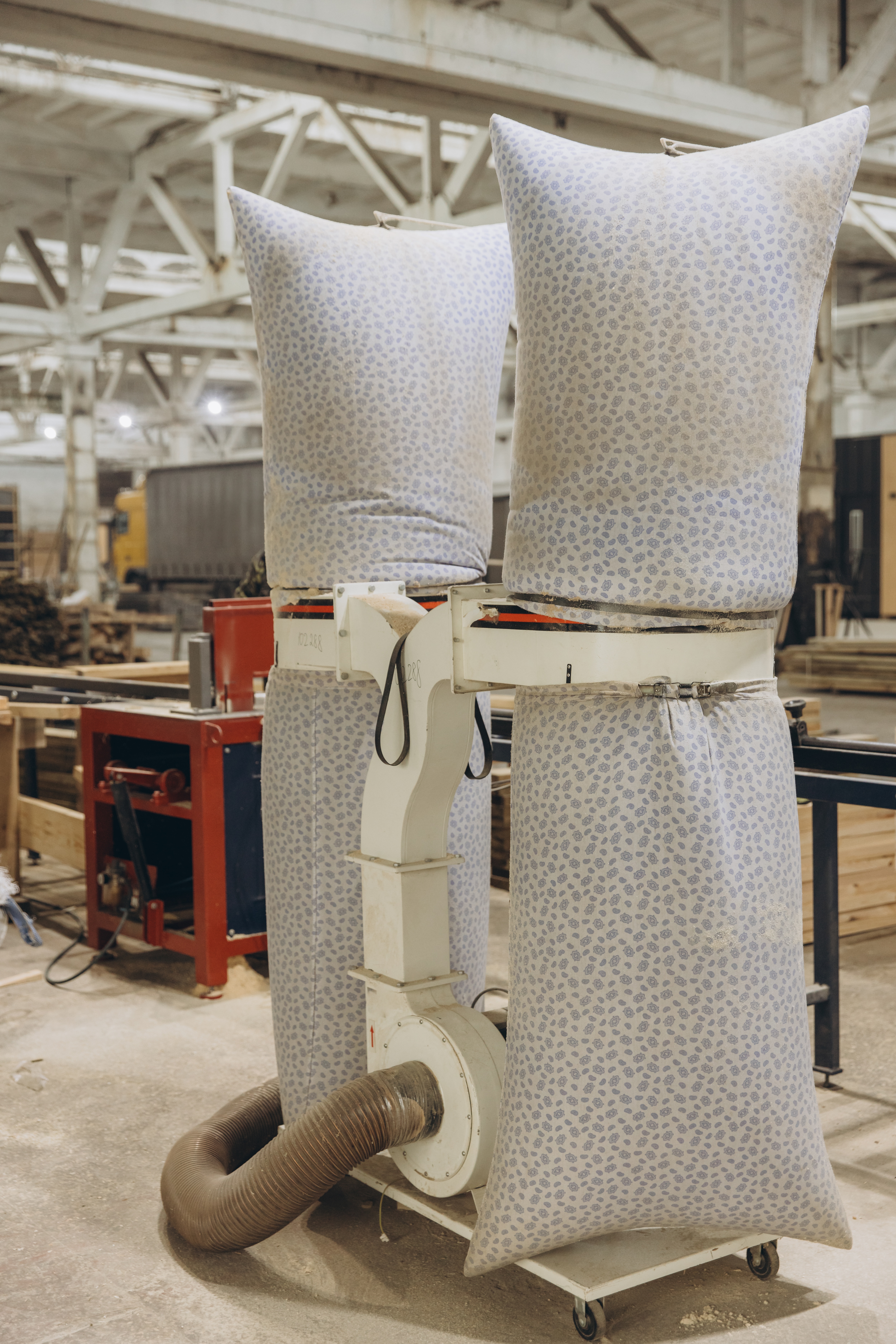
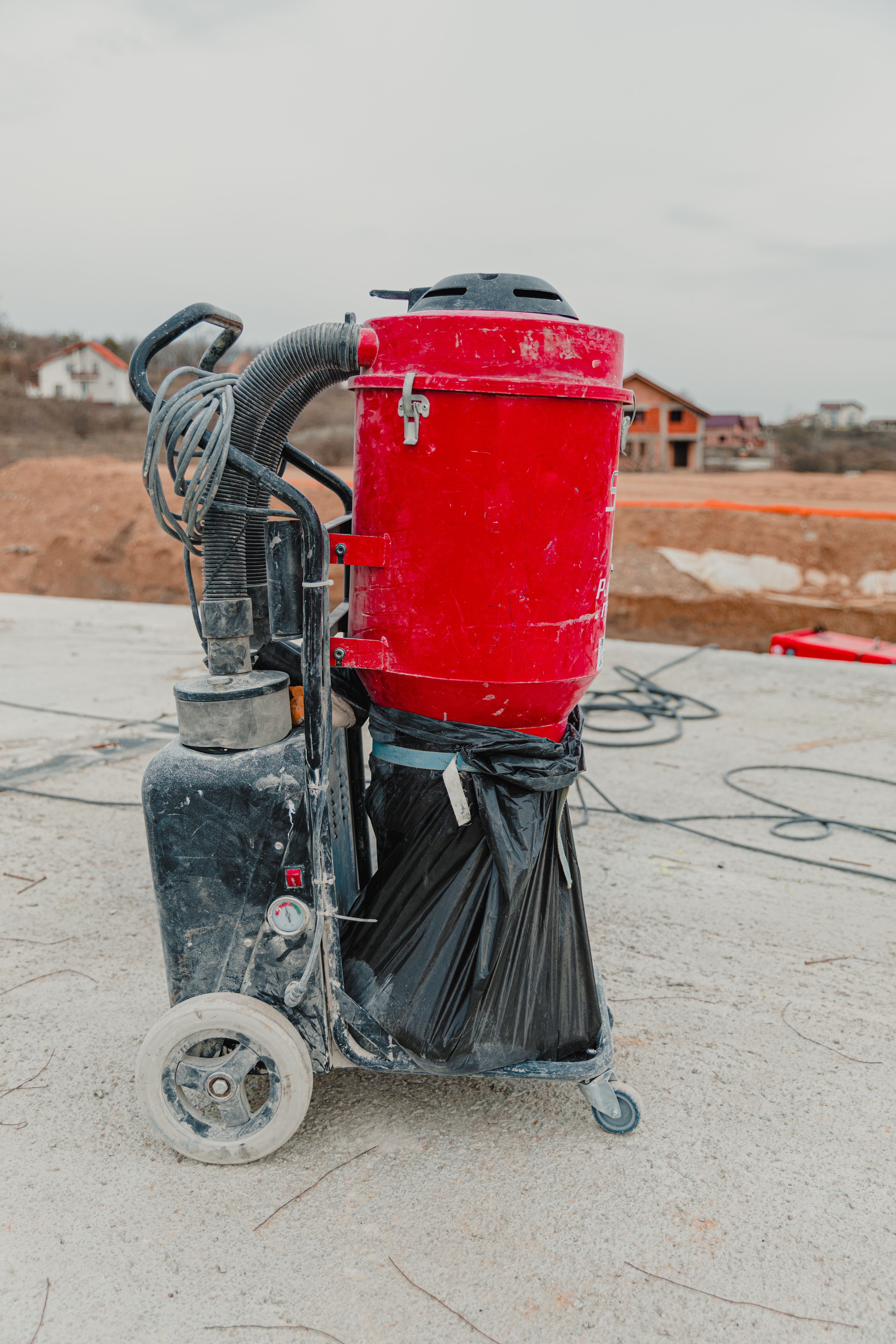
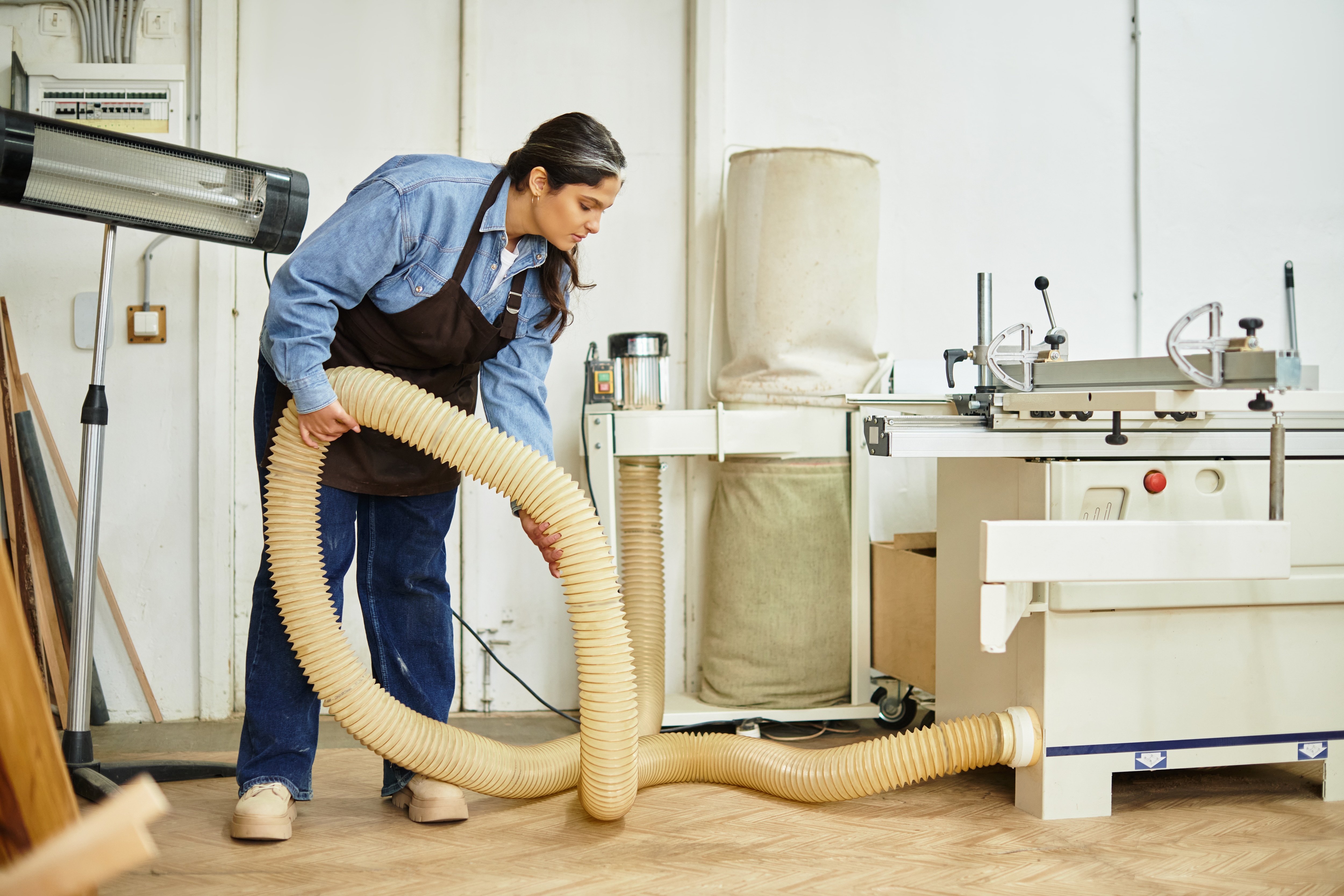
Portable dust collectors can play an important role in maintaining air quality by capturing airborne dust and particulates generated during manufacturing processes and applications such as welding, grinding, sanding, and cutting. Unlike centralized dust collection systems, portable units can be positioned where dust is generated, making them a practical solution for equipment maintenance, hard-to-get-to spaces in an industrial facility, or temporary workstations; they are ideal in spaces where permanent ductwork is impractical or not possible.
Like any industrial duct collection system, however, a portable dust collector is only as effective as its filters. As dust accumulates on the filters, airflow resistance increases, reducing the system's ability to capture airborne particles. If left unchecked, excessive filter loading can decrease collection efficiency, increase energy consumption, place additional strain on the blower, and shorten filter life.
Maintaining proper filter performance requires more than routine inspection. Monitoring the pressure drop across the filters provides valuable insight into their condition, allowing maintenance personnel to determine when cleaning is necessary and identify potential issues before they impact system performance. When combined with an effective pulse jet cleaning system, differential pressure monitoring helps maintain consistent airflow, optimize filter cleaning cycles, and reduce unnecessary maintenance.
Pressure Measurement & Monitoring Solutions from DwyerOmega
Why Dust Collector Filters Become Restricted
Dust collector filters are designed to capture fine airborne particles while allowing clean air to pass through the filter media. As the system operates, dust accumulates on the surface of the filters, gradually increasing resistance to airflow.
Excessive filter loading can lead to several operational issues, including:
- Reduced airflow throughout the dust collection system
- Lower dust capture efficiency at collection points
- Increased fan workload and energy consumption
- Premature filter wear or failure
- More frequent maintenance and unplanned downtime
Understanding Filter Pressure Drop
Filter pressure drop is the difference in air pressure measured on either side of a dust collector filter. Air entering the filter is at a higher pressure than the cleaned air exiting the filter. The difference between these two measurements is known as the differential pressure.
As dust accumulates on the filter media, airflow encounters greater resistance, causing the differential pressure to increase. Monitoring this pressure provides maintenance personnel with a reliable indication of filter loading and overall system performance.
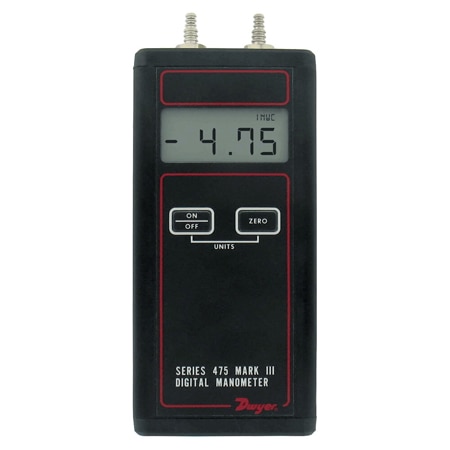
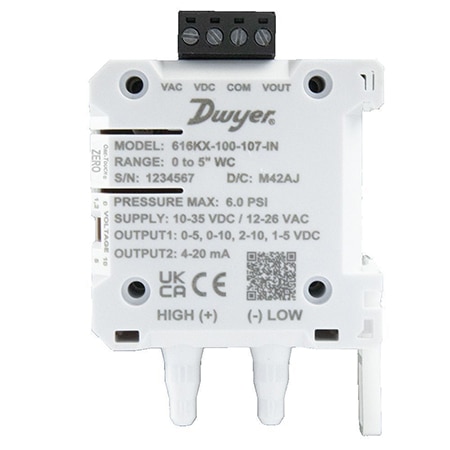
By continuously measuring the pressure drop across the filter bank, a differential pressure gauge or transmitter provides valuable information for determining when filter cleaning or maintenance is required.
How Pulse Jet Filter Cleaning Works
Most portable dust collectors use a pulse jet cleaning system to remove accumulated dust from the filter media without interrupting operation. When the pressure drop across the filters indicates that dust buildup has reached a level requiring cleaning, a timer controller can be manually activated to begin a cleaning cycle.
During the cleaning cycle, the controller energizes a series of solenoid valves that release short, high-pressure bursts of compressed air into the filter cartridges or filter bags. The sudden pulse of air momentarily expands the filter media, dislodging the accumulated dust cake from its surface. The loosened dust then falls into the collection hopper or dust bin for disposal while the dust collector continues operating.
By periodically removing excess dust from the filters, pulse jet cleaning helps restore airflow, reduce filter pressure drop, and extend filter service life.
Innovative Solutions from DwyerOmega
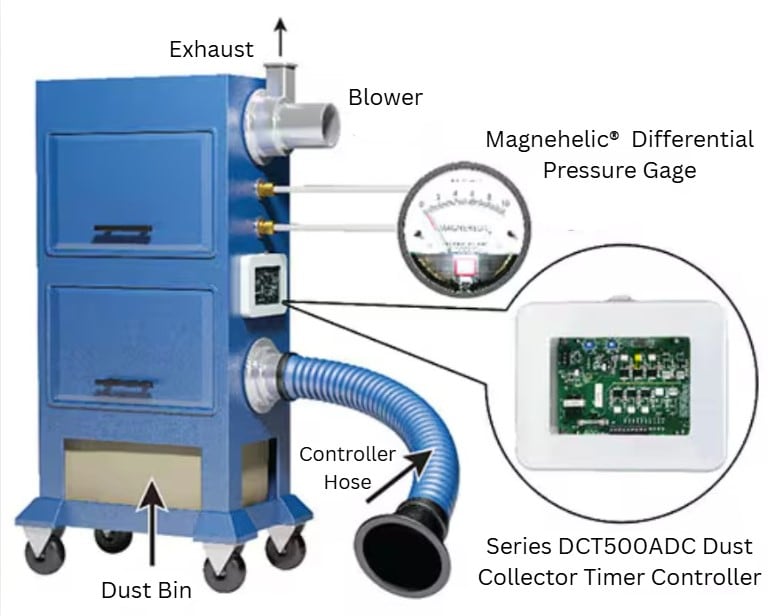
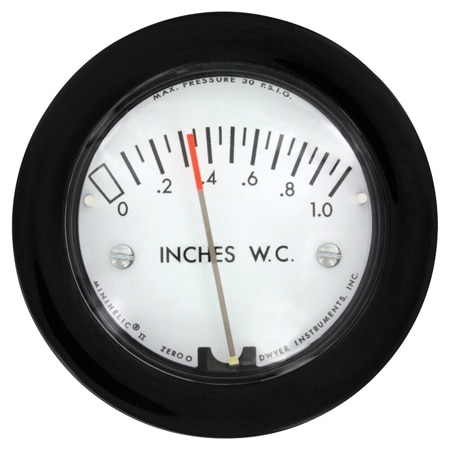
Series 2000 Magnehelic® Differential Pressure Gage
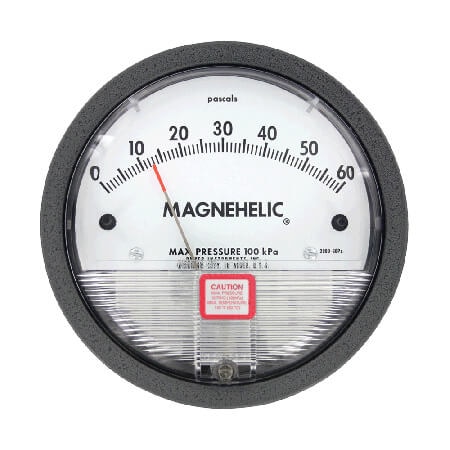
The Magnehelic® Differential Pressure Gage provides reliable low differential pressure measurement for air and non-corrosive gases without requiring electrical power. Its precision diaphragm and patented magnetic movement deliver fast, accurate response to pressure changes, making it a trusted choice for HVAC and industrial applications.
In portable dust collection systems, the Magnehelic® gage is commonly used to monitor pressure drop across dust collector filters, helping maintenance teams identify filter loading and determine when cleaning or replacement may be needed. Tracking differential pressure can help maintain airflow performance, support filtration efficiency, and reduce the risk of unnecessary downtime.
Built with a rugged die-cast aluminum housing and sealed to an IP67 rating, the gage is designed to withstand dusty and wet environments. The large, easy-to-read analog display allows operators to quickly verify system performance, while built-in overpressure protection helps enhance durability.
Key Benefits:
- Monitors pressure drop across dust collector filters
- No electrical power required
- Fast, responsive pressure indication
- IP67-rated protection against dust and moisture
- Clear, easy-to-read analog display
- Rugged construction for long service life
- Ideal for portable dust collectors, HVAC systems, and industrial process applications
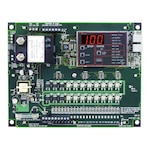
DCT500ADC Timer Controller
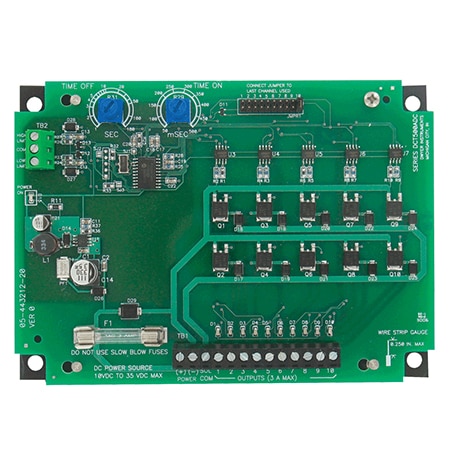
The DCT500ADC Timer Controller helps maintain efficient operation of portable dust collectors by automating pulse-jet filter cleaning cycles. Designed for 10-35 VDC systems and available in 4, 6, or 10-channel configurations, it provides precise control of diaphragm valves that deliver compressed-air cleaning pulses to dust collector filters.
By allowing users to adjust pulse on-time and off-time settings, the DCT500ADC can help optimize filter cleaning performance, support consistent airflow, and extend filter service life. The controller can also be used with pressure switches or differential pressure monitoring devices to enable demand-based cleaning, helping reduce compressed air consumption and unnecessary filter pulsing.
Its compact, user-friendly design simplifies installation with easy panel mounting and features such as a built-in wire strip gauge. An optional weatherproof enclosure is also available for demanding industrial environments.
Key Benefits
- Automates pulse-jet cleaning cycles in portable dust collectors
- Adjustable pulse timing helps optimize filter cleaning performance
- Compatible with pressure-based, on-demand cleaning strategies
- Available in 4, 6, or 10-channel configurations
- Operates on 10-35 VDC power for mobile and DC-powered systems
- Easy installation with compact panel-mount design
- Optional weatherproof enclosure for harsh environments
- Ideal for dust collection, pneumatic conveying, and cement processing applications
Series A3000 Photohelic® Switch/Gages for Pressure Measurement
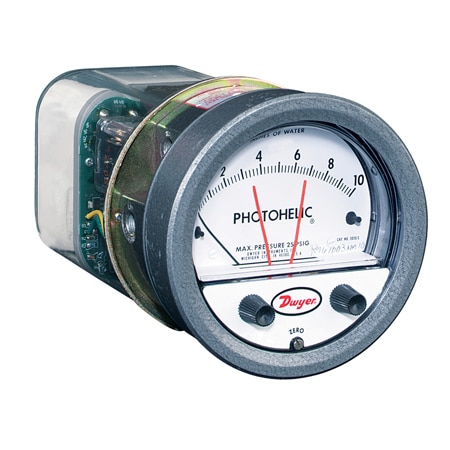
The Photohelic® Switch/Gage combines accurate differential pressure measurement with built-in switching capabilities, making it a valuable tool for automated dust collection systems. Based on the proven Magnehelic® gage design, it continuously monitors pressure while providing adjustable high and low setpoint control through two integrated DPDT relays.
In portable dust collection applications, the Photohelic® can be used to monitor pressure drop across filters and automatically initiate a cleaning cycle when a preset differential pressure limit is reached. This demand-based approach helps maintain airflow performance, reduce unnecessary cleaning cycles, and support filter life by triggering cleaning only when needed.
The unit features easily adjustable setpoints, highly repeatable switching performance, and continuous pressure indication that remains unaffected by switch operation. Available in a wide range of positive, negative, and differential pressure ranges, it offers flexible control for dust collection and other industrial air handling applications.
Key Benefits:
- Combines differential pressure monitoring and switch control in one device
- Automatically initiates filter cleaning when pressure drop reaches a preset limit
- Supports demand-based cleaning to help optimize compressed air usage
- Two integrated DPDT relays for high- and low-limit control
- Easy front-panel setpoint adjustment
- Continuous pressure indication independent of switch operation
- Suitable for portable dust collectors, air handling systems, and industrial process applications
What Is A Stepper Motor & Controllers? – Omega Engineering Introduction to Stepper Motors
