Italia 800 906 907 | Internazionale +39 022 333 1521 | Benvenuti sul nostro nuovo sito web. Avete riscontrato un problema o un bug? Segnalatelo qui.



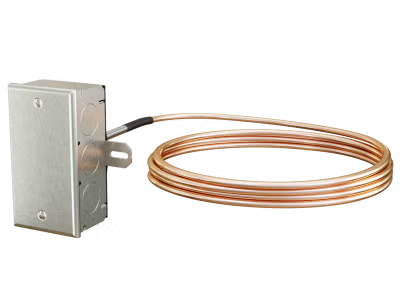
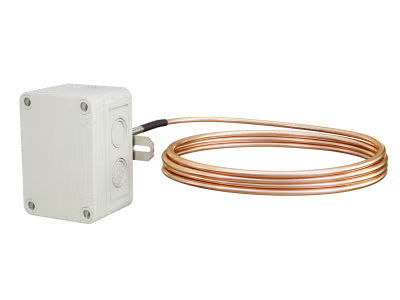
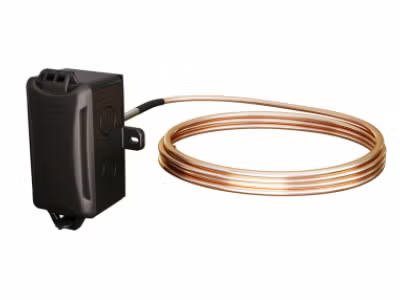
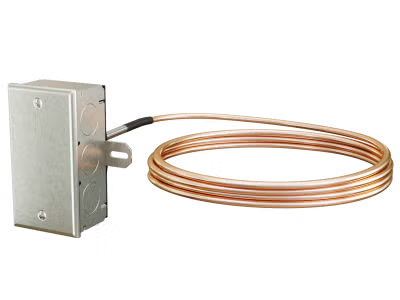
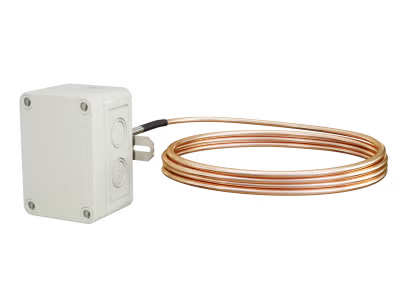
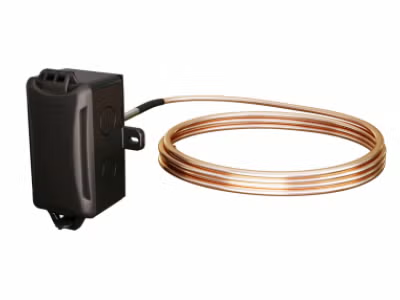
Balco-Copper-Ave
Balco Copper Averaging
- Unità Roof Top
- Monitoraggio temperatura aria mista/aria di mandata/aria di scarico
- Data center
- Ospedali
Balco-Copper-Ave
Da


Panoramica del Prodotto
- Accuratezza 70ºF (21,1ºC): +/- 1%
- Collegamento elettrico Cavi pigtail
- Classificazioni della custodia NEMA Tipo 1
- Raccordo Poliammide 66 (nylon ad alte prestazioni)
- Isolamento Teflon inciso (PTFE) Fili colorati
- Umidità di funzionamento Da 10 a 95% UR, senza condensa
- Temperatura di esercizio, max 115 °C
- Temperatura di esercizio minima -40 °C
- ID serie Balco-Copper-Ave
- Materiale della guaina Rame
- Campo di misura della temperatura Da -40 a 115 °C
- Tipo di sensore di temperatura RTD Balco da 1K Ohm
- Lunghezza del tubo 4.5 in
- Calibro del cavo 22 AWG
Supported Applications
The ACI Balco Copper Averaging Series is a multi-point temperature sensor designed for use with electronic controllers in commercial heating and cooling building management systems. The series provides an average temperature reading of the air inside large ducts, offering improved accuracy compared to single point sensors. Each element is hermetically sealed to prevent moisture intrusion.
Operating Conditions & Performance
The Balco Copper Averaging sensor utilizes a bendable copper sensing element with a diameter of 0.210" (5.34 mm) nominal. The series operates within a temperature range of -40 to 239°F (-40 to 115°C). Operating humidity is rated for 10 to 95% RH, non-condensing.
Performance specifications vary by probe length and sensor type:
- Balco RTD Accuracy (Copper): 8' Length: +/- 1.26% @ 70°F (21.1°C); 12' Length: +/- 1.37% @ 70°F (21.1°C); 24' Length: +/- 1.64% @ 70°F (21.1°C).
- Response Time: 8 Seconds nominal for a 63% step change.
- Sensor Stability: +/ - 0.05% after 1000 Hours @ 150°C (302°F).
The sensor output is 1000 Ohms nominal at 70°F (21.1°C) with a temperature coefficient of 4618 ppm/°C from 0-100°C.
Configuration Options
The series supports multiple configurations across probe lengths, enclosure types, and optional certifications:
- Sensing Points: Four sensing points for 8' and 12' lengths; nine sensing points for 24' length.
- Probe Lengths: Available in 8', 12', and 24' configurations.
- Enclosures & Ratings:
- -GD: Galvanized Steel, NEMA 1 (IP10), Operating Temp -40 to 115°C (-40 to 239°F).
- -PB: ABS Plastic, UL94-HB, Plenum Rated, Operating Temp -30 to 90°C (-22 to 194°F).
- -BB: Aluminum, NEMA 3R (IP 14), Operating Temp -40 to 115°C (-40 to 239°F).
- -4X: Polystyrene Plastic, UL94-V2, NEMA 4X (IP 66), Operating Temp -40 to 70°C (-40 to 158°F).
- Electrical Connection: Two non-polarity sensitive wires with Etched Teflon (PTFE) insulation, MIL-W-16878/4 (Type E), Silver Plated Copper conductors.
- Approvals: RoHS2 and WEEE compliant. NIST Certificate available as an option.
Key Product Differences
The series is distinguished by the specific enclosure material, which dictates the operating temperature limits and environmental ratings (NEMA/IP). The -GD Galvanized Steel and -BB Aluminum enclosures support higher ambient temperatures up to 115°C compared to the plastic options. The -PB Plastic Box offers Plenum Rated compliance with UL94-HB flammability rating.
Installation requires a gradual bend for the copper tubing (minimum 2" / 50.8 mm radius) and includes an integrated foam pad made of Neoprene/EPTDM/SBR Polymer to seal the duct and dampen vibrations. Accessories include optional copper capillary mounting clips or universal plastic mounting clips.
PDF & Manuali