Need assistance? Call us: 1-800-663-4209



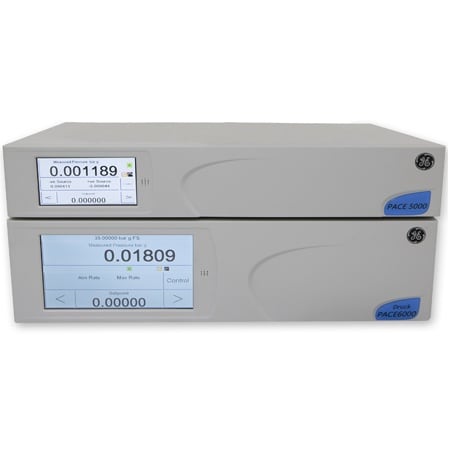
PACE5000-6000
PACE Modular Digital Pressure Controller
- Selection of Chassis and interchangeable control modules
- Single, dual or auto range control module configurations
- High speed pressure control
- Up to 210 bar (3000 psi/21 MPa) gauge and absolute
PACE5000-6000
From
$
3,066.22


Product Overview
- Additional Features 1 Single Channel Pressure Controller Chassis
- Calibration Temperature, Max 45 °C
- Calibration Temperature, Min 15 °C
- Contact Rating 30V d.c. 1 Amp resistive/200 mA inductive
- Data Interface RS232, USB
- Data Interface Note RS232, USB and IEEE-488, SCPI, emulation (DPI520, DPI500, DPI510 & DPI515 depending on model) Ethernet (VXI-II & Sockets using SCPI)
- Display Size 109 mm (4.3 in)
- Display Type TFT
- Enclosure Ratings IP20
- Form factor Benchtop
- Functions Pressure Reference
- Height 320 mm
- Length 400 mm
- Memory ±9999999
- Operating Pressure, Min 0 psi
- Operating Temperature, Max 50 °C
- Operating Temperature, Min 10 °C
- Pressure Accuracy ± 0.0033 %
- Measurement Pressure Type Gauge, Absolute
- Relative Humidity, Max 0.95
- Relative Humidity, Min 5%
- Relative Humidity Note 5% RH to 95% RH non-condensing
- Response Time 2 times per second
- Series ID PACE5000-6000
- Storage Temperature, Max 70 °C
- Storage Temperature, Min -20 °C
- Supply Power Note 90 V AC to 130 V AC @ 47 to 63 Hz & 180 V AC to 260 V AC @ 47 to 63 Hz. Universal input via IEC320 C14 Connector
- Supply Voltage 90 to 130 Vac
- Update Rate 8 times per second
- Weight 5 kg
- Width 88 mm
Supported Applications
The Omega PACE Modular Digital Pressure Controller is designed for test bench, bench top, and rack mount calibration applications. The series supports automated test environments requiring high precision pressure generation and measurement. Specific application capabilities include the automatic and accurate calibration of pressure switches via Switch Test options, leak rate measurements in units per minute or second through Leak Test functions, and testing of pressure rupture points using Burst Test configurations.
The PACE6000 chassis supports an Aeronautical Option for the test and calibration of aeronautical instruments. This configuration enables altitude simulation from -3000 to +55,000 ft and airspeed measurement up to 650 knots with true mach capability.
Operating Conditions & Performance
The PACE series operates within an ambient temperature range of 10°C to 50°C (50°F to 122°F) and is calibrated for use between 15°C to 45°C (59°F to 113°F). Storage conditions are specified from -20°C to 70°C (-4°F to 158°F). The system requires a humidity environment of 5% RH to 95% RH non-condensing and carries an IP20 enclosure rating for indoor use only.
Performance varies by control module precision class. Standard Precision (CM0) offers accuracy from 0.04% Rdg + 0.04% FS up to 0.20% Rdg + 0.20% FS depending on range, while High Precision (CM1) ranges from 0.02% Rdg + 0.02% FS to 0.10% Rdg + 0.10% FS. Premium Precision (CM2) achieves 0.01% Rdg + 0.01% FS up to 0.05% Rdg + 0.05% FS across gauge ranges. The Reference module (CM3) provides absolute pressure accuracy of 0.0016% Rdg (+0.0033% FS). Long-term stability for CM0, CM1, and CM2 ranges is documented as low as 0.01% of reading per annum for higher pressures.
The system supports dry, oil-free, non-corrosive gas media, with dry air or nitrogen recommended. Pressure ratings extend up to 210 bar (3000 psi/21 MPa) gauge and absolute depending on the control module selected.
Configuration Options
The series is available in two chassis configurations: the single-channel PACE5000 featuring a 4.3" TFT colour VGA resolution wide format display with integral touchscreen, and the dual-channel PACE6000 equipped with a 7" TFT colour VGA resolution wide format display.
Control Modules & Precision
- Pace CM0: Standard precision for gauge pressures up to 210 bar g (3000 psi g).
- PACE CM1: High precision configuration.
- PACE CM2: Premium precision with optional Barometric Reference (-B) and Aeronautical (-A) capabilities on PACE6000 chassis only.
- PACE CM3: Reference module for absolute pressure ranges (2, 3.5 bar a; 30, 50 psi a).
Outputs & Communications
The system supports multiple output signals including 0 to 10 V, 0 to 5 V, -5 to 5 V, and 0/4 to 20 mA. Volt Free Contacts (VFC) are available for triggering ancillary devices with a rating of 30V d.c., 1 Amp resistive or 200 mA inductive.
Remote communication interfaces include RS232, USB, IEEE-488, and Ethernet using SCPI protocols. The system emulates DPI520, DPI500, DPI510, and DPI515 models depending on the configuration.
Process Connections & Power
The standard process connection is G 1/8 Female; a 1/8 NPT Female adaptor is provided for North American applications. The power supply accepts universal input from 90 V AC to 130 V AC @ 47 to 63 Hz and 180 V AC to 260 V AC @ 47 to 63 Hz via an IEC320 C14 connector.
Key Product Differences
The PACE5000 chassis measures 440 mm X 88 mm (2U) X 320 mm and weighs 5 Kg or 11 lbs. The dual-channel PACE6000 chassis is larger at 440 mm X 132 mm (3U) X 320 mm with a weight of 6.7 Kg or 17.7 lbs.
Control modules differ by precision class and application focus. The CM2-A module is exclusive to the PACE6000 chassis for aeronautical testing, providing altitude ranges from -3000 to +55,000 ft and airspeed up to 650 knots. Barometric reference options (CM0-B through CM3-B) add precision ranging from 0.10 mbar down to 0.020 mbar depending on the base module class.
Pressure ranges are segmented by control module type: CM0, CM1, and CM2 cover gauge pressures including low differential ranges (25, 70, 200, 350, 700 mbar g) up to high pressure (210 bar g). The CM3 module is dedicated to absolute pressure measurements in the 2 to 3.5 bar a range.
PDFs & Manuals

Show Ratings & Reviews
DOES OMEGA CALIBRATE THIS UNIT?
Hello, thank you for contacting Omega Engineering, we cannot calibrate these units. You will have to contact GE/Druck for calibrating those units.
Date published: 2021-02-01