Need assistance? Call us: 1-800-663-4209



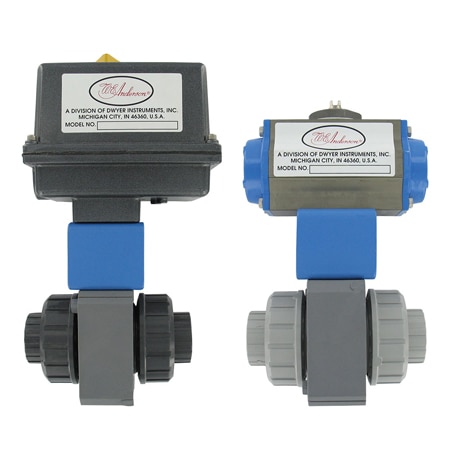
Series-PBVConfiguration
Automated Plastic Ball Valves for Industrial, Irrigation, & Pool Use
- Corrosion-resistant PVC or CPVC body delivers durable, lightweight performance.
- Shear-proof stem and reinforced seals ensure long-lasting, leak-free operation.
- Electric or pneumatic actuation provides precise, reliable flow control.
- Economical automated valve solution for chemical, water, and irrigation systems.


Product Overview
- Series ID Series-PBV
Supported Applications
The Dwyer Series PBV Automated Plastic Ball Valves are designed for industrial, chemical, turf and irrigation, pool and spa applications, as well as use with potable water. These automated 2-way plastic ball valves feature an all-plastic construction (PVC or CPVC) to provide durability in services involving compatible liquids or gases.
Operating Conditions & Performance
The Series PBV operates within a process temperature range of 32 to 140°F (0 to 60°C). Ambient operating temperatures are rated from 0 to 150°F (-18 to 65°C) for electric actuators, while pneumatic actuator housings support -4 to 180°F (-20 to 82°C).
Pressure ratings vary by size at 73°F (23°C):
- 1/2" to 2": 232 psi (16.0 bar) WOG.
- 2-1/2" to 4": 150 psi (10.3 bar) WOG.
- Vacuum: 29" Hg.
Cycle times per 90° depend on the actuator type and valve size. Two-position electric actuators cycle in 2.5 s (1/2" to 1-1/2"), 5 s (2" and 2-1/2"), or 15 s (3" and 4"). Modulating electric units require 5 s for sizes up to 2-1/2" and 15 s for 3" and 4". Pneumatic double acting actuators cycle significantly faster, ranging from .03 s to .12 s depending on the actuator series (DA1 through DA4).
Configuration Options
The Series PBV is available in PVC or CPVC body materials with a shear-proof stem design. Wetted parts include TFE seats and EPDM stem seals, while larger sizes (1-1/4" and up) utilize polypropylene stem bearings.
Actuator Types
- Pneumatic: Double acting (DA series) or spring return (SR series). Spring return models are factory standard as fail-close; add suffix "-FO" for fail-open. Normal supply pressure is 80 psi (5.5 bar), with a maximum of 120 psig (8 bar).
- Electric: Two-position or modulating control. Modulating units accept a 4-20 mA input for infinite valve positioning.
Housing and Enclosure Ratings
- Electric Actuators: Aluminum with thermal bonding polyester powder finish; NEMA 4 standard, optional NEMA 7 (Class I, Div. II groups A, B, C, D).
- Pneumatic Actuators: Anodized aluminum body and epoxy coated end caps.
Power Supply Options
Electric actuators operate on 120 VAC, 50/60 Hz single phase. Optional voltages include 220 VAC, 24 VAC, 12 VDC, and 24 VDC.
Process Connections
Connections are field selectable as Female NPT or socket for sizes 1/2" through 2". Sizes 2-1/2" through 4" feature socket connections only.
Key Product Differences
The series distinguishes between PVC and CPVC model families, indicated by the "P" or "C" in the model number (e.g., PBVPDA vs. PBVCD A). Electric actuators are categorized as Two Position (U-series) or Modulating (V-series), with specific size codes embedded in the suffix.
Pneumatic models differentiate between Double Acting and Spring Return configurations, which also dictate cycle time performance and air consumption characteristics. Explosion-proof electric actuators (-EX option) are available for actuator sizes XX1 through XX6 to meet hazardous location requirements where applicable.
PDFs & Manuals
Show Ratings & Reviews

