Need assistance? Call us: 1-800-663-4209



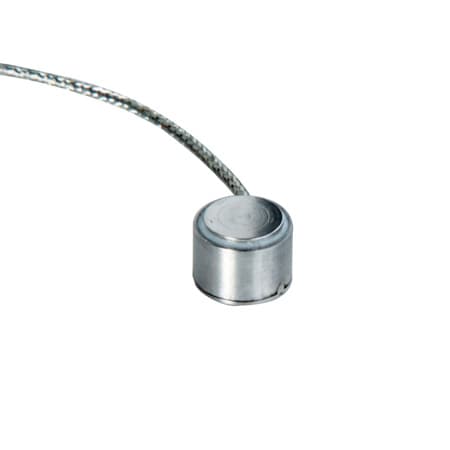
LC307
Top Hat Style, Miniature Compression Load Cell
Models In Stock
- All Stainless Steel Construction
- Built-in Load Button for Easy Installation
- Rugged, Heavy Duty Design
- 5-Point Calibration with 90 kOhm Shunt Cal Data
LC307
From
$
782.78
Models In Stock


Product Overview
- 5-Point Calibration 0%, 50%, 100%, 50%, 0%
- Accuracy ± 0.75 %
- Bridge Resistance 350 Ω
- Cable Length 5 ft
- Calibration Option 5 POINT NIST
- Electrical Connection Cable
- Electrical Output 1.75 mV/V
- Enclosure Ratings IP54
- Full Scale Deflection 0.003 in
- Hysteresis 0.0075
- Linearity ± 0.75%
- Load Cell Type Top Hat
- Materials Stainless Steel
- Operating Temperature, Max 121 °C
- Operating Temperature, Min -54 °C
- Overload, Max 300% FS
- Process Temperature, Max 71 °C
- Process Temperature, Min 16 °C
- Repeatability 0.0075
- Safe Overload 150% FS
- Series ID LC307
- Supply Voltage 5 Vdc
- Thermal Span Effect ± 0.018% FSO/°C
- Thermal Zero Effect ± 0.018% rdg/°C
- Wiring/Connector Table Green: (-) Output; White: (+) Output; Black: (-) Input; Red: (+) Input
- Zero/Balance Error ± 2%
Supported Applications
The Omega LC307 series comprises miniature high-capacity "Top Hat" compression load cells designed for applications requiring minimum space and loads up to 100,000 lb (500 kN). These units are engineered with rugged all stainless steel construction and high-performance strain gages. The design is intended for mounting on a smooth, flat surface.
Operating Conditions & Performance
The LC307 series operates within an ambient temperature range of -54 to 121°C (-65 to 250°F). Accuracy is specified as 0.75% FS BFL, which includes linearity, hysteresis, and repeatability. The load cells feature a nominal output signal of 1.75 mV/V with an excitation voltage of 5 Vdc. Electrical resistance is rated at 350 Ω minimum. Each unit carries an IP54 enclosure rating.
Configuration Options
The series offers standard and metric models across a broad capacity envelope, ranging from 0-250 lb to 0-100,000 lb (0-1 kN to 0-500 kN). Model numbers follow the format LC307 for standard units and LCM307 for metric variants. Key configurable attributes include:
- Capacities: Standard models available in increments from 250 lb up to 100,000 lb; Metric models range from 1 kN to 500 kN.
- Housing Material: Stainless steel construction for all variants.
- Cable and Connection: Includes a 1.5 m (5') 4-conductor cable with an integrated compensation board.
- Calibration Data: Units come complete with 5-point NIST-traceable calibration and 90 kΩ shunt data.
Dimensions vary by capacity, with overall height (H) ranging from 8.1 mm (0.32 in) to 37.3 mm (1.47 in) for standard models, and diameter (D1) spanning 12.7 mm (0.5 in) to 50.8 mm (2.00 in). The series supports optional accessories including the WRS232-USB wireless transmitter, UWTC-1, and UWTC-REC2.
Key Product Differences
The LC307 family is divided into two primary model families based on unit systems:
- LC307 (Standard): Capacities denoted in pounds, with part numbers such as LC307-5K for 5,000 lb capacity.
- LCM307 (Metric): Capacities denoted in kilonewtons, with part numbers such as LCM307-50KN for 50 kN capacity.
Both families share the same "Top Hat" form factor and performance specifications. The series is RoHS compliant and includes NIST Standard certification documentation.
PDFs & Manuals


Show Ratings & Reviews
Regarding "top-hat" load cell item LC307-500 lbf.; Please advise if you can provide the following information - A) What is the Maximum Power (Watt) Rating for this device B) What is the Thermal Resistance of the Device (degrees Celsius per Watt)
Power ratings for this .cell are a follows. Nominal Excitation Voltage is 5 VDC. Maximum current from power supply 15 mA. There is no for Thermal Resistance on this sensor.
Date published: 2021-05-19
Does the LC307 load cell transducer meet the requirements of a non-incendive apparatus and thus is it suitable for application use in a Division 2 hazardous location ?
The LC307 is not rated for hazardous location usage, please see the LCHD-IS load cells for use in a Division 2 hazardous location.
Date published: 2021-05-27
Which surface of the LC-307 load cell would be best held against a stationary surface and which surface is best to apply the load against ?
The SPHERICAL RADIUS shown on the dimensional drawing on the Datasheet is the loading surface that you would apply the load.
Date published: 2021-06-14
Is there any data about natural frequency of the sensor? I would like to use it for applications requiring high-frequency
These load cells are strain gage based (piezo-resistive) devices designed for static or slow changes in load. For high frequency applications a piezo-electric based device should be used. Omega does not offer piezo-electric based force sensors
Date published: 2023-05-31
This is a follow-up question for Application Engineer JK, regarding Thermal Resistance question. When you said "no" in your original answer, do you mean negligible Thermal Resistance? or did you mean no information is available?
There is no data available forThermal Resistance for our load cells
Date published: 2021-05-20
What is the minimum load (in lbf or other equivalent unit) that this sensor starts reading? Does it vary depending on the specific dash number? What would be this number for LC307-3K?
The sensor does actually start reading at very low loads but you should never rely on the accuracy of the reading in the lower 10% of it's load range. In the case of a 0 to 3000 lbf range load cell this be readings below the 300 lbf range
Date published: 2021-06-02