Need assistance? Call us: 1-800-663-4209



7352-3-Series
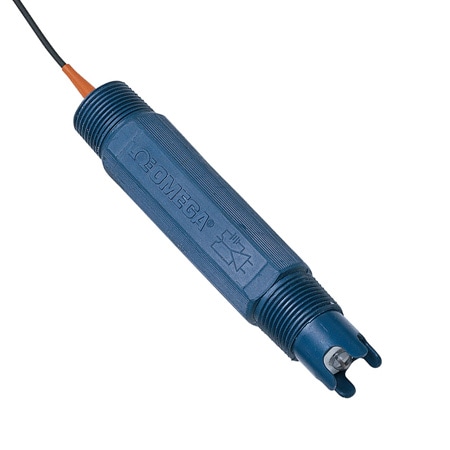
Heavy-Duty Combination pH Sensor For Submersible Applications
Models In Stock
- Strong PPS Body
- Low Maintenance
- Short or Long Insertion Lengths
- Any Angle Orientation
7352-3-Series
From
$
268.49
Models In Stock


Product Overview
- Cable Length 4.6 m
- Diameter 0 mm
- Drift <2 mV per week
- Electrical Connection N/A
- Enclosure Material PPS, PTFE, FKM, Glass
- Impedance 150 MΩ
- Length 0 mm
- Measurement Type pH
- PH Measurement Range 0 to 14.00 pH
- Measurement Pressure, Max 100 psig, 100 psi
- Measurement Pressure, Min 0 psig, 0 psi
- Pressure Note 0 to 100 psig or 0 to 150 psig (HT high temperature version) β ±0.1% over full range
- Process Connection Size 3/4 in
- Process Connection Type NPT Male
- Process Temperature, Max 80 °C
- Process Temperature, Min 0 °C
- Reference Cell Double junction, KCl/AgCl, KNO3
- Response Time 95% of reading in 10 sec
- Sensor Type N/A
- Series ID 7352-3-Series
- Sodium Error Less than 0.05 pH in 0.1 Molar Na+ ion @ 12.8 pH
- Temperature Note 0 to 80°C (32 to 176°F) or 0 to 110°C (32 to 230°F) (HT high temperature version)
- Zero/Balance Error 7.0 ±0.2 pH
Supported Applications
The Omega PHE-7352 and PHE-7353 series are heavy-duty combination pH sensors designed for submersible applications. These electrodes feature a strong PPS body, sealed double junction construction resistant to electrode poisoning solutions (cyanide, ammonia, sulfide, heavy metals in appreciable concentrations), and a non-fouling patented Porous PTFE liquid junction.
Documented use cases include:
- Process water applications
- Waste water pipeline insertion
- Large diameter pipe insertion requiring greater penetration depth
- Installations at any angle orientation
Operating Conditions & Performance
The series operates within a pH range of 0 to 14 pH. Temperature capability depends on the specific version selected: standard models support 0 to 80°C (32 to 176°F), while the high temperature (-HT) version supports 0 to 110°C (32 to 230°F). Pressure ratings are 0 to 100 psig for standard versions and 0 to 150 psig for the -HT high temperature version.
Performance specifications include an accuracy of ±0.1% over full range, a response time of 95% of reading in 10 sec, and drift less than 2 mV per week. The sensor exhibits a sodium error of less than 0.05 pH in 0.1 Molar Na+ ion @ 12.8 pH and an impedance of 150 MΩ @ 25°C (77°F). Zero potential is specified as 7.0 pH ± 0.2 pH.
Wetted Materials
The wetted materials for the sensor include PPS, PTFE, FKM, and glass.
Configuration Options
The series is available in two primary insertion configurations to accommodate different pipeline penetration needs:
- PHE-7352: 152 mm (6.0") overall length with a 23 mm (0.9") insertion depth.
- PHE-7353: 152 mm (6.0") overall length with a 58.4 mm (2.30") insertion depth.
All models come complete with a standard 4.6 m (15') cable; non-standard lengths are available for additional cost. The sensors feature ¾ MNPT front and rear facing threads as the process connection.
ATC Sensor Options
Automatic Temperature Compensation is configurable via specific option codes:
- -PT100: 100 Ω Platinum RTD (standard for -HT high temperature version).
- -PT1K: 1000 Ω Pt RTD.
The series holds RoHS certification. The reference cell utilizes a double junction KNO3 and KCl/AgCl design.
Key Product Differences
Differences within the PHE-7352-15-(*) model number guide are defined by insertion length, temperature rating, and ATC sensor type. The base models (PHE-7352-15 and PHE-7353-15) represent heavy-duty submersible pH electrodes without specified ATC options in the part number suffix.
Variants with "-PT100" or "-PT1K" suffixes include the respective RTD sensors. The addition of the "-HT" suffix designates the high temperature version (0 to 110°C) which includes a 100 Ω Pt RTD ATC and supports up to 150 psig pressure.
PDFs & Manuals

Show Ratings & Reviews
Rated 5 out of
5
by
kram9999 from
Works well.
Built in temperature sensor is nice.
Much cleaner design than older model.
Interested to see how long this sensor lasts in our steel pretreatment.
Date published: 2018-01-25
Rated 1 out of
5
by
bentmol from
Missing information
The new Omega website sucks. It has less information than the old one did. For example, the data sheet for this pH sensor does not say that it needs a power supply and another component to make this sensor work. I know this because we had to buy all 3.
Date published: 2019-09-13
Item PHE-7352-15 pH probe; can I land cable to terminal strip and extend another 150 feet to controller PHCN-961 without amplifier? If so what cable do you recommend?
Thank you for your inquiry. The maximum cable distance we recommend without an amplifier is 50ft.
Date published: 2020-03-11
I need to monitor the pH through the building automation system. Can this sensor produce a 4-20ma or 0-10vdc signal?
No. This probe cannot produce a 4-20 mA or 0-10 VDC process signal.
Review pH probe PHETX-600 instead.
Date published: 2020-02-13
can this unit be used to just act as a water detector? and if you sell a better sensor for this application im asking with the same install profile as this, what is the model?
Thank you for your inquiry. Unfortunately, it is a pH probe to measure only pH of a liquid, not as a detector and no longer carry such a product.
Date published: 2023-04-05
Can this sensor be fully submersed, free floating in a reservoir? (e.g., entire sensor and a few feet of the cable)
Thank you for your inquiry about the pH probe. It can be submersed in a reservoir, yet, the cable is only potted, not water sealed. Using shrink wrap or snake into a pipe to protect water from getting into the body.
Date published: 2022-09-07
How do the leads connect to a display/controller (BNC)?
Hello! Thanks for your question. This pH electrode has a female BNC connector that attaches to the male BCN connector on the controller. If the controller has a terminal connector instead of the BNC then you need an adapter part # ADAPTOR-BNCF-SL.
Date published: 2020-04-30
What material is the seal between the electrode and the sensor body made of?
Thank you for your inquiry about the pH probe. The sensor body is made of PPS (or Ryton) and has a PTFE and FKM seal within the electrode tip.
Date published: 2021-10-21
Is this pH sensor a combination sensor (outputs pH and temperature)? Or does a temperature sensor need to be purchased in addition to this sensor?
Thank you for your inquiry. The pH probe when connected to a pH display or controller will display the pH and compensate for temperature, not display. Unless, your current display or controller has that option, then, it will display temperature as well.
Date published: 2022-09-07
Is there an upper limit on the turbidity (NTU) that will effect the accuracy of this probe? I would like to use this in a very turbid and particle rich environment.
Thank you for your inquiry. Unfortunaetly, there is no data for a maximum NTU levels, since there is a protective guard, it should keep out the debris. Please note that ideally, it should be free of suspended particles that can adhere onto the glass bulb and you will need to incorporate in SOP (Standard Operating Procedure) to clean the glass bulb if covered by debris.
Date published: 2024-08-12