Need assistance? Call us: 1-800-663-4209



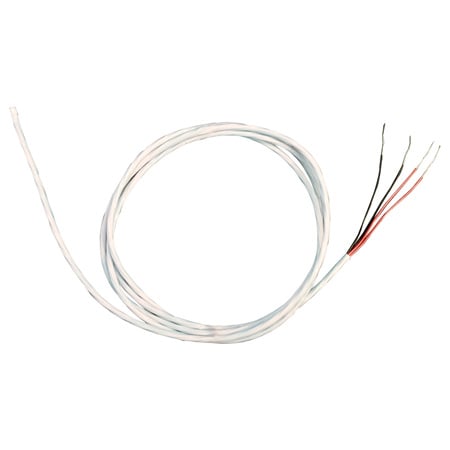
HSRTD
FLEXIBLE SEALED PFA RTD SENSOR, ROHS
Models In Stock
- Pt100 RTD with Class A, 1/3 DIN, or 1/10 DIN accuracy
- Hermetically sealed against moisture and corrosion
- PFA insulated cable
- Temperature range: -60 to 260ºC (-76 to 500°F); Cryogenic range to -200°C also available
HSRTD
From
$
80.34
Models In Stock


Product Overview
- Insulation PFA
- Process Temperature, Max 250 °C
- Process Temperature, Min -60 °C
- Series ID HSRTD
- Temperature Sensor Type RTD
- Tip Diameter 3 mm
- Wire Gauge 26 AWG
- Wire Type Stranded
Supported Applications
The Omega HSRTD series consists of flexible, hermetically sealed Resistance Temperature Detector (RTD) sensors designed for immersion in wet and corrosive environments. The PFA-insulated construction provides protection against moisture and aggressive materials, making the sensor suitable for applications requiring easy cleaning or sterilization.
- Immersion temperature measurement
- Wet environment monitoring
- Corrosive material exposure
- Cryogenic environments (with Cryogenic option)
Operating Conditions & Performance
The HSRTD series operates across a standard process temperature range of -60 °C to 250 °C. A cryogenic configuration extends the lower limit, supporting measurements from -200 °C to 250 °C. The sensors feature an IP68 enclosure rating and utilize PFA (Perfluoroalkoxy alkane) insulation for both conductors and the outer jacket.
Accuracy is defined by specific tolerance classes available in the series:
- Class A: Tolerance varies with temperature, ranging from 0.15 °C at 0 °C to 1.05 °C at 450 °C.
- 1/3 DIN: Accuracy ranges from 0.08 °C at 0 °C up to 0.52 °C at 250 °C; values are not specified above 250 °C in the accuracy chart.
- 1/10 DIN: High-precision tolerance ranging from 0.03 °C (at -50 °C and 0 °C) to 0.08 °C at 100 °C; values are not specified above 100 °C in the accuracy chart.
The sensor element is a platinum RTD with base resistance options of 100 Ω or 1,000 Ω (at 0°C). The standard outside diameter for the cable assembly is approximately 3 mm (0.118 in).
Configuration Options
The series offers extensive configurability regarding wire count, resistance value, accuracy class, and physical dimensions to meet specific installation requirements.
- Sensor Elements: Available with 100 Ω or 1,000 Ω platinum RTD elements conforming to IEC 60751 (DIN Platinum).
- Wire Configuration: Standard configurations include 3-wire and 4-wire options. Conductors are stranded nickel-plated copper.
- Cable Lengths: Metric lengths range from 1 m to 30 m (e.g., 1M, 2M, 5M, 10M). Imperial versions offer specific inch-based lengths such as 40 in, 80 in, and up to 400 in.
- Termination: Sensors are supplied standard with stripped ends. Custom connector options (e.g., TA3F, TA4F) are available upon request or via specific model suffixes.
Key Product Differences
Differences within the HSRTD series are primarily defined by the part number structure and selected performance parameters:
- Cryogenic vs. Standard: Models designated with a cryogenic option support operation down to -200 °C, whereas standard models begin at -60 °C.
- Accuracy Class Selection: The series distinguishes between Class A (general purpose), 1/3 DIN (higher precision up to 250 °C), and 1/10 DIN (highest precision up to 100 °C).
- Resistance Value: Variants are available as Pt100 or Pt1000 elements.
- Imperial vs. Metric Suffixes: Imperial versions typically include an "-E" suffix in the part number to denote inch-based wire lengths (e.g., 40-E, 80-E).


Accessories
accessories
1/16 DIN On-Off LCD Temperature Controllers with Dual Outputs
$356.81 / each
0 In Stock
3-Prong Mini flat pin Connector for Thermocouple, RTD and 3-Wire Thermistor
$6.75 / each
0 In Stock
Show Ratings & Reviews
Rated 4 out of
5
by
PROVE IT from
Resistant to magnetic flux change
I have probably purchased 30 of these over the last 5 years. They perform much better than bimetallic thermocouples for reading temperature in magnetic induction applications. The durability is good, but not outstanding in harsh environments, especially in steam at temperatures greater than 120°C (thus the purchase of 30 over the last 5 years). Their response is faster than metal clad RTDs. The rapid response allows for more contained PID controll. It would be wonderful if Omega made a steam-tolerant packing gland for the RTD where the RTD tip was not in contact with a metal (as is the case in a thermowell).
Date published: 2016-07-01
Rated 5 out of
5
by
BMJa from
RTD Probe
The RTD probe arrived quickly and is as described. The materials seem high quality and it performs as expected.
Date published: 2025-01-22
Rated 5 out of
5
by
jricha00 from
Durable and easy to use
I use these to measure the temperature on the backside of PV modules. The RTDs are easy to use and they are very durable. The pre-tinned wire leads make installation very easy.
Date published: 2020-09-14
Has anyone tried soldering this wire? I'm using 245 Sn63Pb37 solder and it's having terrible problems beading up at all temps. Any suggestions for improvement are appreciated.
Megan, in general beading up could be caused by lack of sufficient flux, or excessive oxidation or contamination. If your solder flows to the heated surface and is unable to bond due to surface being oxidized it will tend to form a ball/bead.
You could try cleaning the surface free to dirt/oil/oxidation. You could try using steel wool to scrape off the oxidation as long as it does it damage your process.
Make sure you are not overheating, since overheating can burn off the flux prematurely. High temperatures burns off the flux way too fast and prevents a good bond
You could also try a different brand of solder wire. For further questions feel free to email us at temp@dwyeromega.com
Date published: 2025-11-25
How long of response time?
Thank you for your inquiry. Response Time (90%) = 7.75 Seconds Max in Water Flowing at 1 meter per Second.
Date published: 2026-07-09
Could this RTD sensor measure at temperature for -80°C? I mean would it damage the sensor at -80°C? Let say if I gonna purchase & send to calibration lab for -80°C calibration and obtain the correction factor for this particular temperature to use this.
Hi CL Lee,
Thank you for the inquiry. The materials are verified to -60 C. I would suggest to test at your target temps for a period of time before investing in calibration for offsets.
Best regards
OMEGA
Date published: 2023-05-16
What is the self-heating coefficient of the 1000 ohm varieties? Also, does the excitation current of the CN32PT readouts change with the 100 ohm vs 1000 ohm RTDs?
Thank you for your inquiry benjfitz. The excitation current for 100 ohm or 1000 ohm RTD is 1 mA. The maximum the excitation current can be is 2 mA. Unfortunately, the self-heating coefficient is not available on our current documentation. Please send an email to temp@omega.com and one of our engineers will assist you in finding this information.
Date published: 2022-06-02
What are the physical differences between Class B, Class A, 1/3DIN, and 1/10DIN models?
Thank you for your inquiry benjfitz. Due to the complexity of your question, please send an email to temp@omega.com and one of our engineers will assist you in finding this information.
Date published: 2022-06-02
What is the self-heating coefficient of the HSRTD Pt100 sensors?
The nominal self heating specification for the probes RTD element would be 0.4K/mw at 0C.
Date published: 2022-04-29
I've ordered an Omega HSRTD-2-100-A-5M. Is this ok for using in a Class 1 Div 2 or Class 1 Div 1 location? If not, do you have a similar sensor (either 4-20mA or RTD) that is completely submersible in a corrosive environment like this one is?
Thank you for the inquiry. We do not offer any explosive area ratings on this series. We do not offer similar sensor with 4 to 20 mA output with explosive area rating.
Best regards,
OMEGA
Date published: 2024-07-05
I am looking to see if putting HSRTD-3-100-1/10-5M in coolant to measure its temp variation would be ok? Looking to make sure we don't contaminate or damage the sensor.
Thank you for your inquiry. The HSRTD is a hermetically sealed RTD sensor for immersion applications. It will work with coolant as long the temperature being measured is within the temperature range.
Date published: 2023-06-07