Need assistance? Call us: 1-800-663-4209



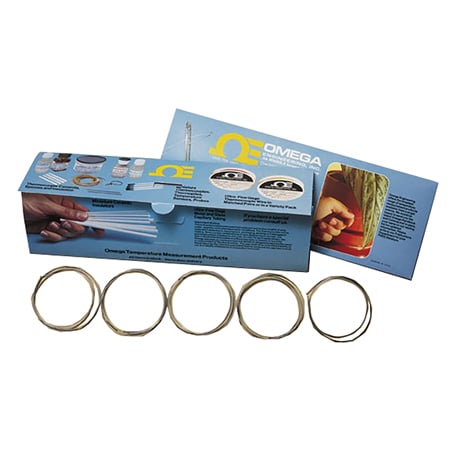


IRCO-CHAL-P13R-P10R
Fine Gage Bare Wire Thermocouple Elements, J, K, T, E, N, R & S
Models In Stock
- Small Size, Fast Response
- Diameters down to .002'
- High Accuracy
- Pin-Point Measurements
IRCO-CHAL-P13R-P10R
From
$
43.51
Models In Stock


Product Overview
- Electrical Connection Stripped Leads
- Junction Type Exposed
- Pack Size 5
- Process Temperature, Min 0 °C
- Series ID IRCO-CHAL-P13R-P10R
Supported Applications
The Omega Fine Gage Bare Wire Thermocouple Elements series provides unsheathed temperature sensing elements for precision measurement. The product line encompasses base metal calibrations (Types J, K, T, E, and N) as well as platinum/rhodium noble-metal types (R, S, and B). These bare wire sensors are supplied in standard lengths suitable for integration into custom assemblies or direct insertion where fine gage dimensions are required.
Operating Conditions & Performance
The series supports a wide range of wire diameters from 0.025 mm (0.001") to 0.81 mm (0.032"). Standard lengths differ by calibration family: base metal thermocouples are offered in standard packages with a length of 300 mm (12"), while Pt/Rh calibrations have a standard length of 150 mm (6"). Base metal thermocouples with wire diameters of 0.125 mm (0.005") and larger are manufactured using Special Limits of Error wire.
Configuration Options
The series is configurable across multiple calibrations, wire sizes, and packaging options to meet specific assembly needs.
- Base Metal Calibrations: Available in Types J (Iron-Constantan), T (Copper-Constantan), N (OMEGA-P®/OMEGA-N®), K (CHROMEGA®/ALOMEGA®), and E (CHROMEGA®/Constantan). These are offered in convenient packages of five.
- Pt/Rh Calibrations: Includes Type R (Pt/13%Rh-Pt), Type S (Pt/10%Rh-Pt), and Type B (Pt/30%Rh-Pt/6%Rh). These are sold individually rather than in packages.
- Wire Diameters: Options range from 0.025 mm (0.001") up to 0.81 mm (0.032"). Specific diameters available include 0.050, 0.075, 0.125, 0.20, 0.25, 0.38, and 0.50 mm.
- Customization: Other sizes and lengths are available on special order. Orders for special sizes, alloys, or assemblies should be explicit and accompanied by a sketch or print if possible.
Key Product Differences
The primary distinction within the series is between base metal and noble-metal thermocouples regarding packaging and standard length. Base metal types (J, K, T, E, N) are supplied in packages of five with a 300 mm (12") standard length. In contrast, Pt/Rh types (R, S, B) are sold individually with a 150 mm (6") standard length. Model numbers follow the format Calibration-Wire Dia., such as CHAL-005 for Type K or P13R-002 for Type R. Additional wire diameters are also available for Type N upon request to Sales.
PDFs & Manuals


Show Ratings & Reviews
Rated 5 out of
5
by
chas53 from
Clean functional Type K TC's
The type K TC's we received were low cost and high quality.
Date published: 2016-09-01
Rated 5 out of
5
by
Vijay from
Question on CHAL-002
I bought CHAL-002 to 005 to fit my needs. They wirk great. Love them.
CHAL-002 seems to fit best for my needs however the wire is so delicate that it kept breaking when I connected to controller. Any suggestions?
Date published: 2017-09-09
Rated 5 out of
5
by
gpetrucc from
Hard to find, but exactly what I was looking for
After quite a bit of searching, I found the product
Date published: 2026-06-12
Rated 5 out of
5
by
phil731 from
it is what it is
received in a timely fashion and worked as it should.
Date published: 2025-08-18
Rated 4 out of
5
by
TX semiconductor from
T/C wire in semiconductor
Works well for measuring temperature in RTP chamber
Date published: 2024-09-05
Rated 5 out of
5
by
Marie from
Great product
These thermocouples are great for measuring the temperature inside small (<1mm) aluminium packages in vacuum
Date published: 2023-09-05
Rated 5 out of
5
by
Carol I from
A highly anticipated order!
I'm not the end user, but the lab was anxious to receive this item.
Date published: 2023-08-17
Rated 5 out of
5
by
Jake Dorfman from
Top notch product
We can always count of Omega for excellent product quality.
Date published: 2022-03-21
What does "bare wire" mean? Are the individual wires completely bare or do they have individual electrical insulation? What I need to know is if I have to keep the pair of wires separated from each other all the way to the connector?
Please disregard AndrewA's answer, as it is incorrect. A thermocouple's measurement depends on a junction between two dissimilar metals and a temperature differential. Those two things create an emf along the entire wire, which is measured by a voltmeter and converted into temperature according to the data tables for whichever type of TC you're using.
If the two wires touch to form a *second* junction, you'll create a current loop from junction 1 (where your hot spot of interest is) and the touching point, nullifying that measurement. You'll effectively be measuring at the point closest to your voltmeter. Do NOT allow the bare wires to touch (not dangerous, but will give you erroneous readings).
Date published: 2024-02-27
Can these measure subzero temperatures as well?
Yes they bare wire Thermocouples can be used below 0C.
Date published: 2021-01-13
What is the best way to connect a fine thermocouple (Chal-002) to a data logger? or what is the best option for extending the wire?
Thank you for your inquiry Ayoub. We recommend that you use an SMPW male connector to attach the CHAL-002 wire to and then use a female connector to extend the run. The wire is so thin on the CHAL-002, you may need to "fold" it a few times for added support, getting it under the contact washer in the SMPW connector. But you need to realize that even, so, it is a fragile connection and much care needs to be taken not to break the wire. Please do not tighten the screw down too tight onto the wire. This can cause breakage also. Additionally, the type of extension you need depends on the data logger, you may need another male connector at the end of your run if the logger accepts a male connection- or just stripped end wire if it has terminal terminations.
Date published: 2023-11-21
I have a CHAL-020, how do I identify the positive or negative, does it matter and if so what could be the issues running it in reverse polarity?
The shorter lead would be the Negative one and hooking it up in reverse would make the response opposite but would not damage anything.
Date published: 2026-03-24
What is the size of the bead of the CHAL-002? Also, how can I tell which side is + and which is - if the thermistor is shipped wound on a white plastic reel/bobbin?
Thank you for your inquiry. The bead should be approximately 2.5 times the wire diameter so for CHAL-002 it would be about 0.005". The negative wire usually has a red tape indication on it and the other side would be positive.
Date published: 2025-12-11
Excuse me, CHAL-015-120, what does 120 mean?
Thank you for your inquiry. 120 is the length of the wire in inches.
Date published: 2024-08-06
Can the CHAL-010 measure below -100c?
All of our thermocouples are made with Special Limits of Error (SLE). Special Limits of Error Wire (SLE) made products are only spec’d out for temperatures above 32°F (0°C). So, anything below 32°F (0°C) does not comply with the SLE specification. We don't state an accuracy for SLE Wire-Made Products below 0°C (32°F). Accuracy testing shows it is no longer linear. We cannot certify or guarantee the accuracy for temperatures below 0 C. The CHAL-010 can still measure temperatures below 0 C but we cannot certify the accuracy. Also, due to the small diameter of this wire, at temperatures of -100 C the wire will become brittle to the point that any small movement may break the wire.
Date published: 2025-02-13
I have CHAL-005-BW thermocouples. How do I tell one end from the other?
Thank you for your inquiry Dan. One end of the thermocouple has the wires joined in the junction while the other side has the wires not join together. The junction side is the one that measures temperature.
Date published: 2023-11-21