Need assistance? Call us: 1-800-663-4209



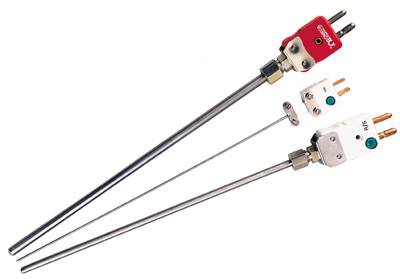
XTA-W5R26
Extreme Temperature Exotic Thermocouple Probes
Models In Stock
- Designed for extreme temperatures up to 2315°C (4200°F)
- Options for Type R, S, B, C, or D thermocouples
- Highly configurable for sheath material, wire gauge, probe length and diameter, and termination styles
- Single or Dual element options available
XTA-W5R26
From
$
330.75
Models In Stock


Product Overview
- Alloy Material (-) Platinum - 6% Rhodium
- Alloy Material (+) Platinum - 30% Rhodium
- Color Code Standard ANSI
- Junction Type Ungrounded
- Operating Temperature, Min 0 °C
- Process Connection Size N/A
- Process Temperature, Min 0 °C
- Series ID XTA-W5R26
- Temperature Sensor Type Thermocouple
Supported Applications
The Omega™ XTA exotic thermocouple probes are designed for extreme-temperature measurement up to 2315 °C (4200 °F). They use either Platinum/Rhodium elements (Type R, S, or B) or Tungsten/Rhenium elements (Type C or D) with a range of insulation and sheath materials, making them suitable for high-temperature process work in inert, oxidizing, reducing, or vacuum conditions.
Because refractory metals are extremely sensitive to any trace of oxygen above approximately 260 °C (500 °F), the tungsten/rhenium sheath options must be used in vacuum or in very pure inert gases such as helium or argon.
Operating Conditions & Performance
The probes measure temperatures up to 2315 °C (4200 °F), with the maximum temperature of the final assembly set by the lowest-rated of the element, insulation, and sheath materials. All probes are ungrounded.
- Element / calibration: Platinum/Rhodium (Type R, S, B) or Tungsten/Rhenium (Type C, D), via calibration codes such as W5R26, W3R25, P10R, P13R, and P30R.
- Sheath materials: Tantalum, Molybdenum, Platinum-Rhodium alloy, or Inconel 600.
- Sheath diameters: 0.062 in (1/16 in), 0.125 in (1/8 in), 0.187 in (3/16 in), and 0.250 in (1/4 in).
- Media: vacuum, inert, oxidizing, or reducing atmospheres, per the selected sheath.
Optional compression fittings allow fast mounting and positioning, and dual-element assemblies provide two sensor readings for built-in backup or for sending signals to different instruments.
Configuration Options
Part numbers follow an ordering-guide breakdown of sheath-material code, calibration code, junction, sheath diameter, wire gauge, insulation code, termination style, length, and single/dual element. Configuration axes include:
- Junction: ungrounded (U).
- Termination styles: Q, HX, SX, TJ, RP, MQ, TJ-BX, TJ-SB, and NB1/NB12.
- Length: 1" to 48" in 0.5" increments (to 100" for selected constructions).
- Element count: single or dual element.
Tungsten/rhenium probes can be tungsten-coated when required for additional protection.
Key Product Differences
The series covers the platinum/rhodium and tungsten/rhenium calibrations across the sheath, diameter, termination, and length options. Representative catalog numbers include:
- XMO-W5R26-U-125-30-A-Q-12
- XMO-W5R26-U-125-30-A-SX-8
- XMO-W5R26-U-062-36-H-SX-4
Specify sheath-material code, calibration, junction, sheath diameter, wire gauge, insulation, termination style, length, and single/dual element to define a complete probe.
PDFs & Manuals

Show Ratings & Reviews
Rated 1 out of
5
by
MEJ1 from
Find a different supplier
My issue with these probes is two-fold: first with the product itself and second with trying to address the product issues. The probes are not consistent from one to the next and I have contacted the engineering team to ensure that they are manufactured with tight tolerances, which they claim they do, but the following has been some of our experience.
When changing thermocouples, we see high levels of temperature variation from one to the next which Omega’s provided calibration data does not account for, we have also seen vast differences in the temperature readings within a dual-probe thermocouple itself (i.e., one side reads 1000º while the other is reading 950º), we have been provided with dual thermocouples that have had the wires crossed, and so on.
We are currently trying to get Omega to replace a few probes that were faulty and that has been a whole saga. First, they tried to claim that they were out of warranty, then when we were finally able to send them in and checked back a month later to find out the status, we were informed that Omega did not ever receive the probes. Upon sending them the signed delivery confirmation (then calling customer service a week later after not hearing anything) they informed us that they found the probes and could now start evaluating them. It has now been several months with zero updates even though we reach out for status updates every few weeks (which we imagine must be as annoying for them as it is for us).
Do what you will with this information, but we found a new supplier.
Date published: 2021-03-17
Can this be put directly into an oven?
The metal probe portion sheath can be inserted into the oven but the connector is rated to only 650C so should not be exposed above it.
Date published: 2024-10-25
Hi, Is Platinum-Rhodium Alloy TC (coded as XPA, https://assets.omega.com/spec/XTA-W5R26.pdf) compatible with fluorine? if yes, then what is the maximum temperature that it can work at in fluorine gas medium? If not, what TCs are compatible? Thanks
Hi Jimmy,
Thank you for the inquiry. We offer a variety of sheath materials. We can provide test data on the sheath alloys used. End user will need to verify if their specific gas concentration, temperature , and presures will be compatible with the alloys used.
Best regards
OMEGA
Date published: 2024-07-25
What kind of reader / data logger can be used to record and view the temperature readings of these ultra high temperature probes?
Hi Jamie,
Thank you for the inquiry. Some options;
https://www.omega.com/en-us/data-acquisition/data-loggers/temperature-and-humidity-data-loggers/hh806/p/HH806AU
https://www.omega.com/en-us/data-acquisition/data-loggers/multichannel-programmable-and-universal-input-data-loggers/om-cp-octpro-logger/p/OM-CP-OCTPRO
And more options available. For more detail please forward request to TEMP@DWYEROMEGA.COM.
Best regards
OMEGA
Date published: 2023-10-29