Need assistance? Call us: 1-800-663-4209



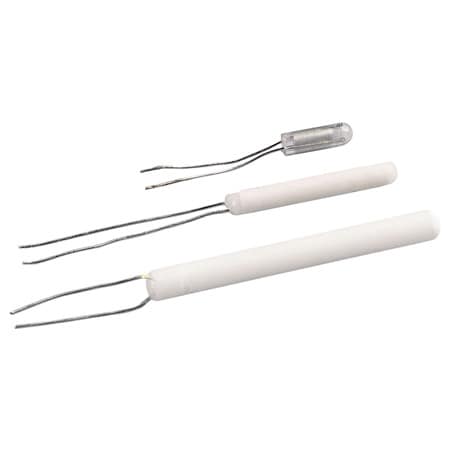
PT100-CY82-CYW4-CY100
Cryogenic Platinum RTD Temperature Sensor
- Platinum Resistance Sensors for Cryogenic Measurements
- 4-Wire stainless steel probe
(Band 4 Silicon Diode Sensor) - Special Low Thermal Conductivity
Extension Wire for CY7 Series Diodes - Special Low Thermal Conductivity
Extension Wire for CY7 Series Diodes
PT100-CY82-CYW4-CY100
From
$
581.03


Product Overview
- Electrical Connection Stripped Leads
- Insulation Tetrafluoroethylene (TFE)
- Current, Max 0.5 mA
- Current, Max Note Higher measurement currents can be applied as long as self heating does not change the measurement value more than the needed measurement accuracy. But should not exceed 2mA for 1002 and 0.5mA for 10002.
- Nominal Resistance 100 Ω
- Process Temperature, Max 600 °C
- Recommended Current 0.3 mA
- Sensor Diameter 1.8 mm
- Sensor Length 12.1 mm
- Series ID PT100-CY82-CYW4-CY100
- Temperature Sensor Type RTD
Supported Applications
The Omega PT-100 Series Platinum Resistance Sensors are wire-wound thermometers designed for use in cryogenic and high-temperature applications. These sensors function as secondary standards and are recommended to be treated as precision instruments, avoiding shock or rough mechanical treatment.
Operating Conditions & Performance
The series operates across a measurement range of 14 to 873 K (equivalent to -200 °C to 660 °C). Accuracy is defined by Class A and Class B specifications. Permissible deviations for Class A sensors are ±(0.15 + 0.002 × |t|) °C, while Class B sensors follow ±(0.3 + 0.005 × |t|) °C. Specific deviation values at key temperatures include:
- -200 °C: ±0.14 Ω (Class A), ±0.32 Ω (Class B)
- 0 °C: ±0.06 Ω (Class A), ±0.12 Ω (Class B)
- 100 °C: ±0.13 Ω (Class A), ±0.30 Ω (Class B)
To avoid erroneous readings caused by joule heating, a maximum power dissipation of 10 microwatts is recommended.
Configuration Options
Sensor Models and Dimensions
- PT-102: Sensor for 14 to 873 K, dimensions 2 x 20.3 mm
- PT-103: Sensor for 14 to 873 K, dimensions 1.8 x 12.1 mm
- PT-111: Sensor for 14 to 873 K, dimensions 1.8 x 5 mm
Electrical Connections and Wires
Sensors support two-lead or four-lead configurations. Connection points (A) are made close to the sensor for four-lead measurement and near instrumentation for two-lead setups. Phosphor-bronze or Manganin wire is recommended, available in 32 AWG or 36 AWG with Formvar™ or Polyimide insulation rated down to 1.4 K.
- CYW4 Series: Special low thermal conductivity extension wires for CY7 Series diodes (e.g., CYW4-32-25, CYW4-36-500)
Accessories and Mounting Options
The series includes various mounting aids and accessories:
- CY82 Series Plugs/Connectors: Includes CY82-P1 (for CYTX231), CY82-P2 (for CYC320), CY82-P3 (plug/back shell for CYD218E), and CY82-P4 (14-pin connector for CYD218S)
- Mounting Materials: Apiezon® N Grease (low viscosity, solidifies at cryogenic temperatures); IMI 7031 Varnish (nonpermanent attachment); Stycast® Epoxy 2850FT (permanent attachment); Indium Solder foil
- Power Supplies: CY101-PS (9V battery powered, preset @ 10 μA) and CY120-PS (120 Vac powered)
Certifications
The series carries CE certification.
Key Product Differences
Variants within the PT-100 Series differ primarily by physical dimensions and specific application interfaces. The PT-102, PT-103, and PT-111 models offer distinct diameters (ranging from 1.8 mm to 20.3 mm) and lengths suitable for different installation constraints while maintaining the same temperature range of 14 to 873 K.
Accessory variations include sensor plugs tailored for specific Omega series instruments (CYTX231, CYC320, CYD218E/S). Extension wires vary by gauge (32 AWG vs. 36 AWG) and length options up to 152 m (500'). Power supply units differ in input source: the CY101-PS is battery-operated with internal current selection, whereas the CY120-PS utilizes line power with switch-selectable currents.
Mounting methods vary based on permanence requirements; Apiezon® N Grease and IMI 7031 Varnish allow for nonpermanent or removable mounting, while Stycast® Epoxy provides a permanent bond. Soldering is supported using 'Stay Clean Solder and Tinning Flux' with subsequent cleaning by basic solvent.
PDFs & Manuals


Accessories
accessories
cables
Show Ratings & Reviews
Can you siggest suitable length extension part for PT-103 by which I can extend up to 2 metres?
Adding additional wire would make it a custom part so the best approach is to send an rfq to temp@omega.com to get pricing and availability.
Date published: 2022-08-25
I would like to ask what is the accuracy of this sensor and also what would be the time constant of the sensor
Hi Hari
Thermal response time
PT-102 & PT-103: 1.75 s at 77 K, 12.5 s at 273 K; Class B accuracy
Best regards
OMEGA
Date published: 2020-10-13
Hi We bought recently you thermometer PT-102. Please can you remind me if it is Class A or Class B?
Hi Vladislav,
Thank you for the inquiry. PT102 is class B accuracy.
Best regards
OMEGA
Date published: 2021-12-23