Need assistance? Call us: 1-800-663-4209



Strain-Gage-Adhesives
Cold-Curing Strain-Gage Adhesive
Models In Stock
- Ideal for most strain gauge applications
Strain-Gage-Adhesives
From
$
18.05
Models In Stock

Product Overview
- Operating Temperature, Max 82 °C
- Operating Temperature, Min -54 °C
- Series ID Strain-Gage-Adhesives
Supported Applications
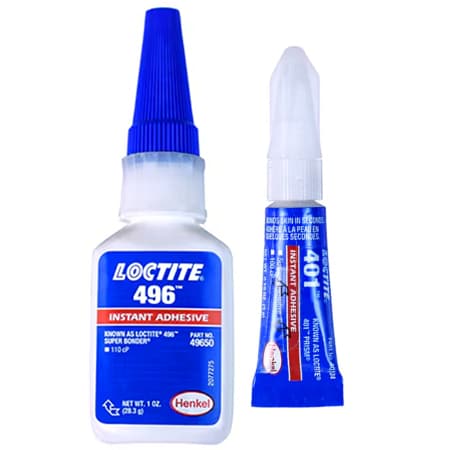
The Omega Cold-Curing Strain-Gage Adhesive series (models SG401 and SG496) consists of solvent-free cyanide-acrylate adhesives developed for applying bonded-resistance strain gauges. These rapid-cure formulations are suitable for all series of strain gauges and compatible with most metals of common use as well as most synthetic materials.
The adhesive is not suitable for porous materials such as concrete, wood, or foam plastic.
Operating Conditions & Performance
Polymerization performance depends on environmental humidity. Relative humidity (RH) between 40% and 70% is most favorable; RH less than 30% retards or stops the reaction, while more than 80% RH causes shock setting.
Setting speed varies by substrate material:
- Steel: 60 to 120 sec.
- Aluminum: 50 to 100 sec.
- Plastics: 10 to 60 sec.
Curing times for measurement depend on the type of measurement and ambient temperature. At 20°C (68°F), minimum curing time is 10 min. for dynamic measurements and 15 min. for static measurements. At 5°C (41°F), these periods extend to 90 min. and 120 min., respectively.
Ultimate curing is achieved after some 24 hours, though measurements can be taken after the minimum times listed above. The thickness of the adhesive film in a correctly adhered gauge is 8 micrometers ± 20%.
Influencing Factors
Setting speed depends on the chemical condition of components to be bonded. Alkaline materials accelerate polymerization, whereas acid materials can retard or completely prevent setting; a neutralizer should be used in acidic cases if a very thin adhesive layer is guaranteed.
Configuration Options
The series supports two package sizes:
- SG401: 0.10 oz. net weight.
- SG496: 1.00 oz. net weight.
The adhesives are supplied as modified versions of a solvent-free cyanide-acrylate adhesive. Complete setting in the given time is achieved only with thin films; thick layers set very slowly and incompletely, making extremely rough contact surfaces unsuitable.
Key Product Differences
The primary distinction between variants is net weight packaging (SG401 vs. SG496). Both models utilize the same solvent-free cyanide-acrylate chemistry with identical setting and curing characteristics relative to substrate material, temperature, and humidity.
PDFs & Manuals

Show Ratings & Reviews
Rated 5 out of
5
by
SLNA from
Thank you!
I received strain gages 1 moth ago. I am happy with them.
Date published: 2015-11-24
Rated 2 out of
5
by
Alan37 from
Price Gouge
Just got the SG496 in the mail and it turns out it is just Loctite 496 which can be had for $25 or less on many other websites. Feeling a little ripped off.
Date published: 2018-07-09
Rated 5 out of
5
by
Anonymous from
Loctite Source
Dwyer/Omega Engineering was a great source for a product that was on backorder with Loctite. I will definitely using them again.
Date published: 2026-05-04
Rated 2 out of
5
by
masonroyal58 from
Needs improvement
I thought the kit was incomplete. They definitely need to add the rapid cure adhesive with this kit. The only useful things in this kit were the cleaning supplies and some of that was wasted by leaking out into the individual bags each of the components were sold in.
Date published: 2018-03-19
Rated 1 out of
5
by
Tassili from
Curing temperature can be damaging to instrument
It may be good to have set of cleaning and bonding, but with curing high temperature is of major concern for some application. normal temperature bonding at 20-25 oC with a couple of minutes waiting is the best solution this company has possible to provide. Sometimes parts where the gages are to be put are large and cannot get into an oven!
Date published: 2016-02-07
Rated 4 out of
5
by
Sparky from
Easy Installation
Pre-attached leads greatly reduce strain gauge installation time. They also eliminate gauges damaged when soldering to the element terminal pads after the strain gauge has ben attached to the test sample.
Date published: 2015-12-04
the web page on this has become confusing. SG401 is a one-part cyanoacrylate, but the links are to an epoxy kit. This became apparent when looking for the SG401 documentation, which is very hard to find now.
Thank you your inquiry. The full specification page for the TT300 2-part epoxy also contains the specifications for both the SG401 and SG496 cyanoacrylate adhesives
Date published: 2019-08-20