
A daisy chain is a wiring method that connects multiple devices in a sequential, linear arrangement. Instead of running individual cables from every device to a central controller or power source, each device connects to the next in the series, creating a single communication or power pathway. The name comes from the way daisy flowers can be linked together to form a garland.
Daisy chaining is widely used in industrial automation, building management systems, computer networking, audio equipment, and power distribution. Depending on the application, the chain may carry power, communication signals, or both. This approach simplifies installation and makes it easier to expand a system by adding additional devices.
How Daisy Chaining Works
In a daisy chain, each device receives power or data from the previous device and passes it to the next. Rather than every device having its own dedicated connection to the host controller, the devices share a common communication path.
The first device in the chain typically communicates directly with the controller or host system, while each subsequent device relays communication along the chain. Many industrial communication protocols use this topology because it minimizes wiring while supporting reliable communication over long distances.
Advantages of Daisy Chaining
Daisy chaining offers several benefits for industrial systems:
- Reduced wiring: Fewer cables are required because each device connects only to the next device in the chain
- Lower installation costs: Less wiring reduces material costs
and installation time - Simplified expansion: Additional compatible devices can often be added without redesigning the entire system
- Improved cable management: A streamlined wiring layout can make troubleshooting and maintenance easier than complex point-to-point wiring
| Advantages | Challenges |
|---|---|
|
Reduced Wiring Daisy chaining minimizes the need for individual connections to a central source. |
Single Point of Failure If one device or connection in the chain fails, the entire chain can be disrupted. |
|
Easier Installation Simpler to set up and manage compared to complex networks of separate wires. |
Signal Degradation In some systems, passing signals through multiple devices may reduce signal quality. |
|
Scalability Additional devices can often be added easily to the chain. |
Limited Capacity There may be restrictions on how many devices can be connected in a chain due to power or data limitations. |
Challenges of Daisy Chaining
Although daisy chaining is an efficient wiring method, it also has several limitations:
- Single point of failure: A failed device or broken connection can interrupt communication with downstream devices
- Signal degradation: Long cable runs or improper termination can reduce signal integrity, particularly in communication networks
- Network capacity limits: Most communication protocols limit the maximum cable length and number of devices that can be connected to a single network segment
- Troubleshooting complexity: Identifying the location of a wiring fault may require checking each device in the chain until the failed connection is found
Innovative Solutions from DwyerOmega
Series iNET-400-500 Expandable Modular USB Data Acquisition System
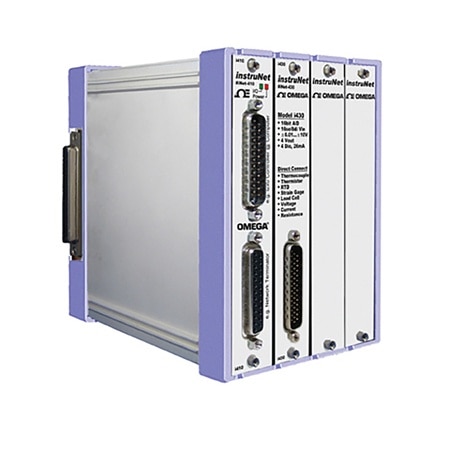
The iNET-400/500 Series Expandable Modular USB Data Acquisition System is a modular USB data acquisition (DAQ) platform designed for engineers and researchers who need a scalable, configurable measurement system. Built around a card-cage architecture, the system allows users to mix and match analog, digital, signal conditioning, and A/D conversion modules to create a customized solution that can grow from a small installation to more than 1,000 measurement channels. By centralizing A/D conversion and leveraging modular signal conditioning, the iNET-400/500 Series Expandable Modular USB Data Acquisition System delivers a cost-effective approach to large-channel-count data acquisition.
Compatible with a wide range of sensor types, including thermocouples, RTDs, thermistors, strain gauges, load cells, accelerometers, voltage, current, and resistance inputs, the platform provides flexibility for diverse test and measurement applications. The included instruNet World Software and dedicated DSP-based controller architecture offload real-time acquisition tasks from the host PC, helping ensure reliable data collection while simplifying system configuration and expansion.
Key Features:
- Expandable architecture supporting 1,000+ channels
- Modular 4-, 8-, 12-, and 16-slot card cage configurations
- Universal sensor compatibility for temperature, pressure, force, vibration, and electrical measurements
- Analog and digital I/O modules with integrated signal conditioning options
- USB 2.0 connectivity with DSP-based real-time data acquisition control
- Includes free instruNet World Software for configuration, monitoring, and data collection
Series AVUL Air Velocity Transmitters

he Series AVUL Air Velocity Transmitters provide accurate measurement of air velocity and volumetric flow for HVAC applications, making them particularly well suited for VAV systems and building duct monitoring. Available in 3% or 5% of reading accuracy models, the transmitters offer flexible integration through simultaneous current and voltage outputs, with field-selectable ranges and output configurations that can be adjusted using onboard DIP switches. An engineered conformal coating on the sensing elements helps protect against contaminants, supporting long-term reliability in demanding air-handling environments.
Designed for both new installations and retrofit projects, the AVUL Series supports multiple output signals and optional BACnet® MS/TP or Modbus® communications for seamless integration with building automation systems. Local configuration and monitoring are simplified through an optional integral display or portable remote display tool, allowing technicians to quickly verify performance and adjust settings in the field.
Key Features:
- Measures both air velocity and volumetric airflow in imperial or metric units
- Available with 3% or 5% of reading accuracy to match application requirements
- Conformal-coated sensing elements for enhanced durability and longevity
- Field-selectable ranges and output settings without requiring power to the unit
- Simultaneous 4-20 mA, 0-5 VDC, and 0-10 VDC output options for broad controller compatibility
- Optional BACnet MS/TP or Modbus RTU/ASCII communications for building automation integration
- Ideal for VAV systems, air handling units, and commercial building ductwork monitoring
Grippers Introduction to Grippers