
Corn is one of the world's most important agricultural commodities and the second-largest crop grown globally. The United States and China lead the industry in production and processing, respectively. Corn serves multiple purposes, including as a staple food crop, a primary ingredient in livestock feed, and a key feedstock for ethanol production.
How Is Corn Harvested?
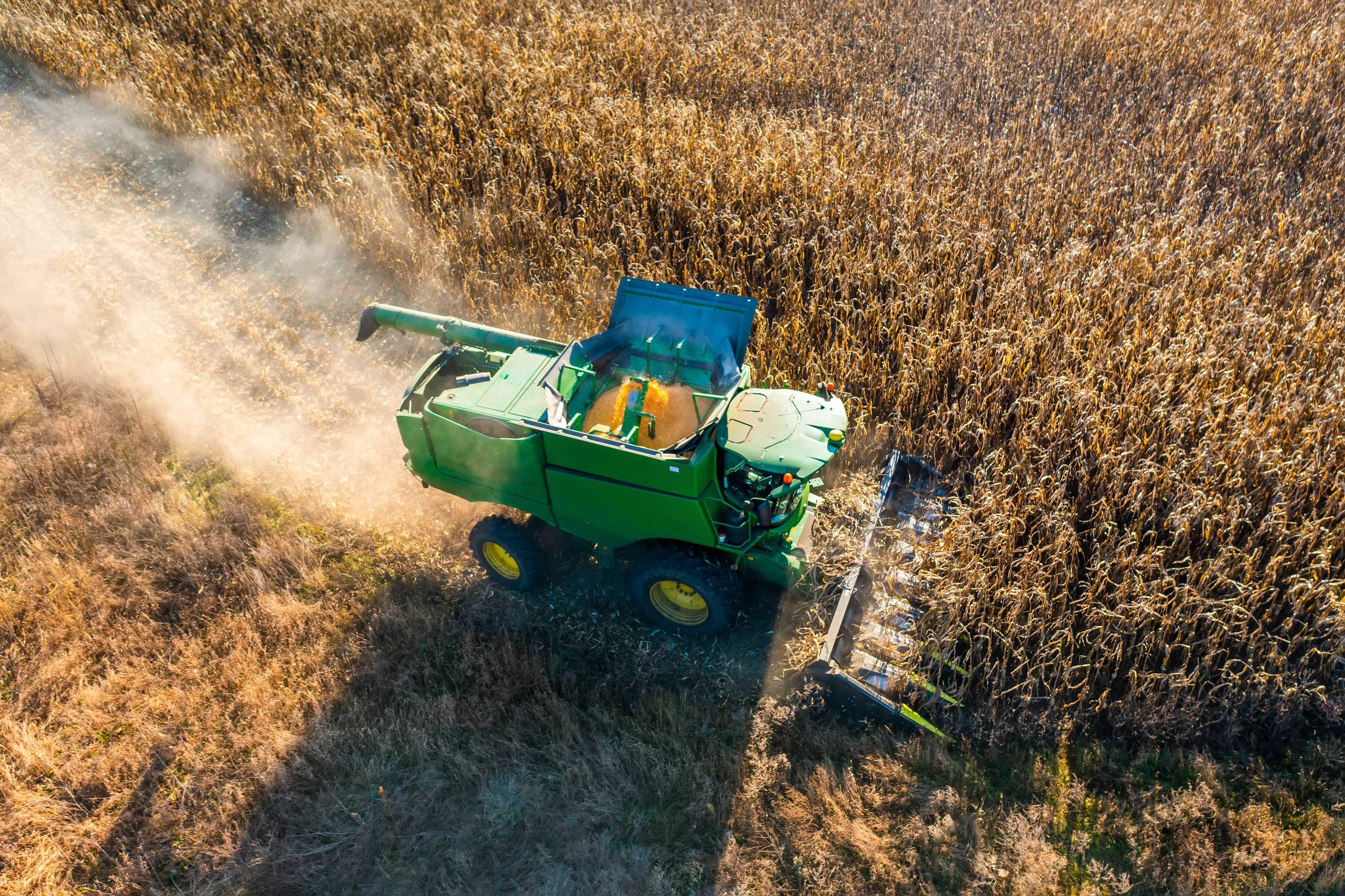
In the early days of agriculture, corn was picked and husked entirely by hand. As farming operations expanded, mechanical corn huskers were introduced to remove husks and debris more efficiently, helping farmers process larger volumes of corn with less labor. While these machines served small and medium-sized operations well, continued growth in agricultural production drove the need for more advanced harvesting equipment.
Today, most corn is harvested using combines, versatile machines that integrate reaping, threshing, and grain collection into a single operation. As the combine moves through the field, it cuts the corn stalks at the base and feeds them into the machine. Inside, a threshing system separates the kernels from the cobs and husks. The cleaned kernels are transferred to a storage hopper, while the remaining plant material is chopped and returned to the field.
After harvest, many farmers leave the corn residue in place to help replenish soil nutrients and reduce erosion. Others allow livestock to graze the fields, utilizing the remaining husks and cobs as a feed source.
Where Does Pressure Measurement Fit In?
Pressure measurement plays an important role in modern corn harvesting and processing operations. Accurate pressure monitoring helps maintain process control, improve equipment performance, enhance safety, and maximize productivity.
In combines and downstream processing equipment, filters and material handling systems can become clogged with dust, debris, or plant material. Monitoring differential pressure across filters and system components helps operators detect restrictions before they lead to equipment failures or costly downtime. Pressure data can also provide insight into critical operating parameters such as flow rates, hydraulic system performance, and motor loads.
By continuously monitoring pressure throughout the process, farmers and processors can identify problems early, protect valuable equipment, maintain product quality, and optimize overall operational efficiency.
Innovative Solutions from DwyerOmega
Series MSX Magnesense® Differential Pressure Transmitter

The MSX Magnesense® Differential Pressure Transmitter provides reliable pressure, airflow, and velocity measurement for monitoring equipment performance and process conditions. By sensing differential pressure and transmitting a signal to control systems or local alarms, the MSX Magnesense® Differential Pressure Transmitter helps operators identify developing issues before they impact productivity.
The MSX Magnesense® Differential Pressure Transmitter offers 32 selectable pressure ranges in Pa, mm w.c., and in. w.c., with support for both unidirectional and bidirectional measurement. In addition to linear pressure output, the MSX Magnesense® Differential Pressure Transmitter can provide airflow and velocity measurements using built-in square root extraction, reducing the need for additional instrumentation.
Dual voltage and current outputs support both process control and signal verification, while an optional rotatable LCD display improves local visibility. An optional toolless terminal block simplifies wiring and installation.
In agricultural processing and material handling applications, the MSX Magnesense® Differential Pressure Transmitter can be used to monitor filter loading, detect airflow restrictions, and help maintain efficient operation of pneumatic conveying and dust collection systems, reducing the risk of unplanned downtime.
Series 2000 Magnehelic® Differential Pressure Gage
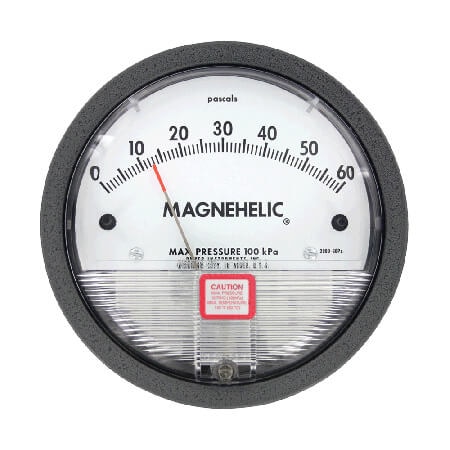
The Magnehelic® Differential Pressure Gage provides a simple, reliable way to monitor low differential pressure in air and non-combustible, compatible gases without requiring an external power source. Using a precision diaphragm and patented magnetic movement design, the Magnehelic® Differential Pressure Gage delivers fast, repeatable response to pressure changes while remaining easy to read and operate.
A clear analog display with an undistorted plastic face allows operators to quickly verify system conditions at a glance. The durable die-cast aluminum housing is sealed to an IP67 rating for dependable performance in dusty or damp environments, while built-in overpressure protection helps safeguard the instrument in demanding applications.
Installation is straightforward with a bezel design that supports flush panel mounting. Because the Magnehelic® Differential Pressure Gage operates without electrical power, it provides a cost-effective solution for continuous pressure monitoring with minimal maintenance requirements.
In agricultural processing applications, the Magnehelic® Differential Pressure Gage can be used to monitor filter condition, verify airflow through dust collection systems, and identify pressure drops that may indicate blockages or equipment performance issues. By providing clear visual indication of system status, the Magnehelic® Differential Pressure Gage helps support efficient operation and reduce unplanned downtime.
Grippers Introduction to Grippers