Besoin d'aide? Appelez-nous: 1-800-663-4209



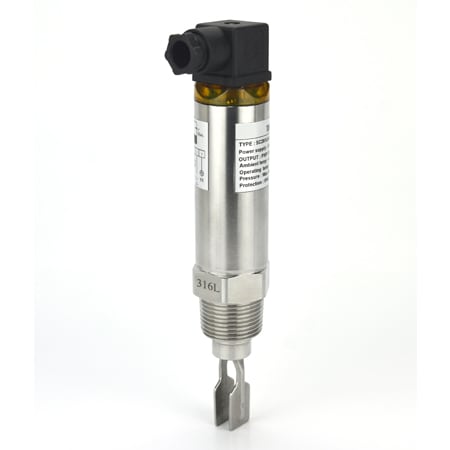
LTUM1-3014-Series
Interrupteur de niveau à fourche de réglage mini-type en acier inoxydable 316
316 SS Mini-Type Tuning Fork Level Switch
Modèles en stock
- Interrupteur de niveau à fourche avec sortie PNP/NPN
- Large plage d'alimentation électrique 12-55 Vcc
- Aucun étalonnage fréquent requis, conception robuste et durable, facile à utiliser. Mode de sécurité haute/basse, sûr et fiable.
- Réglage de la sensibilité disponible pour différentes densités de fluides.
LTUM1-3014-Series
À partir de
£
299.06
Modèles en stock

Aperçu du produit
- Homologations CE, RoHS, UKCA
- Densité, max 0,7 g/cm³
- Connexion électrique DIN 43650 A (électrovanne)
- Caractéristiques nominales du boîtier IP65
- Matériaux Acier inoxydable 304 ; acier inoxydable 316
- Nombre de fils 3
- Pression de Fonctionnement, max 600 psi
- Température de fonctionnement, max 80 °C
- Température de fonctionnement, min -40 °C
- Longueur de la sonde 1.625 in
- Taille du raccordement au process 3/4 po
- Type de raccordement au process NPT mâle
- Température maximale du processus 100 °C
- Température minimale du processus -40 °C
- ID de série LTUM1-3014-Series
- Type d'approvisionnement électrique CC
- Tension d'alimentation 12 à 55 Vcc
- Vibration 1 KHz
- Échelle de viscosité 1 à 10 000 cSt
Supported Applications
The Omega TF280-N and TF280-P Mini-Type Tuning Fork Level Switches are designed for level detection in various industrial applications. The device utilizes a tuning fork sensor that vibrates at a specific frequency; when submerged in a medium, the vibration changes to trigger an output signal. These switches support media with Specific Gravity (S.G.) equal to 1 g/cm³, less than 1 g/cm³, and greater than 1 g/cm³.
Operating Conditions & Performance
The series is powered by DC power supply and features a magnetic test function for verifying proper installation and operation after the switch is installed. The sensing spot adjusts based on the specific gravity of the medium: it moves upward if the S.G. is lower than 1 g/cm³ and downward if the S.G. is greater than 1 g/cm³.
During a magnetic test, bringing a magnet close to the testing point causes the output status to switch from NO to NC or NC to NO, while the red LED switches ON or OFF. This function confirms that wiring and functioning are correct.
Configuration Options
The series is available in Standard Type and Extension Type configurations with distinct dimensional profiles:
- Standard Type: Height 215mm, Diameter φ38. Includes HEX38 connection, 3/4PT process connection, stem length of 36mm, and insertion lengths associated with the standard profile.
- Extension Type: Height 250mm, Diameter φ23. Features an insertion length of 120mm or 250mm depending on configuration.
The switches offer configurable output signals and wiring modes via a DIN Connector:
- Output Signal Types: PNP and NPN.
- Wiring Configuration (DIN & Cable):
- PnP High/Max: Pin 1 (Brown) = N-, Pin 2 (Black) = L+, Pin 3 (Blue) = Output, Pin 4 (Yellow Green) = Ground.
- NPN Low/Min: Pin 1 (Brown) = N-, Pin 2 (Black) = L+, Pin 3 (Blue) = Output, Pin 4 (Yellow Green) = Ground.
Wetted materials and the housing are constructed from 316L Stainless Steel. The process connection is specified as 3/4PT.
Key Product Differences
The series includes two primary model families identified by their output logic:
- TF280-N: Represents the NPN output configuration variant.
- TF280-P: Represents the PNP output configuration variant.
The model number guide follows the format: TF280-N/ TF280-P - <Model Type> - <Output Type> - <Connection Type> - <Fork Type> - <Sensing Spot Adjustment> - <Other Options>. Variations in the series address different fork designs and sensing spot adjustments required for media with varying specific gravities.
PDF & Manuels


