


Accurate humidity measurement is essential in laboratories, pharmaceutical facilities, clean rooms, manufacturing environments, HVAC systems, and other applications where environmental conditions affect quality, safety, or performance.
For calibration teams, the challenge is not simply measuring humidity. It is verifying that an instrument continues to measure accurately under known and repeatable conditions. That requires more than a sensor reading. It requires a controlled environment, a reliable reference, and a clear process for comparing and documenting results.
Whether calibration takes place in a laboratory or at the measurement site, a well-designed workflow can help technicians identify measurement errors, reduce uncertainty, and maintain confidence in their instruments.
Humidity & Temperature Calibration
Explore the equipment used to generate, reference, measure, record, and verify humidity and temperature conditions across calibration workflows.
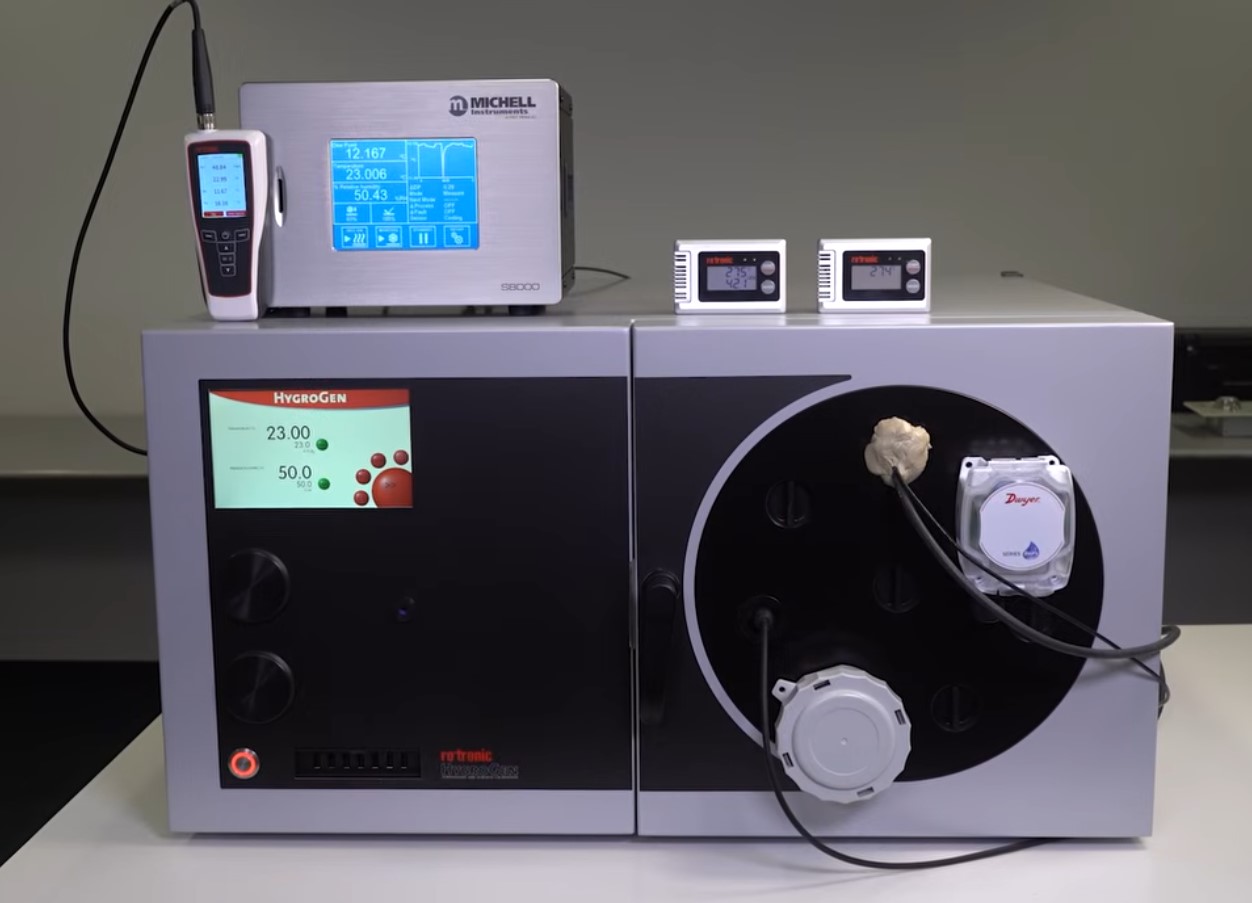

Series HygroGen2 Portable & Robust Humidity Generator for On-Site Calibration
Portable humidity and temperature generator
The Challenges of Laboratory Calibration
Laboratory calibration requires consistency. Instruments must be tested at defined humidity and temperature conditions so that results can be compared across calibration intervals, technicians, and instruments.
Small changes in ambient conditions can affect the results. If the surrounding humidity or temperature changes during a test, it may be difficult to determine whether a difference comes from the instrument under test or from the environment itself.
A controlled calibration environment helps reduce those variables. It gives technicians a stable basis for evaluating sensor response, repeatability, and agreement with a reference measurement.
The Challenges of On-Site Calibration
On-site calibration introduces a different set of practical concerns. Instruments may already be installed in a clean room, production area, storage facility, HVAC system, or building-management application.
Removing an instrument for testing can interrupt operations or create additional logistical challenges. In some cases, transporting the instrument to a laboratory may not be practical.
A portable calibration workflow allows technicians to bring controlled test conditions closer to the instrument. This can reduce disruption while still providing a structured method for verifying performance.
Creating Stable Calibration Conditions
The foundation of any humidity calibration process is a known and stable environment. The instrument under test must be exposed to controlled humidity and temperature conditions long enough for its readings to stabilize.
Once conditions are stable, technicians can compare the instrument’s measurement with a trusted reference. Repeating this process at one or more test points helps reveal whether the instrument is operating within its required tolerance.
A controlled environment also makes it easier to test multiple instruments or sensor types using a consistent procedure.
Comparing Readings with a Trusted Reference
The purpose of a reference instrument is to provide an independent measurement for comparison. When the reference and the instrument under test agree within the required tolerance, the result supports confidence in the instrument’s performance.
When the readings do not agree, the difference may indicate sensor drift, contamination, installation issues, response-time differences, or the need for adjustment or service.
This comparison is especially valuable when calibrating instruments used in quality-critical applications. It helps technicians move beyond simply observing a reading and instead evaluate how that reading performs against a dependable standard.
Monitoring and Documenting the Process
Real-time monitoring allows technicians to see how an instrument responds as the test conditions stabilize. This can help identify slow response, unexpected fluctuations, or differences between instruments during the calibration process.
Data logging adds a permanent record of the test. Time-stamped humidity and temperature measurements can support calibration reports, quality documentation, troubleshooting, and future comparisons.
Together, real-time monitoring and recorded data help make calibration results easier to review, explain, and reproduce.
Supporting a Repeatable Calibration Workflow
A flexible calibration setup can be used to verify a wide range of instruments, including:
- Humidity and temperature probes
- Portable meters
- Environmental data loggers
- HVAC and building-management sensors
- Duct-mounted transmitters
- Clean-room monitoring instruments
- Pharmaceutical and manufacturing sensors
Innovative Solutions from DwyerOmega
Series HG Portable Humidity Generators
The Rotronic HygroGen2 Series Portable Humidity Generators provide a reliable and efficient solution for laboratory and on-site calibration of relative humidity and temperature measuring instruments. Designed for precision and portability, the series generates stable humidity conditions from 5 to 95% RH and temperatures from 0 to 60 °C, with optional extensions for expanded operating ranges. Rapid stabilization and simultaneous calibration of multiple probes help reduce downtime and streamline calibration workflows.
Available in two configurations, the HG2-S accommodates up to 6 probes, while the larger HG2-XL supports up to 19 probes. Both models feature precise humidity and temperature control, integrated software, and optional automated calibration and remote connectivity capabilities, making them ideal for a wide range of calibration requirements.
Key Features:
- Generates stable humidity conditions from 5 to 95% RH with ±0.1% RH stability
- Precise temperature control from 0 to 60 °C with optional extended ranges
- Rapid humidity and temperature stabilization for efficient calibration
- Simultaneously calibrates up to 6 probes (HG2-S) or 19 probes (HG2-XL)
- Portable, robust design with optional automated calibration and remote control capabilities
Michell S8000 Precision Chilled Mirror Hygrometer
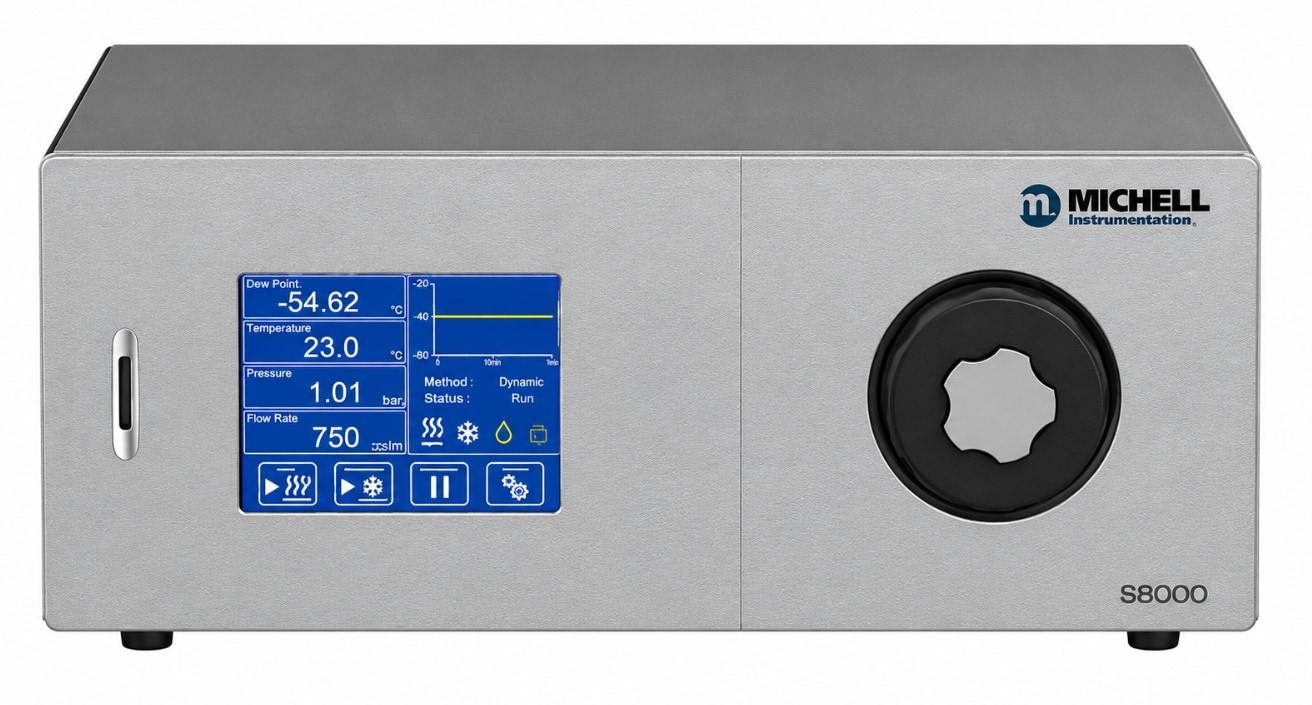
The Michell S8000 Precision Chilled Mirror Hygrometer delivers highly accurate and reliable dew point, temperature, and pressure measurements for industrial and laboratory applications. Utilizing advanced optical chilled mirror technology, the instrument provides direct, repeatable dew point measurements down to -60 °C with an accuracy of ±0.1 °Cdp. Its fundamental measurement principle ensures long-term stability and minimal drift, making it ideal for demanding humidity measurement and calibration applications.
Designed for precision and ease of use, the S8000 features a compact, self-contained design with an intuitive touchscreen interface for simplified configuration and operation. The instrument supports multiple humidity measurement units, including relative humidity, absolute humidity, ppmv, and ppmw, while USB and Ethernet connectivity enable convenient data logging and system integration.
Key Features:
- High-precision dew point measurements down to -60 °C with ±0.1 °Cdp accuracy
- Advanced optical chilled mirror technology ensures reliable, low-drift measurements
- FAST technology guarantees frost formation below 0 °C for accurate frost point measurement
- Intuitive touchscreen interface simplifies configuration and operation
- Supports pressures up to 2 MPa (20 barg) with USB, Ethernet, and SD card data logging capabilities

What Is An Immersion Heater? Types Of Immersion Heating Elements What is an Immersion Heater?
what is an industrial electric heater? What is an industrial heater?