Need assistance? Call us: 1-800-663-4209



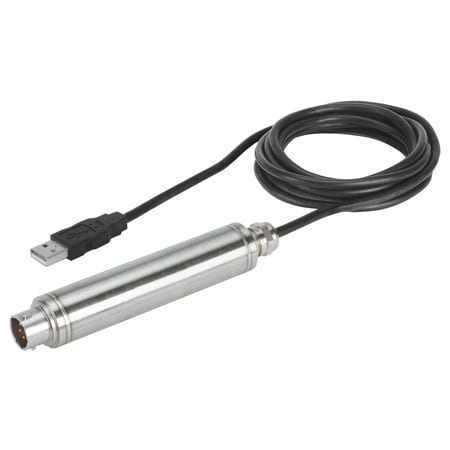
IN-USBH-Sig-Cond
USB In-Line Field Calibratable Signal Conditioner
Models In Stock
- High Speed USB Output Option for mV Transducers
- Up to 1000 Readings/Second
- Free Downloadable Software
- Ready-Made Cable Assemblies Now Available!
IN-USBH-Sig-Cond
From
C$
1,046.32
Models In Stock


Product Overview
- ADC Resolution 24 bit
- Approvals CE
- Bridge Resistance 350 to 15000 Ω
- Cable Length 2 m
- Diameter 22 mm
- Electrical Connection MIL-26482-I 10-6P, USB A
- Input Electrical Connection MIL-26482-I 10-6P
- Input Range 1 to 400 mV/V
- Input Type Voltage
- Isolation 2 MΩ @ 50 Vdc case to output terminations
- Length 101 mm
- Linearity Error 0.001%/°C
- Mating Connector PT06F10-6S
- Mounting Mounting Bracket
- Operating Temperature, Max 80 °C
- Operating Temperature, Min -40 °C
- Resolution Up to 5.5
- Sensor Excitation 4.1 Vdc (Excludes the PX309 and PX409 series)
- Series ID IN-USBH-Sig-Cond
- Weight 200 g
- Zero/Balance Error 0.001%/°C
Supported Applications
The Omega IN-USBH is a USB In-Line Field Calibratable Signal Conditioner designed for mV pressure or load transducers. It enables the direct connection of these sensors to a computer, utilizing free PC software to function as a virtual meter, chart recorder, and data logger on laptops or Windows® tablets with USB connections.
The device supports applications requiring dynamic measurement or slow-moving process monitoring by providing adjustable sampling rates up to 1000 Hz. Logged data can be exported in spreadsheet format for later viewing and analysis.
Operating Conditions & Performance
The IN-USBH operates within an ambient temperature range of -40 to 80°C (-40 to 176°F). It provides a resolution of up to 5.5 significant figures with a 24-bit A/D conversion and maintains a linearity error of 0.001% FSO. The thermal error is specified as 0.001% FSO/°C.
Performance specifications include a bandwidth typical of up to 1000 updates per second (±3%) and minimum isolation of 2 MΩ @ 50 Vdc from case to output terminations. The unit provides regulated excitation at 4.1 Vdc* directly to the transducer, eliminating the need for an external power supply.
Transducer requirements are defined as follows:
- Bridge Sensitivity: 1 to 400 mV/V
- Bridge Resistance: 350Ω to 15,000Ω
Configuration Options
The series features a compact in-line design with an overall length of 101 (4.00) mm and a diameter of ø22 (0.88) mm. The housing is constructed from a 316L Stainless Steel Case, weighing approximately 200 g (7.1 oz) including the USB cable.
Connectivity options include:
- Transducer Side Connection: PTIH-10-6P 6-pin twist-lock male connector
- Mating Connector: PT06F10-6S (sold separately)
- USB Side Connection: 2 m (6') USB 2.0 cable
The IN-USBH is field-calibratable using two-point or datasheet parameters via the included software. A stainless steel mounting bracket is included with the unit.
Cable Assembly Options
Pre-made interconnecting cable assemblies (CA*INUSBH) are available to connect specific transducers to the IN-USBH. These cables feature different insulation types and wiring codes tailored to various Omega sensor families:
- PVC Insulation (-30 to 80°C / -22 to 176°F): Available for load cells (LC series) and pressure transducers (PX, LCHD).
- FEP Insulation (-55 to 125°C / -67 to 257°F): Offered for high-temperature applications with specific PX series models.
- Cable Lengths: Standard assemblies are listed at 0.15 m (implied by part number suffix), though lengths longer than 15' may be available upon contacting sales.
Key Product Differences
The primary model, IN-USBH, is the field-calibratable USB in-line signal conditioner. The series supports various configurations through optional pre-made cable assemblies (CA*INUSBH) that match specific transducer wiring codes and connector types.
Differences between available cables are defined by:
- Insulation Material: PVC or FEP, determining the temperature rating of the assembly.
- Wiring Code: Codes such as 2A, 3, 4/4A, 5, 6, and 8 correspond to specific pinout arrangements for different transducer families (e.g., LC111, PX35, LCHD).
- Connector Types: Assemblies may terminate in PT06F10-6S or MS3106E-14S-6S connectors on the transducer side to match specific sensor interfaces.
PDFs & Manuals
Software & Drivers


Show Ratings & Reviews
In-USBH software displays an error of 'Saturation Alarm Low' while displaying the maximum specified force without any load. what could be the issue? we checked the connection and its ok. Thanks
This symptom usually indicates a damaged sensor. Measure the raw output signal from the load cell with no load applied. It should be close to 0 millivolts. A high millivolt signal would indicate a damage cell. Also recheck you wiring. You should have a connection between pins E & C and between F & D.
Date published: 2024-11-15
We have a LCDH-2K which is spec'd at 10V excitation. The IN-USBH only provides 4.1V excitation due to using the USB port. Will this be a problem or will we just lose sensitivity by using a lower excitation?
Running the LCHD-2K Load Cell on 4.1VDC would not be problem. The IN-USBH will scale correctly.
Date published: 2023-10-02
What are the differences between all of the "wiring codes" specified with the cables listed under Accessories?
Thank you for your question. Please see page 2 and 3 of the datasheet to see which cables will be used with specific units:
https://assets.omega.com/spec/IN-USBH.pdf
For further questions email pressure@omega.com
Date published: 2020-12-29
I would like to use the IN-USBH with the TQ513-200. Will the data output of the IN-USBH change sign (positive/negative) with a change in the direction of the force on the shaft of the TQ513-200?
Yes.The IN-USBH is capable of reading a birdirectional millivolt signal from a strain gage bridge based sensor. You scale it to read negative values using the software.
Date published: 2020-05-27
I want to be able to read the data from the LCHD-10K load cell with a pre-existing program. Is there a way to communicate with the IN-USBH or the free software to be able to read the live data into my program while the load cell is in use?
Yes. You can use the IN-USBH and free software to read load dated real-time on your computer.
Date published: 2022-01-31
Sorry if this is a newb question. Will the software and IN-USBH work with an LVDT like the LD620 series? I need position information logged with the force data off an existing IN-USBH/LCWD-5K load cell. I don't see LVDTs mentioned for compatibility.
Thank you for your inquiry, the IN-USBH is designed to work with mV\v sensors and is not compatible with the LD620.
Date published: 2022-06-02