


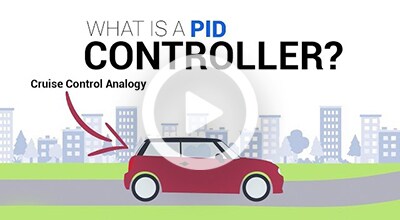
What is a PID Controller?
A PID controller is an instrument used to regulate temperature, flow, pressure, velocity and other process variables.
PID control works much the same way as the cruise control on a car, where external influences such as hills (gradients) would decrease speed.
The PID algorithm restores from current speed to the set point speed by controlling the power output of the vehicle's engine.
PID stands for Portional Integral Derivative control. As its name implies,
a PID controller combines proportional control with additional integral and derivative adjustments which help the unit automatically compensate for changes in the system.
The basic idea of a PID controller is to read a sensor (process variable) then compute the desired actuator output by calculating proportional,
integral, and derivative responses and summing those three components to compute the regulated output.
The purpose of a PID controller is to measure process conditions, calculate feedback ,and adjust output to force process level to match a set point.
For example a thermostat that forces the heating and cooling unit to turn on or off based on a set temperature.
Still have questions?
We Have Answers!
Call or Chat online at Omega.com
Thanks for watching and be sure to like and subscribe!