Netherlands 07077 03815 | Intl +31 (0) 7077 03815 | Welcome to our new website, found an issue or bug? Please report it here



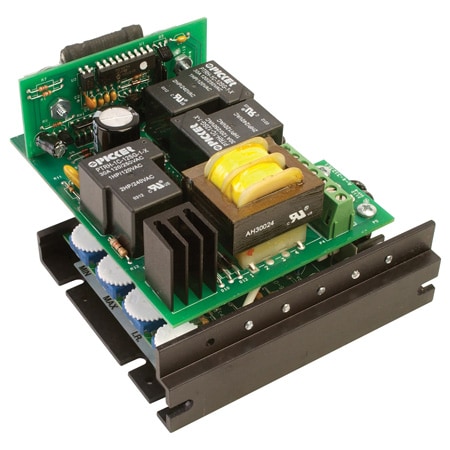
OMDC-130-Series
DC Motor Speed Control with Reversing Capability
- Provides DC Motor Speed Control with Reversing Capability
- Speed Regulation is ±1% of Base Speed
- Adjustable Minimum/Maximum Speed
- Adjustable Current Limit


Product Overview
- Acceleration, Max 0.5 Sec
- Control Characteristics Via 5 kΩ 0.5 W Potentiometer or 0 to 10 Vdc isolated signal
- Deceleration, Max 0.5 Sec
- Efficiency 85% typical
- Form factor Chassis Mount
- Current, Max Note Shunt Field Current, Max: 1 Adc, Current Limit: 1 to 18 Adc(Trimpot)
- Operating Temperature, Max 45 °C
- Operating Temperature, Min -10 °C
- Overload Capacity 200% for 1 min
- Protection G-Mov for Transient
- Sensor Type Opto-isolator
- Series ID OMDC-130-Series
- Speed Range Note Speed Range: 50:1, Trimpot Speed Range, Min: 0 to 30% of maximum speed, Trimpot Speed Range, Max: 60 to 110% of base speed
- Speed Regulation ±1% of base speed
- Supply Power Note Power Devices: Isolated case tab
- Tightening Torque 4.4 in. lb. maximum or 0.05 Nm
- Voltage Note Shunt Field Voltage: 100 Vdc for 120 Vac input; 200 Vdc for 240 Vac input
Supported Applications
The Omega OMDC-130 Series Reversing DC Motor Speed Control provides speed regulation with reversing capability for industrial motion control. Documented applications include door openers, feeders, tapping machines, pumps, screen presses, and conveyors.
Operating Conditions & Performance
The series operates on 120 Vac or 240 Vac input (±10% of rated line voltage) at 50 or 60 Hz. Ambient temperature range is -10 to 45°C (15 to 115°F). Performance specifications include ±1% speed regulation, a 50:1 speed range, and acceleration/deceleration times of 0.5 seconds.
Key electrical characteristics:
- Output Voltage: 0 to 90 Vdc (120 Vac input models) or 0 to 180 Vdc (240 Vac input models).
- DC Output Current: Ranges from 500 mA to 1.2 ADC, up to 5.5 ADC for LC models, and up to 10 ADC for HC models.
- Controller Overload Capacity: 200% for one minute.
- Typical Efficiency: 85% typical.
The control features onboard dynamic braking and a unique zero-speed detect circuit. In the event of power loss or an emergency stop, the unit enters dynamic brake mode until power is reapplied and a run condition is recognized.
Configuration Options
The series offers configurable dimensions across LC (Low Current) and HC (High Current) housings. Speed adjustment is supported via a 5 kΩ speedpot or an isolated 0 to 10 Vdc analog input signal.
- Housing Dimensions: LC Models measure 126.16 W x 107.95 L x 68.27 mm D (4.96 x 4.25 x 2.68"); HC Models measure 158.75 W x 177.8 L x 103.2 mm D (6.25 x 7.0 x 4.06").
- Start/Brake Cycle Rate: LC models support up to 3 cycles per minute; HC models support up to 30 cycles per minute.
- Current Limiting: Adjustable via trimpot (1 to 18 ADC for Models 130x100 and 132x200).
Options include a 5K Speed Pot with 8" Leads, Dial and Knob Included. The OMDC-HS125 Heat Sink is available to support higher current output for LC100/LC200 models.
Key Product Differences
The series distinguishes between input voltage ratings (130 vs 132) and housing classes (LC vs HC), which determine maximum horsepower, continuous current capacity, and cycle rates:
- OMDC-130LC100 / OMDC-132LC200: LC models rated for up to ½ HP at 5.5A (with heat sink) or 1 HP depending on voltage, with a cycle rate of 3 per minute.
- OMDC-130HC100 / OMDC-132HC200: HC models rated for up to 1 HP at 10A (90 Vdc) or 2 HP at 10A (180 Vdc), with a cycle rate of 30 per minute.
Note: Cycles per minute are based on typical inertia type loads. Higher rates may be achieved with constant torque or low inertia loads, while lower rates may be required for very high inertia loads. With a suitable external heat sink (where extrusion temperature does not exceed 70°C), maximum output amps can increase to 10A DC.
PDFs & Manuals