Need assistance? Call us: 1-800-663-4209



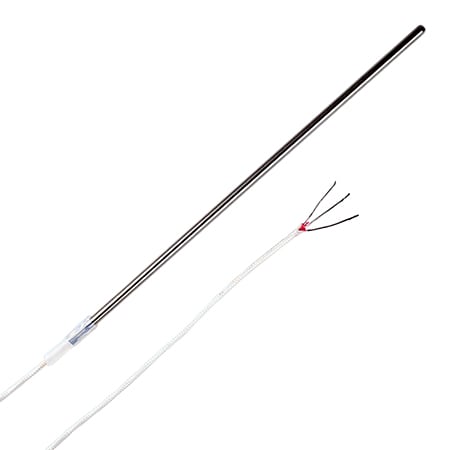
PR-10
RTD Probe with Insulated Wire and Heat-Shrink Tubing Support
Models In Stock
- Low temperature range: -50 to 250°C (-58 to 482°F)
- High temperature range: -50 to 450°C (-58 to 842°F)
- Extreme temperature range: -200 to 600°C (-328 to 1112°F)
- 316 SS probe with class A RTD accuracy and configurable options
PR-10
From
C$
110.33
Models In Stock


Can't find the right model?
Use our custom configurator to fine tune your product
Product Overview
- Accuracy Class A
- Accuracy Detail Class A from -100 to 450°C (-148 to 842°F); or else Class B
- Cable Material PFA
- Electrical Connection Stripped Leads
- Enclosure Ratings IP67
- Insulation PFA
- Nominal Resistance/Curve Note 100 Ω at 0°C standard; TCR = 0.00385 Ω/Ω/°C standard
- Probe Type RTD Probe with Insulated Wire and Shrink Tube Support
- Series ID PR-10
- Sheath Material 316 Stainless Steel
- Shock IEC 60068-2-27; 50g/11ms (15 probes tested together) Duration: 1 day
- Temperature Coefficient 0.00385Ω/Ω/°C
- Temperature Coefficient Note α=0.00385Ω/Ω/°C
- Temperature Probe Style Immersion Probe
- Temperature Sensor Type RTD
- Vibration IEC 60068-2-6; 5 to 2000 Hz sweep rate, one active per minute;10 sweep cycles; acceleration 5g (15 probes tested together) Duration: 1 day
- Wire Gauge 26 AWG
- Wire Termination Temperature, Max 250 °C
Supported Applications
The Omega PR-10 series consists of RTD probes with insulated lead wire and shrink-tube strain relief support at the sheath/wire transition. Documented applications for this probe include liquid immersion, slurries and emulsions, granular material measurements, as well as temperature monitoring of heat bars, kilns, and pipes. The PR-10 series is suited for both process and laboratory temperature measurements.
Operating Conditions & Performance
The PR-10 series covers three distinct temperature ranges depending on the model variant: -50 to 250°C (-58 to 482°F), -50 to 450°C (-58 to 842°F), and -200 to 600°C (-328 to 1112°F). Accuracy is specified as Class A for the PR-10L (Low) model. For the PR-10H (High) model, accuracy is Class A from -50 to 300°C (-58 to 572°F); or else Class B. The PR-10E (Extreme) model offers Class A from -100 to 450°C (-148 to 842°F); or else Class B.
Response time T90 varies by probe diameter and temperature range:
- PR-10L (Low): 1/8" 2.4 sec, 3/16" 2.8 sec, 1/4" 3.25 sec.
- PR-10H (High): 1/8" 2.8 sec, 3/16" 4.11 sec, 1/4" 5.41 sec.
- PR-10E (Extreme): 1/8" 9 sec, 3/16" 9.8 sec, 1/4" 10.6 sec.
The series carries an IP67 ingress protection rating and meets vibration standard IEC 60068-2-6 (5 to 2000 Hz sweep rate, one active per minute; 10 sweep cycles; acceleration 5g) and shock standard IEC 60068-2-27 (50g/11ms).
Configuration Options
The PR-10 series is offered in a configurable model structure: PR-10<variant>-<wire_count>-<resistance>-<diameter>-<length>. Key configuration options include:
- Sensor Element & Resistance: Standard nominal resistance is 100 Ω at 0°C with a TCR of 0.00385 Ω/Ω/°C (PT100). Dual element configurations are offered in both PT100 Ω and PT1000 Ω.
- Wire Configuration: Available in 2-, 3-, or 4-wire setups with PFA wire material. Standard lead wire length is 40 inches; longer lengths may be built using the configurator.
- Terminations: Stripped ends are standard, though other terminations may be configured.
- Diameters & Lengths: Probe diameters of 1/8, 3/16, and 1/4 inch. Standard probe lengths include 2, 3, 4, 6, 9, 12, 18, and 24 inches; other lengths are available via configurator.
- Wire Termination Max Temp: PR-10L supports up to 100°C (212°F); PR-10H and PR-10E support up to 250°C (482°F).
Key Product Differences
The series is divided into three primary models based on temperature capability:
- PR-10L (Low): Process Temperature Range -50 to 250°C (-58 to 482°F); Class A accuracy.
- PR-10H (High): Process Temperature Range -50 to 450°C (-58 to 842°F). Note: PR-10H probes in 1/8" diameter will have a metal barrel at the transition. Accuracy is Class A from -50 to 300°C (-58 to 572°F); or else Class B.
- PR-10E (Extreme): Process Temperature Range -200 to 600°C (-328 to 1112°F). Accuracy is Class A from -100 to 450°C (-148 to 842°F); or else Class B.
PDFs & Manuals


Show Ratings & Reviews
Rated 3 out of
5
by
UC Davis Medical Center from
RTD Probe review
The connection point from the probe to the wire is a weak point that has broken a few times. We have repaired and/replaced this probe multiple times. Also the connection to the thermometer has failed as well.
Date published: 2021-03-02
Rated 4 out of
5
by
648965742 from
Good for static measurement, response time varies
Easy to use, accurate devices. Warning, I saw different response times between the two devices I ordered when the temperature was changing rapidly. One responded to an 80 C difference in ~ 1 min, the other took 5 min to stabilize.
Date published: 2020-07-20
Rated 3 out of
5
by
paddy from
Nice design - Required proprieatay connector
I bought an Omega data logger with 4 thermocouple inputs and 2 RTD connections. The device worked right out of the box - is easy to use and record with. Unfortunately Omega has designed the data logger so that we have to use their proprietary connectors , almost like an earphone jack, for the RTDs. My master technician tried to solder these connects and messed one of them up. Called up Omega. 3 week lead time, and no they would not replace the connector. a Little disappointed on that front. Very limited instructions on how to solder this connector. We guessed as to what terminal goes to what RTD wire and took an educated guess. Lucky for us our guess was right.
Date published: 2018-03-26
Rated 5 out of
5
by
Dog_One from
Probe Where You Need To
For many situations, this probe is an ideal thermal sensor that is rugged, accurate, and small enough to satisify a majority of typical needs. Even if not specified as an engineering requirement, I highly recommend having some of these on-hand for times when you need a quick retrofit or a second temperature verification. These probes are extremely versatile and quite durable.
Date published: 2025-10-17
Rated 5 out of
5
by
Dale R from
All is good.
All is working as expected. Was easy to find a suitable item in need.
Date published: 2025-09-19
Rated 5 out of
5
by
Nicole1234 from
Great RTD Probes
These RTDs arrived quickly and were well-labeled and packaged. They matched the description from the website perfectly, and they fit into our system as we had expected. They gave reliable temperature readings to our receiver.
Date published: 2025-06-20
Rated 5 out of
5
by
Good One from
AMAZING AND HELPFUL
Exactly what we needed and Sales associate was extremely helpful.
Date published: 2024-11-11
Rated 5 out of
5
by
M Leonard from
Great Company, Great Product
Great product, exactly as expected. The Team at Omega is easy to work with. Great customer service. 10/10!
Date published: 2024-09-19
What conditions would cause the RTD to drift over time and are their preventative measures that can be taken to help prevent this drift?
Thank you for your inquiry. Causes of RTD Drift: 1. Mechanical Stress & Vibration, 2. Thermal Cycling & Shock, 3. Exposure to corrosive atmospheres. Preventative Measures: 1. Use Ruggedized Sensors rated for the environment, 2. Use the RTD within its temperature limits, 3. Choose the appropriate sheathing for your application.
Date published: 2026-07-01
We have a PR-10H-4-100-1/8-4 and a PR-10H-4-100-1/8-6. How long in the actual Pt sensor inside the probe and how far is it from the tip? Thx G.
Typically the RTD sensor will extend from the tip to about 0.75" up the probe. Omega recommends that the probes be inserted 2" into the process to obtain good readings.
Date published: 2025-10-24
What is the maximum pressure rating for this RTD probe?
Omega does not place a pressure rating specification on theses probes.
Date published: 2024-04-29
Can these probes be bent 90 deg at about the midpoint and still function properly?
Thank you for your inquiry BigThermalGuy. Unfortunately, the PR-10 series cannot be bent as that will damage the sensor and it will not work properly. Please review the PR-26 series which can be bent. Here is the link: https://www.omega.com/en-us/temperature-measurement/temperature-probes/probes-with-integral-connectors/p/PR-26-Standard
Date published: 2023-10-14
What is the MTBF of these RTDs? Specifically looking at Naval Sheltered environments.
Thank you for the inquiry. Please forward this question to TEMP@OMEGA.COM.
Best regards
OMEGA
Date published: 2023-08-30
What is the tolerance on the diameter and length?
Thank you for the inquiry. Please forward this question to TEMP@OMEGA.COM
Best regards
OMEGA
Date published: 2022-03-21
What is the accuracy of the probe?
Thank you for your inquiry Nathan2. The accuracy of the PR-10 series RTD probes is Class A accuracy conforming to IEC 60751. For more information, please review this link: https://assets.omega.com/tech-ref-legacy-pdfs/z251.pdf
Date published: 2025-10-29
Does the entire probe need to be in the temp you want to measure? Measuring area with heat >250C, can you have the probe in this area until 20*diameter of probe, and thread the rest of the probe so the start of the lead wire is in an area <250C
Thank you for the inquiry. The whole probe does not need to be immersed in process. Approximately 20 x diameters should be adequate. You'll need a probe long enough to prevent over heating the transition to the leads.
Best regards,
OMEGA
Date published: 2024-07-06