España 800 900 532 | Fuera de España +34 911 776 121 | Bienvenido a nuestro nuevo sitio web. ¿Encontró algún problema o error? Por favor, infórmelo aquí.



RTD-Hazardous
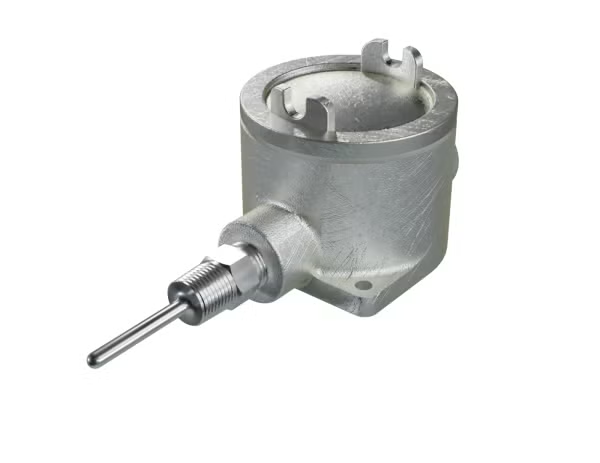
Carcasa para zonas peligrosas para RTD de platino
- Atmósferas Peligrosas
- Aplicaciones Industriales de Sensores
- Sistemas de Agua Refrigerada
- Sistemas de Agua Caliente
- Calderas
- Bombas
- Compresores
- Enfriadoras
- Sistemas de Escape
RTD-Hazardous
Desde


Resumen del Producto
- Exactitud +/- 0,06 % Clase A
- Detalle de Exactitud (Fórmula de tolerancia: +/- ºC = (0,15ºC + (0,002 *
- Materiales de aleación (-) Cobre
- Materiales de aleación (+) Cobre
- Homologaciones DIN EN 60751 (IEC 751)
- Conexión eléctrica Cables flexibles
- Nota sobre el alojamiento Centro de recinto
- Accesorio Acero inoxidable 304
- Aislamiento PTFE
- Número de puntos de detección 1
- Corriente de operación 5 mA
- Humedad de funcionamiento 10 a 95 % HR, sin condensación
- Temperatura de operación, máx. 200 °C
- Temperatura de operación mínima -40 °C
- Diámetro de la sonda 0.25 in
- Tamaño de la conexión al proceso 1/2 pulgada
- Tipo de conexión al proceso NPT macho
- Tiempo de respuesta 8 segundos nominales
- Efecto de autocalentamiento 7 mW / °C
- ID de serie RTD-Hazardous
- Material de la funda Acero inoxidable 304
- Estabilidad +/- 0,03 % después de 1000 horas a 300 °C (572 °F)
- Temperatura de almacenamiento, máx. 85 °C
- Temperatura de almacenamiento, mínima -40 °C
- Coeficiente de temperatura DIN EN 60751 (IEC 751)
- Rango de medición de temperatura -40 a 200 °C
- Nota sobre el pozo termométrico Material del termopozo
- Calibre del cable 22 AWG
Supported Applications
The ACI Platinum RTD Hazardous Housing series provides single-point temperature sensing for commercial and industrial heating and cooling building management systems. Designed specifically for hazardous atmospheres, these sensors are engineered for use in environments requiring explosion-proof or dust-ignition proof protection. Documented applications include process control, exhaust systems, and general industrial sensor applications where Class I, II, and III hazardous location ratings are required.
Operating Conditions & Performance
The series utilizes Platinum RTD sensors with a measurement range of -40 to 200°C (-40 to 392°F). Sensor accuracy is specified as Class A (±/− 0.06%), defined by the tolerance formula: ±/− °C = (0.15 °C + (0.002 * |t|)), where |t| is the absolute value of temperature above or below 0°C in °C. Specific accuracy points include ±/− 0.23°C (±/− 0.414°F) at -40°C (-40°F), ±/− 0.15°C (±/− 0.27°F) at 0°C (32°F), and ±/− 0.55°C (±/− 1.00°F) at 200°C (392°F). The sensors exhibit a nominal response time of 8 seconds for a 63% step change.
Enclosures are rated for an ambient operating temperature range of -50 to 60°C (-58 to 140°F) and storage temperatures from -40 to 85 °C (-40 to 185 °F). The series supports humidity levels of 10 to 95% RH, non-condensing. Electrical connections utilize 22 AWG Etched Teflon colored lead wires with silver-plated copper conductors.
Hazardous Location Ratings
The connection heads meet the following enclosure ratings:
- Explosion Proof: CL. I, Div. 1 & 2, Groups A, B, C, D
- Dust-Ignition Proof: CL. II, Div. 1, Groups E, F, G
- Raintight: CL. II, Div. 2, Groups F, G
- Wet Locations: CL. III
Certifications include UL 1203 and CSA C22.2 No. 30. The enclosures carry NEMA ratings of 3, 4, 7ABCD, and 9EFG.
Configuration Options
The series is available in three primary configurations: Room (Wall Mounted), Duct, and Immersion. Each configuration supports specific process connections, insertion lengths, and housing materials to accommodate diverse installation requirements while maintaining hazardous location compliance.
Sensor Elements & Outputs
- Model Series: A/100 (100 Ω nominal) or A/1K (1 KΩ nominal).
- Wire Configuration: Two-wire (non-polarity sensitive) or three-wire (polarity sensitive).
- Sensor Curve: PTC (Positive Temperature Coefficient), DIN EN 60751 (IEC 751), with a temperature coefficient of 3850 ppm / °C.
Housing & Process Connections
- Room Configuration (-R): Features a Copper-Free Aluminum enclosure. Includes two ½" NPT female hubs for conduit connections.
- Duct Configuration (-D): Utilizes a Feraloy® Iron Alloy connection head with probe lengths of 4", 8", 12", or 18". The process thread is ½" NPT (National Pipe Tapered).
- Immersion Configuration:
- -I: Includes a welded thermowell made of 304 Stainless Steel with insertion lengths of 2.5", 4", or 6".
- -INW: Immersion without a welded thermowell, designed for use in existing thermowells (bore diameter 0.260").
- Probe Material: 304 Stainless Steel with a probe diameter of 0.250" (6.35mm).
Options & Accessories
- NIST Certificate available for calibration verification.
- Thermowells are offered separately for higher flow rates, temperatures, pressure ratings, or corrosion resistance requirements.
- Lead wire lengths of 14" (35.6 cm) or 24" (61 cm).
Key Product Differences
The series distinguishes between Room, Duct, and Immersion models based on the enclosure material and probe geometry. The "-R" configuration uses a Copper-Free Aluminum housing optimized for wall mounting in rooms. In contrast, "-D" (Duct) and "-I/-INW" (Immersion) configurations utilize Feraloy® Iron Alloy connection heads to withstand duct or process line conditions.
Within the Immersion category, the "-I" variant includes a factory-welded 304 Stainless Steel thermowell with specific insertion lengths (2.5", 4", 6"). The "-INW" variant omits the welded well, allowing installation into existing field-installed thermowells that meet the specified bore diameter of 0.260" and thread requirements.
Model numbers further differentiate between sensor resistance (100 Ω vs. 1 KΩ) and wiring configuration (Two-Wire vs. Three-Wire). The "EXPL" suffix denotes the hazardous location rating inherent to this series, while an optional "NIST" designation indicates a three-point NIST certificate is included.
PDFs y Manuales