


 Pneumatic pick-and-place robots are a cornerstone of industrial automation, essential for high-speed, the precision handling of components, packaging, and assembly line efficiency. Relying on these machines to handle repetitive tasks ensures consistent high-accuracy and improves production – all while reducing labor costs. However, the efficiency and reliability of these robots depends on proper object detection, secure gripping, and precise placement.
Sensors ensure that robots can detect objects, adjust their grip accordingly, and verify successful placement. This capability is particularly important in applications where components vary in size, shape, or fragility, requiring real-time adjustments to avoid damage or misplacement. Without precise sensing, pneumatic pick-and-place robots would struggle with inconsistent object handling, leading to dropped parts, misalignment, and production errors.
Three key sensor types essential for optimizing pneumatic pick-and-place applications:
- Vacuum and Pressure Sensors - Monitor suction levels in vacuum grippers to confirm a secure hold on objects and detect potential leaks or pressure fluctuations.
- Force and Torque Sensors - Measure the force applied by robotic grippers, preventing excessive pressure that could damage fragile parts while ensuring a firm grip.
- Laser and Ultrasonic Sensors - Enable accurate distance measurement, object detection, and alignment, allowing robots to position components with precision.
By integrating these sensing technologies, robotic systems can operate with greater efficiency, reliability, and adaptability across a wide range of industrial applications.
Vacuum and Pressure Sensors: Ensuring Reliable Gripping
Vacuum grippers are widely used for handling objects quickly and efficiently. However, their success hinges on maintaining the right level of suction throughout the handling process. If vacuum pressure fluctuates due to air leaks, surface inconsistencies, or system inefficiencies, parts can be dropped, leading to product damage, operational downtime, and costly waste.
Vacuum and pressure sensors are essential for continuously monitoring and adjusting suction levels in real-time. These sensors detect leaks, verify that the gripper is holding the object securely, and provide feedback to ensure consistent and stable operation. Without them, a robotic system would operate blindly, unable to confirm whether an object is securely held until a failure occurs.
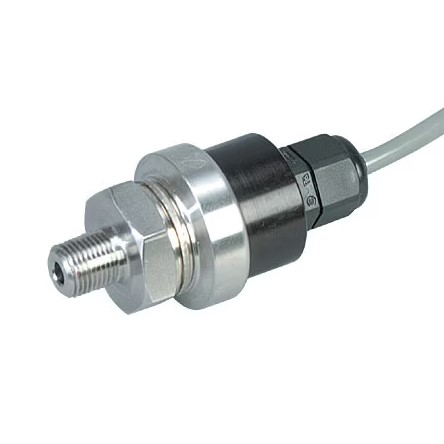
Key Sensor: PX480A Series Pressure Transducers
PX480A Series vacuum and absolute pressure transducers deliver highly accurate, real-time monitoring of suction levels in vacuum-based gripping systems. Utilizing micro-machined silicon sensing technology, they offer precision with ±0.3% full-scale accuracy and rapid response times to detect even minor pressure changes.
✔ Prevents Dropped Objects - Detects fluctuations in vacuum pressure, alerting the system before failure occurs.
✔ Optimizes Gripping Performance - Maintains proper suction levels for consistent handling of objects.
✔ Reduces Downtime - Identifies vacuum leaks early, preventing system malfunctions.
With 316L stainless steel wetted parts and IP65-rated protection, these sensors are built for durability in demanding industrial environments, making them an excellent choice for pick-and-place applications.
Force and Torque Sensors: Protecting Components and Ensuring Precision
Unlike vacuum grippers, mechanical grippers rely on physical force to hold and manipulate objects. While this method provides versatility in handling different materials, it introduces a critical challenge: applying the right amount of force. Too much pressure can crush, deform, or scratch fragile components, while too little force results in dropped parts.
Force and torque sensors provide the necessary feedback to ensure that a robotic gripper applies the optimal amount of pressure for each object. These sensors allow robotic systems to dynamically adjust their grip – accommodating variations in size, shape, and material without manual recalibration – and ensure that forces remain within safe and effective limits.
Discover DwyerOmega's Selection of Torque Sensors
Rotary Torque Sensors
Ideal for applications where parts rotate during handling or assembly. These sensors measure torque applied to rotating shafts and are useful in monitoring motors or grippers with rotational motion.
Reaction Torque Sensors
Designed to measure static or dynamic torque without requiring rotating components. These sensors are ideal for evaluating the gripping force applied by a stationary mechanical gripper.
Digital Torque Gauges
Portable and versatile, these handheld devices are used to verify torque levels during setup or maintenance and to spot-check robotic grippers or tools to ensure compliance with specified force thresholds.
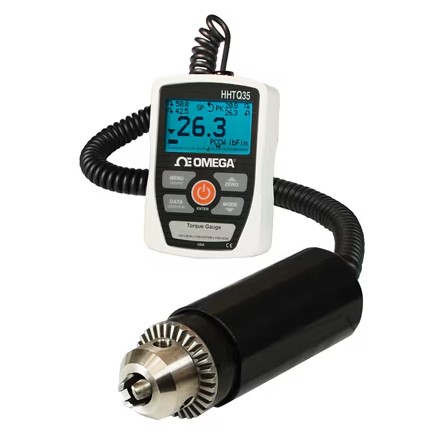
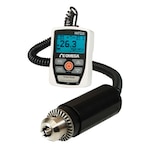
Key Sensor: HHTQ35 Series Digital Torque Gauge
The HHTQ35 Series is a highly practical solution for real-time force verification in robotic applications. This digital torque gauge supports both clockwise and counterclockwise measurements, making it valuable during both setup and quality assurance procedures.
With a clear digital display and intuitive interface, it allows operators and engineers to:
✔ Calibrate robotic grippers and tools with precise torque control
✔ Verify applied force during routine checks or after tool changes
✔ Ensure force compliance across multiple stations in automated lines
The HHTQ35 is available in multiple torque ranges and units, offering flexibility for various use cases. Its portability and ease of integration make it an ideal choice for improving robotic reliability where precision gripping or controlled torque is critical.
Laser and Ultrasonic Sensors: Enhancing Object Detection and Positioning
For a pick-and-place robot to function efficiently, it must accurately detect, locate, and align objects before gripping them. If an object is slightly misaligned, a traditional robotic system without sensing feedback might miss the pickup entirely, leading to costly inefficiencies.
Laser and ultrasonic sensors solve this problem by providing precise, real-time distance and position measurements. These sensors ensure that an object is properly located before the robot engages, helping prevent misgrips, misplacements, and unnecessary system corrections. Additionally, they assist in quality control by verifying that objects have been placed correctly after handling.
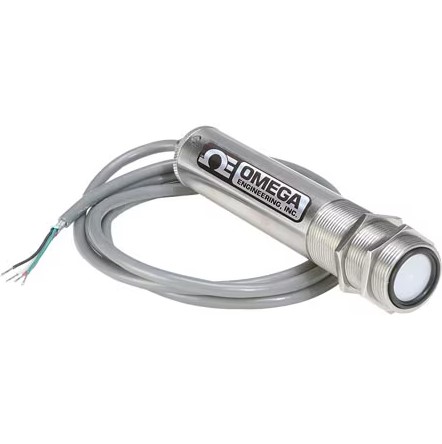
Key Sensor: OS130A-Series Infrared Sensors
DwyerOmega’s OS130A-Series infrared sensors offer high-precision, non-contact object detection in industrial environments. Featuring a compact 316 stainless steel design, these sensors are built to withstand harsh conditions while providing accurate measurements for robotic positioning.
✔ Ensures Accurate Object Pickup – Detects and confirms object position before engagement.
✔ Increases Efficiency – Reduces unnecessary movements by verifying position before actuation.
✔ Works in Harsh Environments – Non-contact operation avoids interference from dust, dirt, and debris.
For applications requiring long-range sensing or highly precise alignment, additional laser-based or ultrasonic sensors can complement infrared sensors to enhance robotic accuracy.
Contact a DwyerOmege Expert Today!
DwyerOmega | Blog | What is a Pressure Gauge?
Written by: Dan Schultz
Updated on: October 30, 2025

DwyerOmega | Blog | What is an Intrinsically Safe Product?
Written by: Dan Schultz
Updated on: March 30, 2026