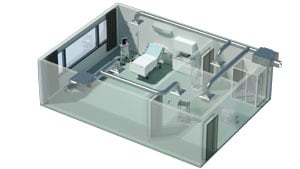
Controlled environments rely on precise airflow management to protect people, processes, and products. Maintaining the correct pressure relationship between adjacent spaces is a core requirement in many applications, including hospital isolation rooms and manufacturing cleanrooms. Differential pressure transmitters and room status monitors are used to measure, verify, and communicate these conditions. While both device types support differential pressure control, they differ, depending on the application, in how they are applied.
Understanding Differential Pressure in Controlled Spaces
Differential pressure is the difference between two measured pressures, typically between adjacent rooms. In controlled environments, maintaining a defined pressure relationship ensures that air flows in a predictable direction. Air moves from higher pressure to lower pressure; maintaining that helps prevent contaminants from entering or leaving a space.
This principle is central to applications such as isolation rooms and cleanrooms. A positive-pressure room prevents external contaminants like dust or particulates from entering. A negative-pressure room contains contaminants within the space, preventing them from escaping into the surrounding areas.
Because these pressure relationships are critical, they must be continuously measured and verified using dedicated monitoring devices.
What Are Differential Pressure Transmitters?
Differential pressure transmitters are electromechanical devices used to measure pressure with high accuracy. In controlled environments, they are configured to measure the difference in pressure between two spaces, such as a cleanroom and an adjacent corridor or an isolation room and its anteroom.
These devices detect the pressure of air or gas on each side of a sensing element and convert that difference into a usable output signal, typically an electrical signal such as voltage or current. This output can then be monitored, displayed, or processed by building automation systems (BAS) and other control devices.
At a minimum, differential pressure transmitters provide:
- Continuous differential pressure measurement
- Electrical output signals for monitoring and control
- Integration with HVAC and building control systems
- Analog outputs (such as 4–20 mA or 0–5 V)
- Digital communication via BACnet or Modbus
- Compatibility with building automation systems (BAS)
What Are Room Status Monitors?
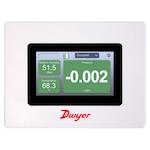
Room status monitors expand on the functionality of pressure-only devices. In addition to measuring differential pressure, they monitor and display multiple environmental parameters within a space.
Depending on configuration, a room status monitor may track:
- Differential pressure (often across multiple rooms)
- Temperature
- Relative humidity
- Air changes per hour (ACH)
- Airflow or ventilation status
- Door position or open duration
Because they can aggregate several inputs, room status monitors are often used where broader environmental verification is required rather than pressure alone.
Evolution from Gauges to Integrated Monitoring
Historically, differential pressure was verified using manometers or mechanical gauges. In some cases, airflow direction was used as a proxy for pressure relationships, since air naturally moves from high to low pressure.
As building automation systems became more sophisticated, monitoring requirements shifted. Facilities increasingly required:
- Continuous electronic measurement
- Remote visibility
- Automated alarms
- Integration with HVAC control systems
Where Room Monitors Are Used
Differential pressure transmitters and room status monitors are used in environments where contamination control or environmental stability is required.
Common applications include:
- Hospital isolation rooms (Airborne Infection Isolation Rooms or AIIRs)
- Pharmaceutical manufacturing and compounding areas
- Semiconductor fabrication facilities
- Cleanrooms across multiple industries
- Research laboratories
Grippers Introduction to Grippers