Landfill gas (LFG) emissions from municipal solid waste (MSW) landfills play a significant role in discussions around climate impact and public safety. MSW landfills are the third‑largest source of human‑related methane emissions in the United States, accounting for approximately 14.4 % of these emissions in 2022.1
As organic waste decomposes within a landfill, it generates landfill gas composed of several different gases and volatile organic compounds (VOCs), with methane and carbon dioxide making up over 90 % of them. If not properly managed, LFG can migrate beyond the landfill boundary and enter nearby structures through foundation cracks, utility penetrations, or ventilation pathways. Because landfill gas contains both climate‑active components and flammable constituents, controlling its generation, movement, and concentration is critical for mitigating environmental impact as well as protecting operational and community safety.
How is Landfill Gas Managed?
Landfill gas management is achieved through a coordinated set of engineering controls designed to manage its movement and reduce the risks associated with uncontrolled release. These systems are typically implemented as part of normal landfill operations and evolve over the life of the site.
Pressure and Vacuum Measurement
Gas in a landfill does not move randomly. It moves in response to pressure gradients, flowing from areas of higher pressure to areas of lower pressure through whatever pathways are available. In a landfill gas system, those pathways include waste pores, collection piping, well screens, and any imperfections in the cover system.
Because gas movement is governed by these pressure gradients, understanding what the pressure is doing at specific points in the system becomes essential. Pressure measurements provide direct visibility into how effectively the gas collection system is influencing subsurface conditions, revealing whether gas is being drawn consistently toward engineered pathways or allowed to migrate elsewhere.
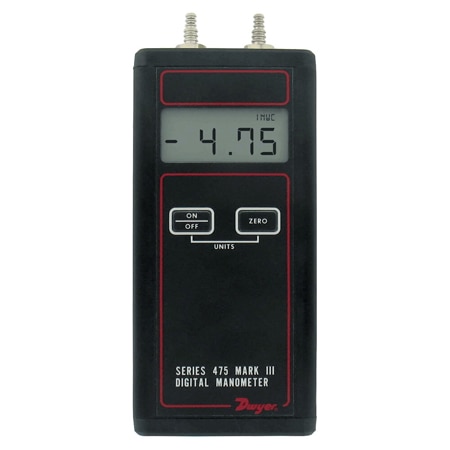
- Manometers are commonly used at individual wells to measure local vacuum in inches of water column. Their simplicity makes them reliable during field tuning
- Pressure transducers provide continuous measurements at headers, blower inlets, and system control points. Their electrical outputs feed alarms and trend analysis tools
Flow Measurement and Management
While pressure measurements indicate how driving forces are distributed throughout the landfill, flow measurements show how the system actually responds. Flow represents the cumulative result of applied vacuum, waste permeability, well construction, and piping resistance. In this way, flow provides a clear, system-level view of whether gas is being collected evenly, efficiently, and under controlled conditions.
Methane-rich landfill gas is continuously generated, and although its production cannot be controlled directly, its movement can be guided. Under the low-pressure and highly variable conditions typical of municipal solid waste landfills, operators rely on flow data to confirm that pressure gradients are producing the intended results—drawing gas toward collection wells rather than surface defects, maintaining operation under negative pressure, and limiting extraction rates that could encourage oxygen intrusion or subsurface heating.
- Orifice plates and pitot tubes are commonly installed in header piping to estimate gas flow using differential pressure. These devices are well suited for large-diameter pipes and provide a practical means of tracking overall system throughput.
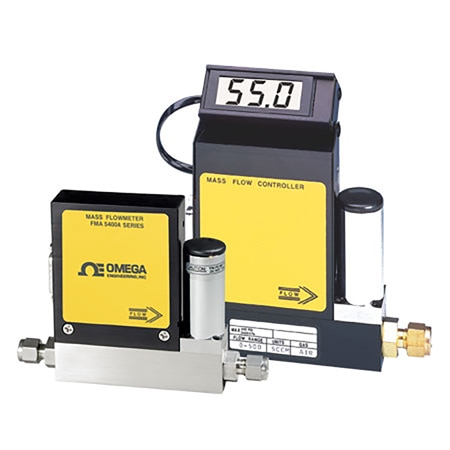
- Thermal mass flow meters are often used at individual wells or smaller headers where low and variable flow rates are expected. Because they measure mass flow directly, they are less sensitive to changes in pressure and gas composition.
Innovative Solutions from DwyerOmega
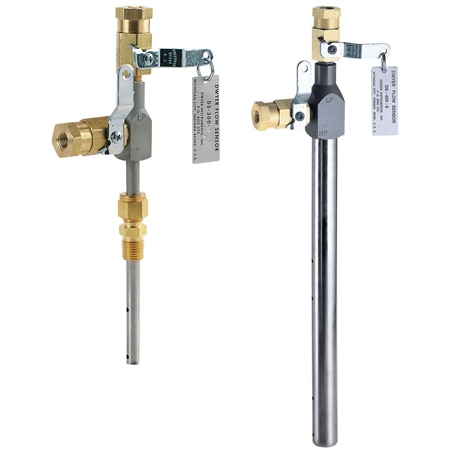
Series DS In‑Line Flow Sensors apply a well‑established averaging Pitot tube approach to gas and liquid flow measurement in schedule 40 pipe from 1 to 10 inches. This design enables repeatable flow rate sensing when paired with an appropriately ranged differential pressure gage, making it a practical option where straightforward installation and dependable measurement are required.
The DS‑300 and DS‑400 variants address different installation needs. The DS‑300 is intended for direct insertion through a compression fitting and supports smaller pipe diameters, while the DS‑400 accommodates longer insertion lengths and threaded branch connections. Both series are compatible with standard Capsuhelic® gage kits and are suited for a range of industrial media, including combustion air, steam, cooling water, oil, and process gases. In landfill environments, these sensors can be used to monitor methane‑rich gas streams, supporting control strategies that reduce the risk of methane migration and worker exposure.
Suggested Pairings For Series DS In-Line Flow Sensors
| Product | Description | Buy Now |
|---|---|---|
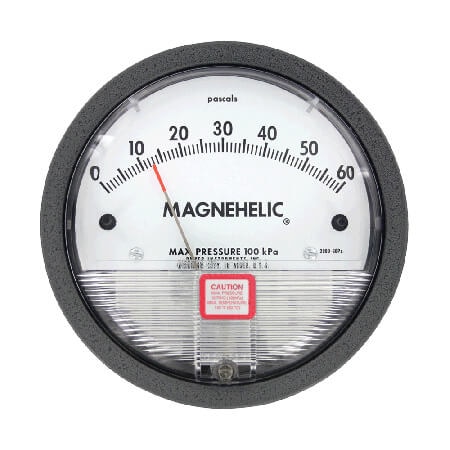
| Series 2000 Magnehelic® Gage | The Series 2000 Magnehelic® gage provides reliable measurement of low differential air and non‑corrosive gas pressures without requiring external power. Its rugged, IP67‑rated housing and clear analog display make it suitable for HVAC, filter monitoring, and general process applications where straightforward, maintenance‑free indication is needed. |
|
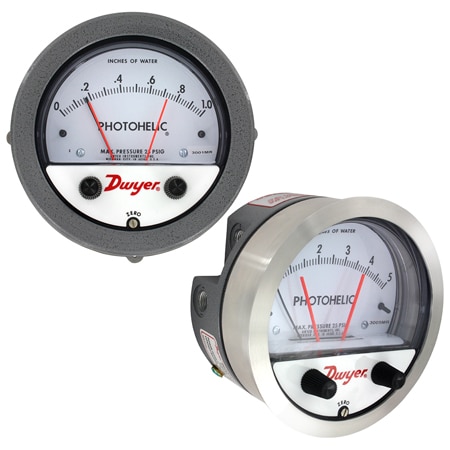
| Series 3000MR Photohelic® Switch/Gage | Series 3000MR / 3000MRS Photohelic® Switch/Gages combine accurate differential pressure indication with adjustable high and low limit switching in a single compact instrument. The gage provides continuous, mechanical pressure indication independent of switch operation or power availability, while the solid‑state design supports reliable control in high‑cycle applications. |
|
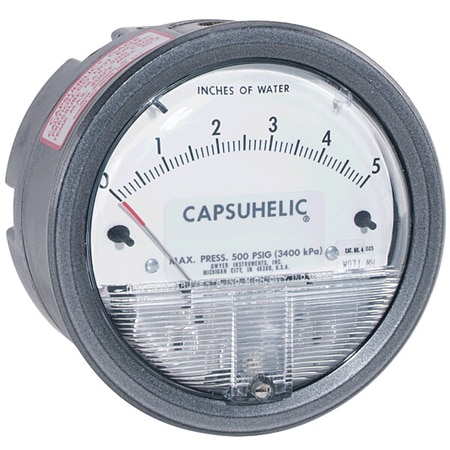
| Series 4000 Capsuhelic® Gage | The Series 4000 Capsuhelic® Differential Pressure Gage provides fast, accurate indication of low differential pressures while withstanding system pressures up to 500 psig. Its capsule‑based design allows precise measurement of small differentials in high‑pressure gas or liquid systems, making it well suited for flow measurement, filter monitoring, and vacuum or differential pressure applications. |
|
1 U.S. Environmental Protection Agency (EPA), Basic Information about Landfill Gas, https://www.epa.gov/lmop/basic-information-about-landfill-gas
Grippers Introduction to Grippers