
Concrete is everywhere, forming the foundation of buildings, roadways, sidewalks, parking structures, and countless other surfaces we rely on every day. Despite how common it is, the basic science behind concrete mixing is often overlooked.
Concrete is made from just a few core components:
- Sand and/or aggregate
- Cement, produced from limestone and clay that are crushed and processed into a fine powder
- Water
Water activates the cement through hydration, allowing the mixture to bind and harden properly. Too little water makes the mix stiff, difficult to work with, and prone to voids and surface cracking. Inadequate hydration can also prevent cement particles from fully reacting, resulting in reduced long-term strength.
Too much water creates the opposite problem. Excess water weakens the final structure by increasing porosity as the concrete cures. This can lead to bleeding, microcracks, surface scaling, and premature failure under load. Even small variations in water content can significantly affect compressive strength, durability, and finish quality.
Well-mixed concrete typically has a consistency similar to thick oatmeal. This balance allows the material to be workable during placement while still curing into a dense, strong structure once set. Maintaining that balance consistently is one of the biggest challenges in real-world concrete production.
Using Flow Meters to Control Water Ratio on Concrete Mixer Trucks
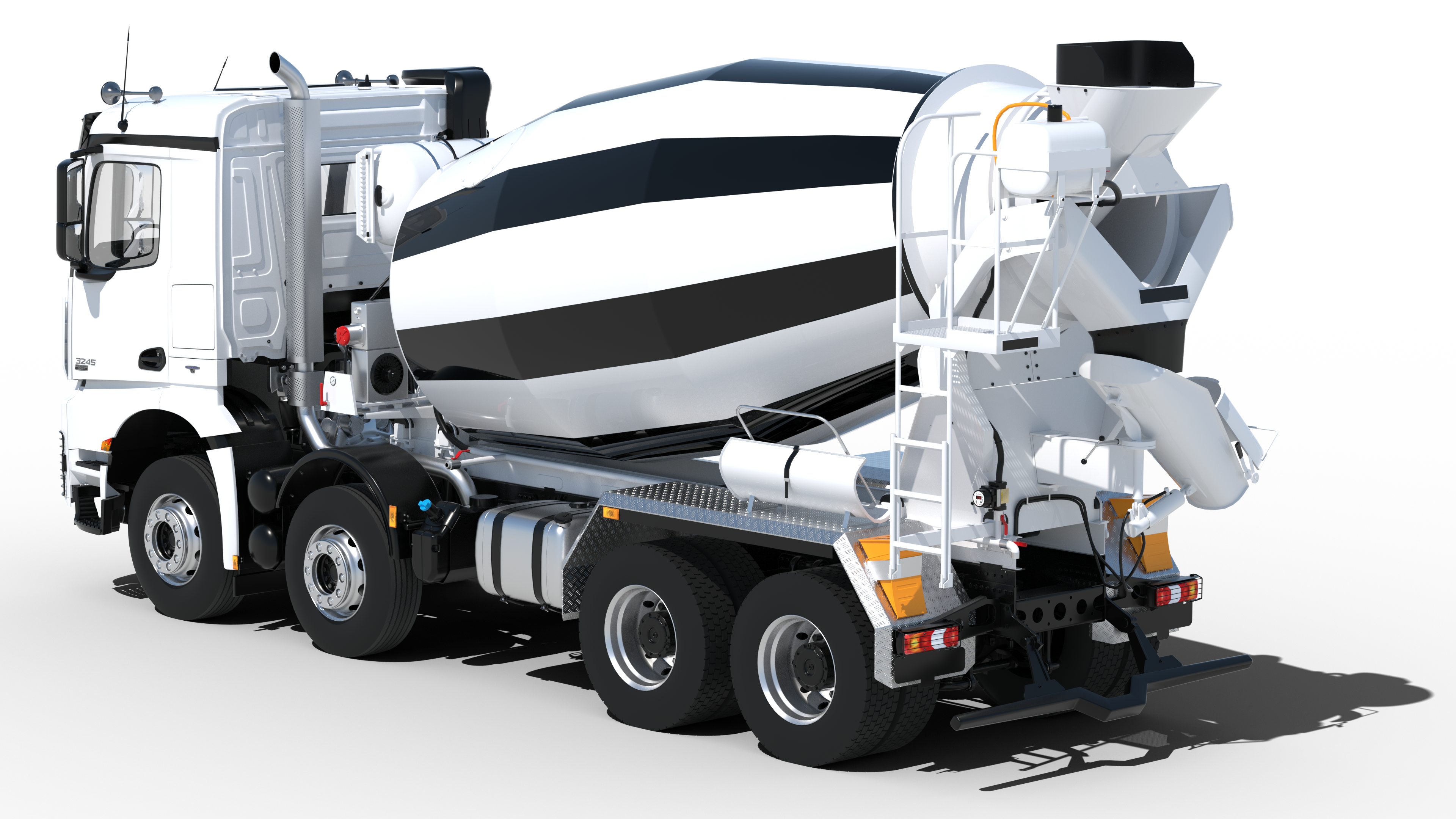
In many applications, concrete is mixed or adjusted directly on the job site using ready-mix trucks. While this offers flexibility, it also introduces variability. Water may be added at different times based on environmental conditions, travel time, or workability needs. Without accurate measurement, it becomes difficult to verify that the correct water-to-cement ratio is maintained.
Installing flow meters on concrete mixer trucks provides an automated way to monitor and control water addition during on-site mixing. Instead of relying on manual estimation or visual judgment, flow measurement allows operators to precisely track how much water is introduced into the drum.
With a flow meter in place, each batch can be mixed to specification regardless of operator, location, or job conditions. The system can log total water usage, support quality documentation, and help ensure compliance with mix design requirements. This level of control reduces variability between loads and helps prevent common issues such as strength loss, rework, or rejected pours.
From a process perspective, accurate water measurement improves repeatability, reduces material waste, and supports consistent concrete performance. As construction projects increasingly emphasize quality assurance and traceability, flow measurement on mixer trucks has become a practical tool for maintaining mix integrity from plant to pour.
Innovative Solutions from DwyerOmega
Series CP/CN/CT/CX Coolpoint® Vortex Shedding Flow Meter
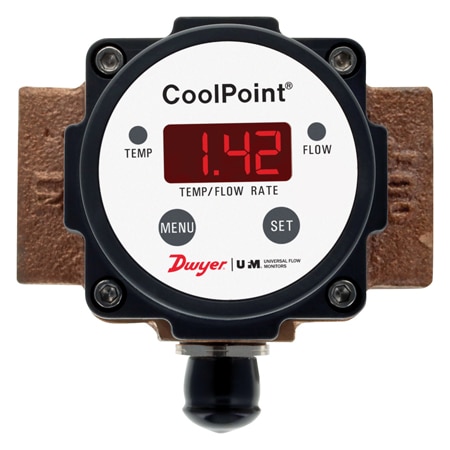
Series CP/CN/CT/CX CoolPoint® Vortex Shedding Flow Meters are designed for reliable flow measurement of water, water glycol mixtures, and other low viscosity fluids in demanding industrial applications. Using a vortex shedding measurement principle, these meters contain no moving parts to clog or wear, resulting in low maintenance requirements and long-term measurement stability.
This series is available in both 3-wire and 2-wire configurations to support a wide range of installation and control system requirements. The 3-wire version uses a separate power supply from the 4–20 mA output and includes a bright LED display with menu-driven buttons for easy setup and operation. Users can select Flow units such as GPM or LPM directly from the display, simplifying commissioning and on-site adjustments.
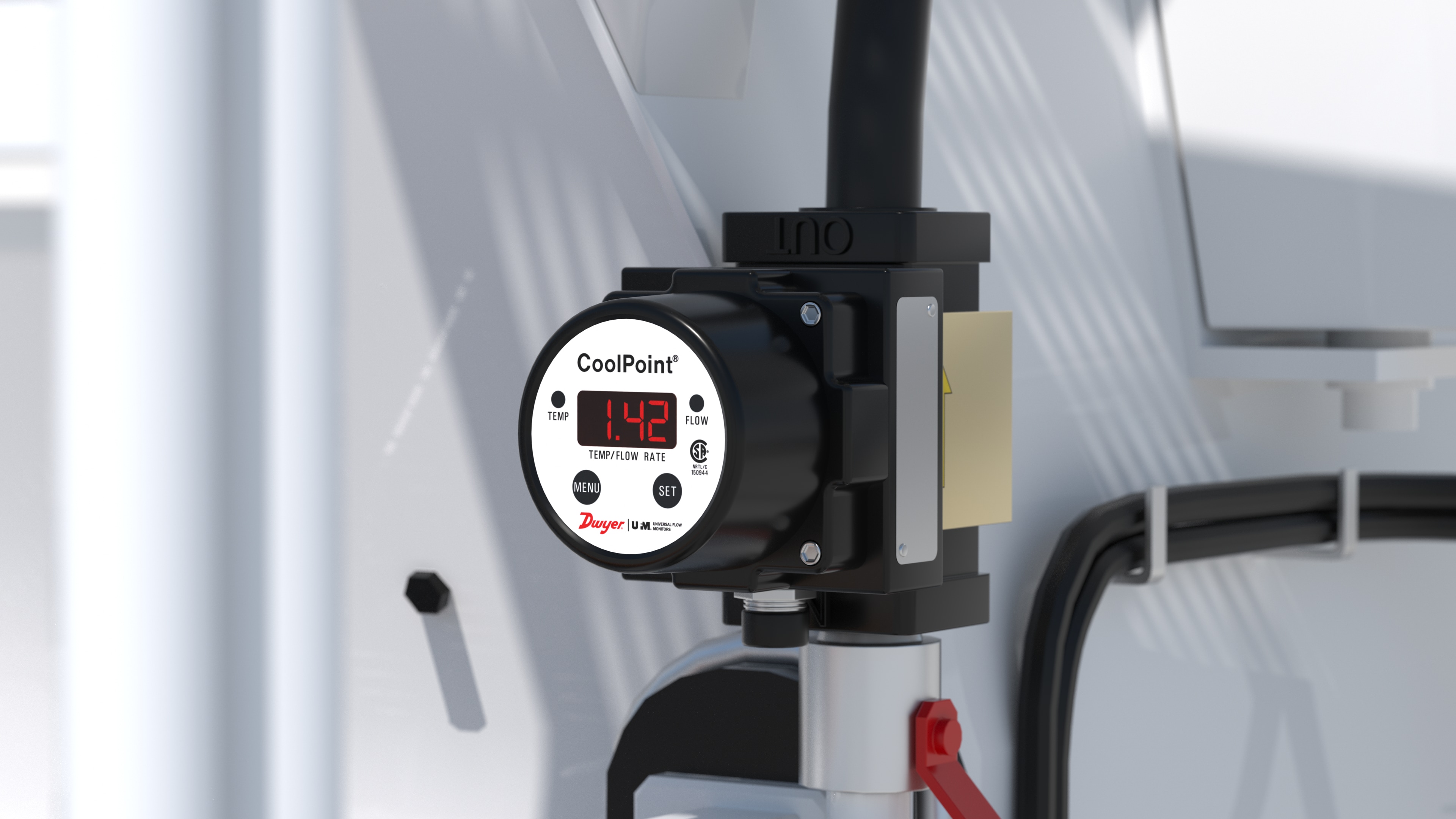
Series CP/CN/CT/CX CoolPoint® Vortex Shedding Flow Meters can be configured to the Series CX Metal Vortex Shedding Flow Meter for Concrete Trucks (available in two process connection types: NPT Male and Barbed Fitting). This flow meter is ideal for measuring total water add for concrete mixing.
Grippers Introduction to Grippers