
Center pivot irrigation systems are a widely used method for distributing water across large agricultural fields. As the name suggests, the system rotates around a central pivot point, applying water through a series of sprinklers mounted along the span. When properly designed and operated, center pivot systems provide relatively uniform water application while reducing labor requirements compared to flood or manual irrigation methods.
To ensure consistent performance throughout the growing season, farmers must monitor key operating parameters. Pressure and flow transmitters play a critical role in verifying that the irrigation system is operating within its intended range and responding quickly when conditions change.
Pressure Monitoring in Center Pivot Systems
Pressure transmitters are commonly used to monitor line pressure along the irrigation system. Maintaining pressure within a specified range is important for both water distribution and operating cost control. If pressure is too low, water may not travel effectively to the far end of the pivot, leading to uneven application and potential crop stress. Excessive pressure, while capable of maintaining spray performance, increases energy consumption and accelerates wear on pumps, pipes, and sprinkler components.
As noted by the University of Nebraska–Lincoln CropWatch program, insufficient pressure can reduce application uniformity, while excessive pressure raises energy costs without delivering proportional agronomic benefits. Continuous pressure measurement allows operators to confirm that pumps, regulators, and pressure-reducing valves are functioning as intended.
Pressure transmitters can also help identify developing issues such as leaks, clogged nozzles, or pressure fluctuations caused by elevation changes across the field. Early detection allows farmers to correct problems before they result in uneven irrigation or lost yield, particularly during critical growth stages.
Series 626 and 628 Industrial Pressure Transmitters
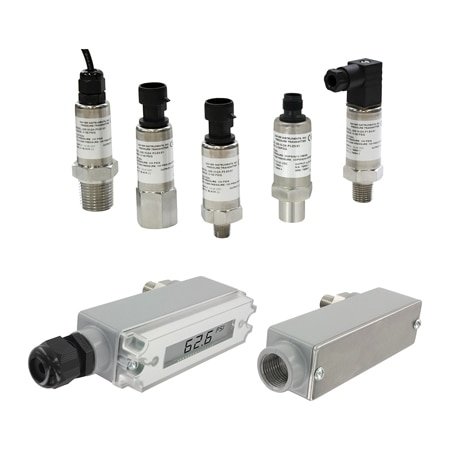
For center pivot irrigation systems, Series 626 and 628 Accurate Industrial Pressure Transmitters are well suited to line‑pressure monitoring in field conditions. These compact transmitters are designed for harsh environments and offer rugged construction with resistance to shock and vibration, which is important for equipment mounted on moving pivots. Their design also addresses common electrical challenges in agricultural settings, including exposure to electrostatic discharge and transient surges that can occur during nearby lightning events. By providing stable, continuous pressure feedback under these conditions, the Series 626 and 628 transmitters support reliable monitoring of pump performance and distribution pressure across the pivot, helping operators maintain target pressure ranges without excessive maintenance or downtime.
Flow Measurement for System Performance Verification
Flow transmitters are used to measure fluid velocity and volumetric flow within a center pivot irrigation system. In a pivot configuration, water moves through a radial pipeline extending down the length of the field. While all sprinklers are supplied by the same main line, they do not operate at the same flow rate. Sprinklers located near the pivot point irrigate a relatively small surface area and therefore require lower flow, while sprinklers near the end of the pivot cover significantly larger areas and operate at higher flow rates.
Monitoring system flow helps verify that the hydraulic design is being maintained in operation. Deviations from expected flow profiles may indicate issues such as partially blocked lines, malfunctioning regulators, or pump performance degradation that may not be obvious from pressure measurement alone.
When used alongside pressure transmitters, flow measurement provides additional diagnostic context. Stable pressure with reduced flow can suggest localized restrictions, whereas concurrent reductions in pressure and flow may point to upstream supply limitations. Flow data also supports water use tracking, allowing growers to correlate applied water volume with crop requirements and seasonal planning goals.
Level Measurement at the Water Source
Level transmitters can be installed at the reservoir, pond, or pump station supplying water to the center pivot system. Monitoring source water level helps confirm adequate availability throughout the irrigation cycle and provides early indication of drawdown conditions that could affect system performance during peak demand.
Level measurement is particularly valuable in systems relying on surface water storage, where declining supply can impact pump operation or introduce air entrainment risks. When combined with pressure and flow data, level measurement adds context to system behavior and supports more informed irrigation scheduling decisions.
Grippers Introduction to Grippers