Tracking how much energy an HVAC system consumes is essential for improving overall energy efficiency. In hydronic systems, thermal energy measurement provides the data needed to evaluate performance and identify opportunities for optimization. Several approaches are available, depending on system design, accuracy requirements, and budget.
Core Components of Thermal Energy Measurement
Measuring thermal energy in a hydronic system requires three primary components:
- A fluid flow sensor
- Two temperature sensors (one at the inlet and one at the outlet)
- A calculator
Although it is technically possible to perform this calculation manually, the process is complex and prone to error. For this reason, incorporating a calculator—either as a standalone BTU controller, part of a building management system (BMS), or integrated into a complete system—is recommended for reliable results.
Building a Custom System with Separate Components
One approach to thermal energy measurement is to build a system using individual components. This method is often the most cost-effective and allows for flexibility in system design.
In this configuration, the flow sensor, temperature sensors, and calculator are selected and installed separately. For example:
- A BTU controller
- Two temperature sensors
To reduce system complexity, it is also possible to limit the system to two primary components. For example:
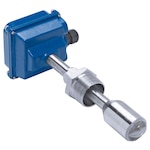
- A BTU controller can be paired with a thermal dispersion transmitter
While building a system from separate components offers flexibility and lower upfront cost, it requires careful integration to ensure compatibility and maintain measurement accuracy.
Complete Thermal Energy Measurement Systems
In contrast to custom-built systems, complete thermal energy systems integrate the flow sensor, temperature measurement, and calculation into a single, calibrated solution. These systems simplify installation and reduce the risk of mismatch between components.
Two common types of complete systems are ultrasonic and electromagnetic heat meters.
Ultrasonic Flow Meters
Ultrasonic flow meters used for thermal energy measurement are complete systems that include flow sensing, temperature inputs, and energy calculation.
These devices measure flow rate by transmitting ultrasonic pulses through the fluid. Sensors embedded within the meter body send and receive signals across the flow path. As fluid velocity changes, the transit time of the ultrasonic signal changes, allowing the meter to determine flow rate.
The system then:
- Measures supply and return temperatures
- Calculates the temperature differential
- Combines flow and temperature data to determine energy transfer
Electromagnetic Heat Meters
Electromagnetic heat meters are also complete systems that integrate flow measurement, temperature sensing, and energy calculation.
These meters operate by generating a magnetic field within the flow path. As a conductive fluid passes through the field, it induces a voltage proportional to flow velocity. Electrodes measure this voltage and convert it into a flow rate.
The system calculates energy using:
- Measured flow rate
- Temperature differential
Grippers Introduction to Grippers