
Relative humidity is often overlooked compared to temperature. When a room is too hot or too cold, the response is immediate. Adjust the thermostat, turn on a fan, or add heat. Humidity is different. It is less visible, harder to sense directly, and often addressed only after it causes a problem.
That does not make it less important. Relative humidity plays a measurable role in indoor air quality, process stability, and product integrity across a wide range of applications. Monitoring it allows operators to maintain controlled conditions rather than reacting to issues after they appear.
1. Monitor Production Conditions
Humidity can directly influence manufacturing outcomes. In pharmaceutical environments, excess moisture can accelerate chemical degradation and reduce product stability. Consistent humidity control helps maintain expected shelf life and product efficacy.
Other industries face similar risks. In electronics manufacturing, for example, uncontrolled humidity can increase the likelihood of corrosion or condensation, while overly dry conditions can contribute to electrostatic discharge. Measuring relative humidity provides the data needed to keep production within defined tolerances.
2. Preserve Stored Product Quality
The need for humidity control does not end when production is complete. Storage environments introduce their own risks, especially for materials sensitive to moisture.

Products such as food and beverage goods, pharmaceuticals, and electrical components can degrade when exposed to elevated humidity levels over time. Moisture can promote spoilage, alter physical properties, or compromise packaging. Monitoring relative humidity in warehouses and storage facilities helps ensure that conditions remain within acceptable limits throughout the product lifecycle.
3. Maintain Occupant Comfort and System Performance
Humidity also affects occupied spaces. Relative humidity influences how people perceive temperature, which means it contributes to overall comfort in residential, commercial, and institutional environments.
Maintaining relative humidity within a moderate range can support occupant well-being and reduce complaints about air quality. It can also improve HVAC efficiency. Systems that operate within balanced humidity conditions typically require less adjustment to maintain comfortable temperatures, which can support more stable energy use.
4. Reduce Risk of Mold and Airborne Pathogens
Relative humidity outside of recommended ranges can increase health and safety risks. When humidity rises above approximately 60 percent, conditions become more favorable for mold growth. Mold remediation can be costly and disruptive once contamination spreads.
At the other end of the range, very low humidity can contribute to increased persistence or transmission of some airborne viruses. While humidity alone does not determine infection risk, maintaining levels within a moderate range is one component of a broader indoor air quality strategy.
Innovative Solutions from DwyerOmega
Series RHP Humidity & Temperature Transmitters
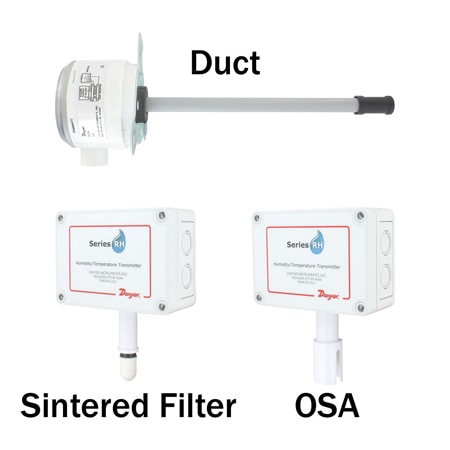
Series RHP Humidity & Temperature Transmitters combine relative humidity and temperature measurement in a single device, helping reduce installation complexity and overall system cost. Using polymer capacitance sensing technology, these transmitters are available in 2 %, 3 %, or 5 % relative humidity accuracy options, allowing users to align performance with application requirements.
The combined output enables integration into building automation or process control systems, where both humidity and temperature inputs are needed. An optional LCD display provides local visibility for duct-mounted installations.
A radiation shield design helps limit the effects of radiant heat, supporting more representative measurements in environments where temperature gradients are present.
Model 485B Handheld Thermo-Hygrometer
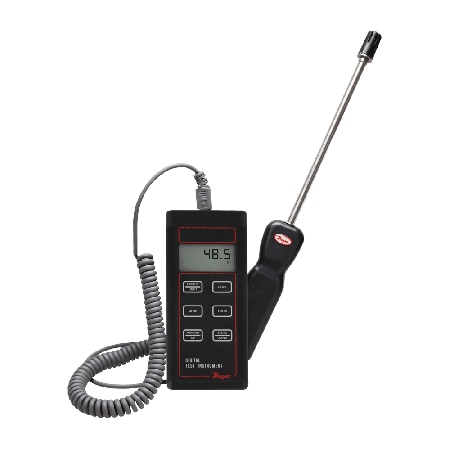
The Model 485B Handheld Thermo-Hygrometer is a portable instrument designed for spot measurements and field verification of relative humidity and temperature. In addition to direct readings, it calculates dew point and wet-bulb temperature, providing additional context for evaluating environmental conditions.
A data hold feature allows users to freeze readings during measurement, and onboard memory stores up to 99 data points for later review. This makes the instrument suitable for commissioning, troubleshooting, and periodic validation tasks.
Grippers Introduction to Grippers