


More than half a century has passed since Apollo 11 first landed on the Moon, and, since then, spaceflight has evolved dramatically. We’ve seen a lot: deep-space probe programs, orbital space stations, commercial rockets, and lunar missions on the horizon. What remains constant, however, is the critical role sensing technology plays at every phase of a mission.
Breaking Down a Rocket
A rocket can be divided into three fundamental systems:
- Propulsion
- Guidance
- Payload
Propulsion: Ensuring Safe and Efficient Thrust
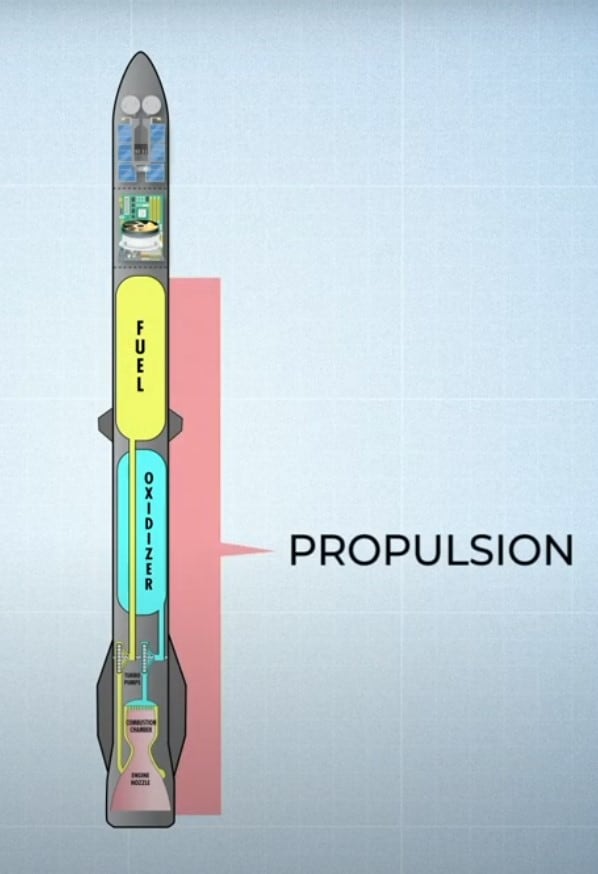
The propulsion system truly is the heart of any rocket. High-pressure gas, such as helium, forces fuel and oxidizer from their tanks into the rocket engine's turbo pumps and combustion chambers through the engine nozzel, where ignition produces the thrust needed for liftoff.
Key Sensor Applications
Pressure Sensors:
- Monitor fuel tank pressures, which are very high, to ensure consistent propellant delivery
- Regulate pressures found in the combustion chamber and engine nozzel, which are low
- Detect leaks, pressure drops, or over-pressurization scenarios
Temperature Sensors:
- Track thermal conditions of turbo pumps, valves, and combustion chambers
- Ensure fuel remains within stable thermal ranges before and during ignition
- Support cryogenic fluid management in rockets using liquid hydrogen or oxygen
Guidance: Staying on Course with Sensor Feedback
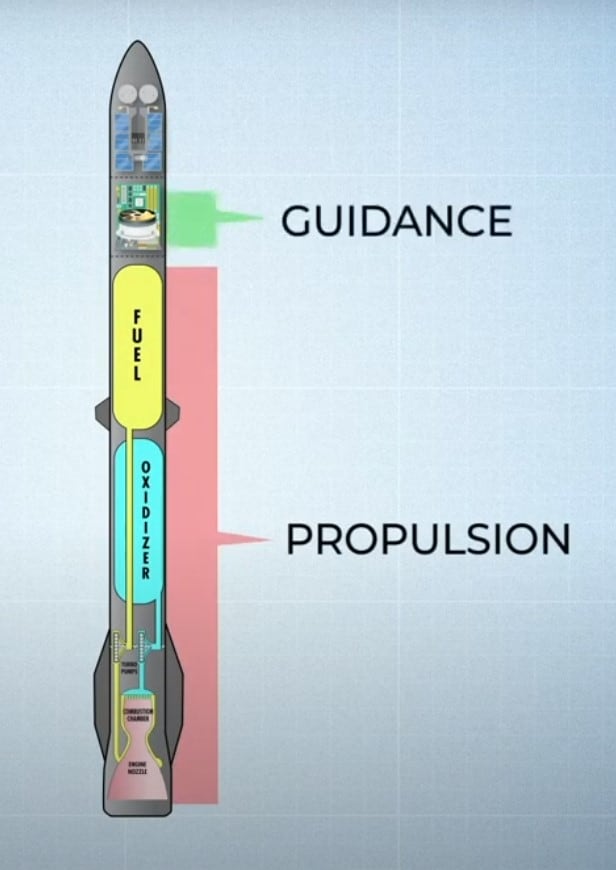
While propulsion gets the rocket off the ground, it’s the guidance system that keeps it on target. At the heart of the guidance system is a tightly integrated network of sensors, computers, and other devices, all working together in real time. Linear acutators are used to control the rocket's direction by gimbaling the engines, helping to guide the rocket on its intended course. Pressure and temperature sensors are used to monitor vital systems throughout the rocket.
Key Sensor Applications
Pressure Sensors:
- Monitor pressure levels in Reaction Control System (RCS) thrusters
- Ensure sufficient pressure is available to fire maneuvering jets
- Detect pressure drops indicating possible leaks or fuel system faults
- Support real-time adjustments during critical flight phases (e.g., orbital insertion, docking)
- Enhance fault detection and flight system reliability
Temperature Sensors:
- Track thermal conditions in engine bays and propulsion modules
- Monitor actuator motor temperatures to prevent overheating
- Measure fluid temperatures in hydraulic or pneumatic systems
- Regulate localized heat from thruster operation
- Provide feedback to cooling and thermal management systems
Payload: Life Support and Environmental Monitoring
Once the rocket has achieved its trajectory, the focus shifts to protecting and supporting the payload, which is the mission-critical cargo. Whether that payload is a communications satellite, a planetary rover, or a team of astronauts, it must be kept within precisely controlled environmental conditions to ensure mission success.
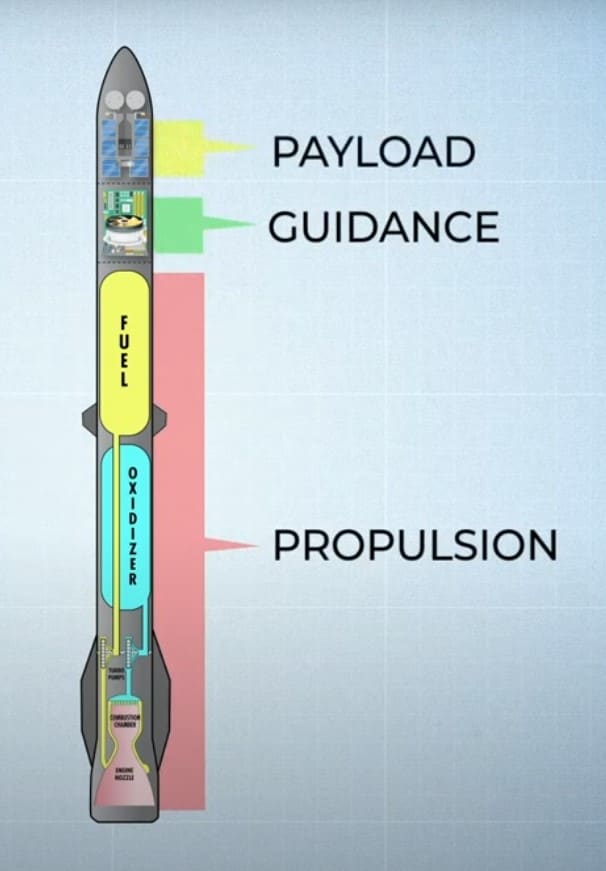
Inside the payload bay or crew module, sensor networks serve as the vital link between life support systems, equipment integrity, and onboard computing. These systems operate autonomously in the vacuum of space, often far from the possibility of intervention, making real-time sensor feedback absolutely essential.
Key Sensor Applications
Pressure Sensors
- Verify cabin pressurization within safe human tolerance levels
- Detect micro-leaks in structural seals or airlocks
- Assist in regulating pressure for payload modules carrying pressurized scientific equipment or habitats
- Maintain balance during docking procedures or EVA (extravehicular activity) airlock cycling
Temperature and Humidity Sensors
- Regulate internal climate conditions for human comfort and safety
- Maintain optimal thermal environments for electronics and scientific instruments
- Prevent condensation, which can damage sensitive optics and circuit boards
- Monitor variations between sunlit and shaded spacecraft surfaces, where thermal extremes can occur rapidly

Beyond the Launch: Thrust Vectoring and Stage Separation
Propulsion sensing doesn’t end at liftoff. In multi-stage rockets, sensors continue to play a vital role throughout the flight. They provide critical feedback for thrust vector control systems, ensuring engine angles are adjusted with precision to maintain stability and trajectory. Sensors also monitor stage separation mechanisms, verifying conditions such as controlled depressurization and thermal states so that spent stages can safely detach without jeopardizing the mission.
DwyerOmega Ingenuity: Space-Ready Sensor Technologies
The following DwyerOmega products represent sensor solutions capable of performing many of the propulsion, guidance, and payload applications outlined above. Though engineered for demanding environments here on Earth, designed to deliver dependable measurements in challenging conditions, their precision, durability, and reliability make each a strong candidate for use in spaceflight environments.
PX409-Series Configurable, High Accuracy Pressure Transducers
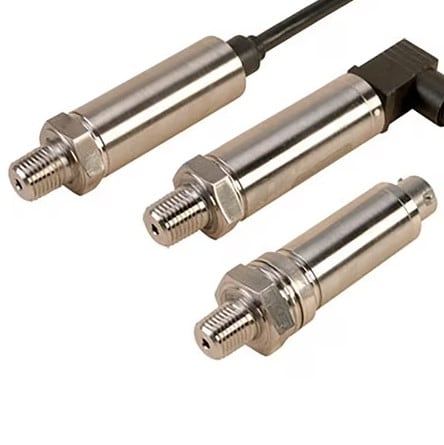
The PX409 Series delivers fast response times, high precision performance, and an accuracy of ±0.08% BSL. Its all-stainless steel wetted parts, welded construction, and premium temperature compensation ensure dependable operation even in challenging environments. Each unit includes a 5-point NIST-traceable calibration certificate, supporting confidence in long-term stability and repeatability.
For spaceflight applications, these characteristics make the PX409 well-suited to monitoring the high and low pressure ranges present in propulsion systems, detecting leaks or pressure drops in guidance systems, and verifying stable pressurization in payload environments.
RTD-831-Series Bolt-On RTD Sensor with Aluminum Flag Housing
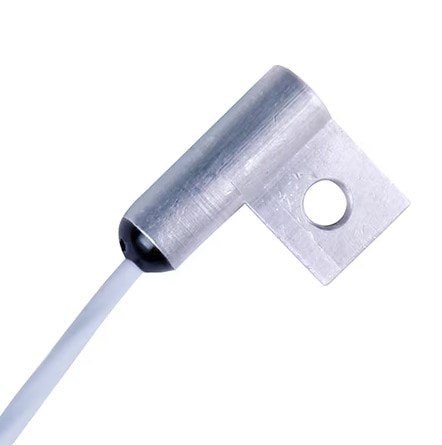
The RTD-831 Series features an updated housing design for improved strain relief and a compact aluminum flag housing that mounts easily to most flat surfaces. The flag is machined to accept standard #3 and #4 screws, with options available for #5, #6, and #8, allowing the sensor to be either bolted or cemented in place. Available with 100 Ω or 1000 Ω platinum RTD elements, and in a high-temperature version, the RTD-831 provides reliable and durable surface temperature measurement across a range of applications.
In the context of spaceflight, these qualities make the RTD-831 well-suited for monitoring thermal conditions in propulsion components such as valves, turbo pumps, or engine bays, as well as for ensuring stable temperature control in payload environments where sensitive electronics and instruments must be protected from extreme heat or cold.
SA1-RTD-Series Self-Adhesive Polyimide Fast Response RTD Surface Sensors
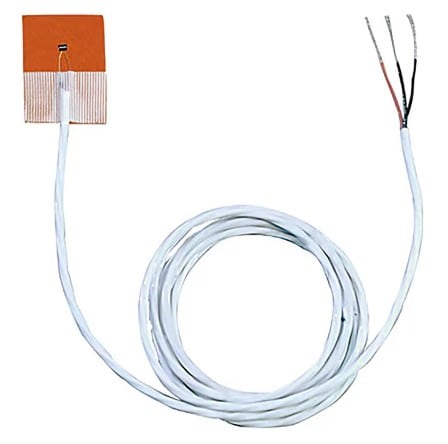
The SA1-RTD Series provides DIN Class A accuracy (±0.06 Ω or ±0.15 °C at 0 °C) in a compact, thin-film platinum RTD design. A silicone-based, self-adhesive backing rated to 260 °C (500 °F) allows for easy installation on flat or curved surfaces, and the sensor can be reapplied or permanently mounted with OMEGABOND cements. Its fast response and flexibility make it ideal for a wide range of surface temperature monitoring needs.
In spaceflight applications, these qualities translate into reliable surface monitoring for propulsion components where thermal gradients must be tracked, as well as for payload modules where electronics, structural elements, or insulation materials need close temperature control under extreme environmental swings.
Connect with a DwyerOmega Expert Today!
DwyerOmega | Blog | What is a Pressure Gauge?
Written by: Dan Schultz
Updated on: October 30, 2025

DwyerOmega | Blog | What is an Intrinsically Safe Product?
Written by: Dan Schultz
Updated on: March 30, 2026