


Threaded connections are one of the most common process connection types used in industrial instrumentation. They provide a simple, reliable way to attach sensors, transmitters, gauges, and fittings to piping and vessels across a wide range of applications.
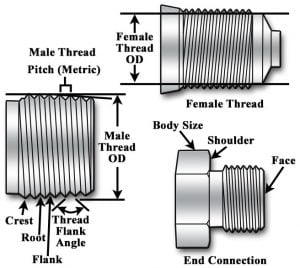
Because threaded connections are often relied upon to both mechanically secure a device and prevent fluid or gas leakage, selecting the correct thread type and standard is critical. Using the wrong thread form or mixing incompatible standards can result in poor sealing, damaged threads, leaks, or premature failure.
At a high level, threaded connections fall into two primary categories:
- Straight (parallel) threads
- Tapered threads
Straight (Parallel) Thread Standards
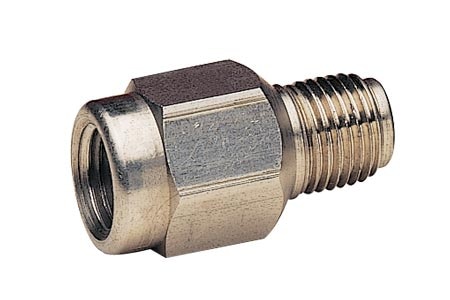
Straight, or parallel, threads maintain a constant diameter along their entire length. Because the mating threads do not wedge or compress against one another during installation, straight threads on their own do not form a pressure-tight seal.
As a result, straight threads are most often used as mechanical fastening connections rather than sealing connections. When leak prevention is required, sealing is achieved through a secondary element such as an O-ring, gasket, or washer. This sealing component is compressed against a machined surface as the connection is tightened, while the threads simply provide the clamping force and alignment.
This design makes straight threads well-suited for applications that require consistent positioning, repeated assembly, or controlled sealing surfaces, where the integrity of the seal is independent of thread engagement.
Common Straight Thread Standards
- NPS (National Pipe Straight): The U.S. standard for straight pipe threads
- ISO 228-1: The international standard for parallel threads
Tapered Thread Standards
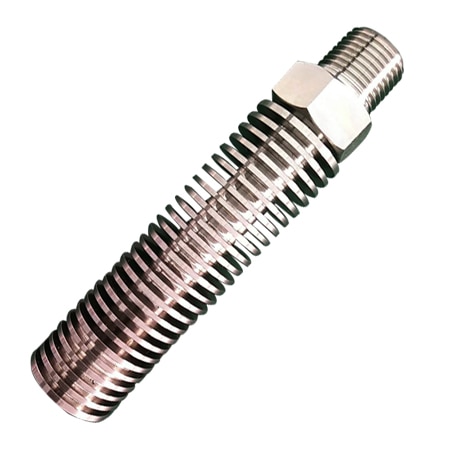
Tapered threads are designed specifically to create a pressure-tight seal. As the male and female threads are engaged, the gradual taper causes the thread flanks to compress against one another, tightening progressively as the connection is made. This wedging action helps seal the connection as torque increases.
To ensure a reliable, leak-free seal and to reduce the risk of thread damage or galling, a compatible thread sealant compound or PTFE tape is typically applied during installation. Sealants also make future disassembly easier by preventing the threads from binding.
Because of their ability to both secure and seal a connection, tapered threads are the most common choice for process instrumentation, particularly in applications involving liquids, gases, and pressurized systems.
U.S. Tapered Thread Standard (NPT)
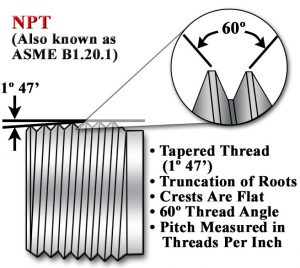
The primary U.S. standard for tapered pipe threads is NPT (National Pipe Thread), which is defined by ANSI/ASME B1.20.1. This standard specifies the thread geometry, taper, and dimensional tolerances required to ensure consistent sealing and mechanical compatibility across manufacturers.
NPT threads are designed to create a pressure-tight seal through a combination of thread interference and the use of a thread sealant. As the male and female threads are tightened, the tapered profile causes the thread flanks to compress against each other, increasing sealing effectiveness with additional torque.
Key NPT Characteristics:
- Taper rate: 1/16 inch per inch, measured as the change in diameter over distance
- Thread sealing: Achieved through thread interference and sealant
- Connection types:
- MNPT or NPT(M) for male (external) threads
- FNPT or NPT(F) for female (internal) threads
International Tapered Thread Standards (BSPT and ISO)
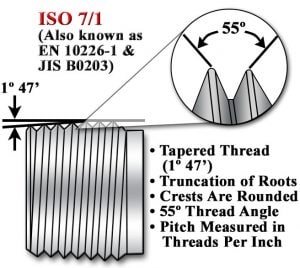
International tapered thread standards are defined by EN 10226-2 and ISO 7-1. These standards are closely related to several national standards, including:
- German DIN 2999
- British BS 21
- Japanese JIS B0203
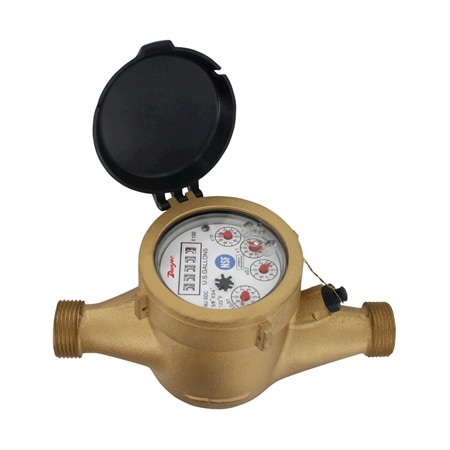
Many industrial instruments are available with BSPT process connections. Availability varies by product and manufacturer.
Why NPT and ISO Threads Are Not Interchangeable
Although NPT and ISO/BSPT threads may appear similar, they are not compatible and should never be used together.
Differences include:
- Taper angle
- Thread pitch and threads per inch
- Root and crest geometry
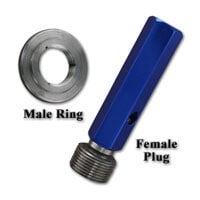
Verifying Thread Compatibility
To ensure proper fit and sealing performance, thread gauges are commonly used:
- Plug gauges for female threads
- Ring gauges for male threads

What Is A Stepper Motor & Controllers? – Omega Engineering Introduction to Stepper Motors
