


Corrosion is a leading cause of material degradation in industrial environments. Salt corrosion test cabinets are widely used to evaluate how materials, coatings, and assemblies perform under accelerated corrosive conditions. While the overall test method is well established, achieving consistent and repeatable results depends heavily on control of internal test parameters, particularly the air flow used to generate the salt fog. Precise adjustment of bubbler air flow using a flow meter is a key factor in maintaining test accuracy and standard compliance.
What are Salt Corrosion Test Cabinets?
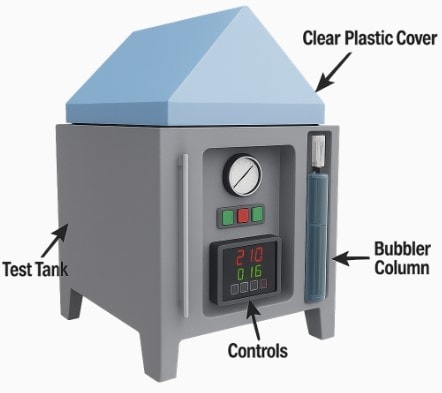
Salt corrosion test cabinets, also referred to as salt spray or salt fog chambers, expose test specimens to a controlled saline environment. A salt solution is atomized into a fine mist and distributed throughout the chamber, accelerating corrosion processes that would otherwise take much longer under natural exposure conditions.
These systems are typically used as comparative tools to evaluate coatings, materials, and surface treatments under repeatable conditions rather than to predict exact service life.
How Salt Fog is Generated
A key component of salt corrosion testing is the atomization system, which produces a consistent and uniform salt fog. This process generally relies on:
- Compressed air supply
- An air saturator (bubbler)
- An atomizing nozzle
- A salt solution reservoir
Before reaching the atomizing nozzle, compressed air passes through a bubbler chamber, where it is humidified and heated. This step is essential because properly conditioned air promotes stable fog formation and prevents excessive evaporation or droplet variation within the test chamber.
What is the Bubbler and Why Does It Matter?
The bubbler (air saturator) introduces air through heated water, increasing its humidity and stabilizing its temperature before atomization. This conditioned air improves:
- Fog consistency
- Droplet size distribution
- Chamber uniformity
Variations in bubbler performance can lead to inconsistent salt deposition rates, which directly affect test repeatability and compliance with standards such as ASTM B117 or ISO 9227:2022.
Role of a Flow Meter in Bubbler Air Flow Adjustment

A flow meter integrated into the air supply line provides precise control over the volume of air entering the bubbler. This seemingly simple component plays a critical role in test performance.
1. Controlling Fog Density
The air flow rate directly influences how much solution is atomized into the chamber. A properly adjusted flow meter helps maintain:
- Target fog collection rates
- Consistent chamber saturation
- Uniform exposure across test specimens
Excessive air flow can produce overly dense fog or large droplets, while insufficient flow may result in inadequate salt deposition.
2. Supporting Standard Compliance
Most salt spray test standards specify performance criteria such as:
- Fog collection rate
- Chamber temperature and humidity stability
- Uniform exposure conditions
A flowmeter allows operators to fine tune bubbler air flow to meet these requirements reliably, supporting repeatable and auditable test conditions.
3. Stabilizing Atomization Conditions
Because the bubbler conditions the air prior to atomization, air flow fluctuations can affect:
- Nozzle performance
- Droplet formation
- Salt solution delivery rate
Precise flow control minimizes variability introduced by upstream air pressure changes, helping maintain stable fog generation over long test durations.
4. Enabling Repeatable Test Setup
In many test environments, different operators or facilities must replicate the same test conditions. A calibrated flowmeter provides a quantifiable and repeatable setting, reducing dependence on subjective adjustments and improving inter-lab consistency.
Innovative Solutions from DwyerOmega
Series VF Visi‑Float® Acrylic Flow Meters
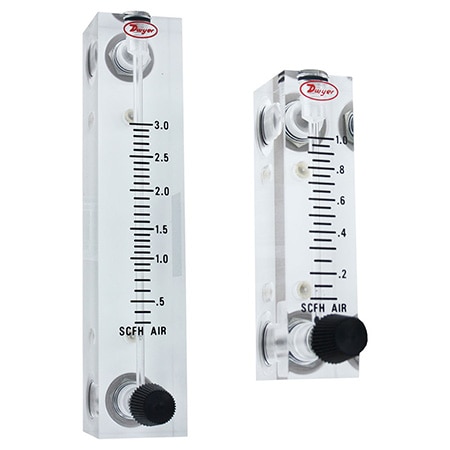
The Series VF Visi‑Float® Flow Meter is well suited for controlling bubbler air flow in corrosion and environmental test systems. Its clear acrylic body and high-contrast white scale provide easy visual confirmation of air flow settings, supporting accurate and repeatable test setup.
Precision‑machined tapered bores deliver high repeatability, which is critical when maintaining stable atomization conditions over extended test durations. Direct reading operation allows operators to quickly verify flow without additional instrumentation, reducing setup variability between tests and between operators.
Available with 2‑inch and 4‑inch scales and optional integral metering valves, the Series VF Flow Meter enables fine adjustment of bubbler air supply while maintaining a compact footprint. Its long-standing acrylic machining heritage and optional NIST calibration make it a practical choice for laboratories requiring consistent, auditable air flow control.
Practical Considerations
When evaluating or specifying a salt corrosion test cabinet with bubbler air flow control, consider:
- Flow meter accuracy and resolution for fine adjustment
- Ease of calibration and readability
- Integration with the compressed air system
- Stability under continuous operation
Inconsistent air flow control is a common source of test variability, even when other parameters such as temperature and solution concentration are tightly controlled.
DwyerOmega | Blog | What are Anemometers?
Written by: Dan Schultz
Published on: April 17, 2026