



As standards for indoor air quality (IAQ) monitoring become more stringent, confidence in measurement accuracy becomes increasingly important. For HVAC systems that rely on carbon dioxide (CO₂) measurements to control on-demand ventilation, unaccounted environmental variables—particularly barometric pressure—can introduce significant measurement error.
In applications such as demand‑controlled ventilation, building automation, and indoor air quality monitoring—particularly in facilities at elevation or subject to changing weather systems—barometric pressure fluctuations can be significant enough to influence reported CO₂ values. When CO₂ measurements are used as a control variable, these variations can affect ventilation decisions, energy consumption, and the ability to meet indoor air quality requirements if they are not explicitly accounted for.
To correct for this effect, pressure-compensated sensors incorporate a barometric pressure measurement and normalize CO₂ readings to standard atmospheric conditions, ensuring reported ppm values reflect concentration rather than changes in air density.
Without pressure compensation, a CO₂ sensor may appear to be operating correctly while reporting values that are meaningfully higher or lower than the true concentration. This can lead to improper ventilation rates, reduced energy efficiency, or failure to meet IAQ requirements.
Understanding why this happens starts with understanding how CO₂ is measured.
Innovative Solutions from DwyerOmega

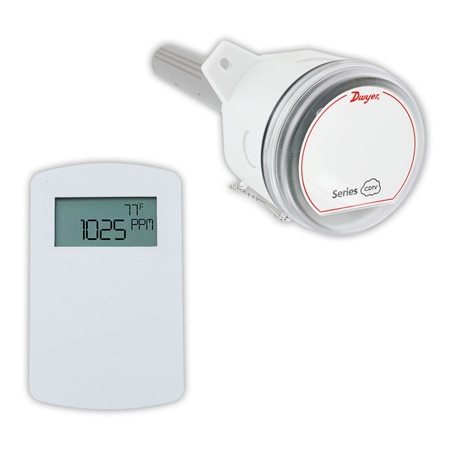
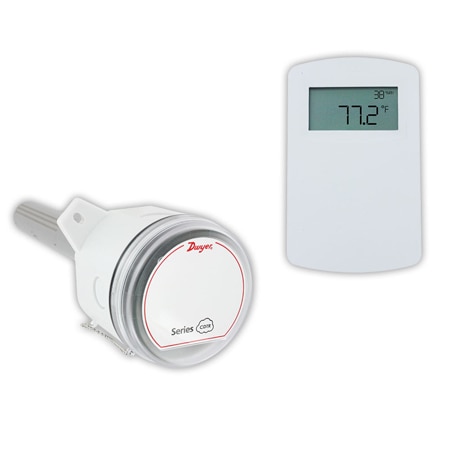
How NDIR CO₂ Sensors Work
Many HVAC CO₂ measurements are made using non-dispersive infrared (NDIR) sensing technology. In an NDIR sensor, infrared light is passed through a sample of air contained within a measurement chamber. On the opposite side, photodetectors measure the intensity of the transmitted light.
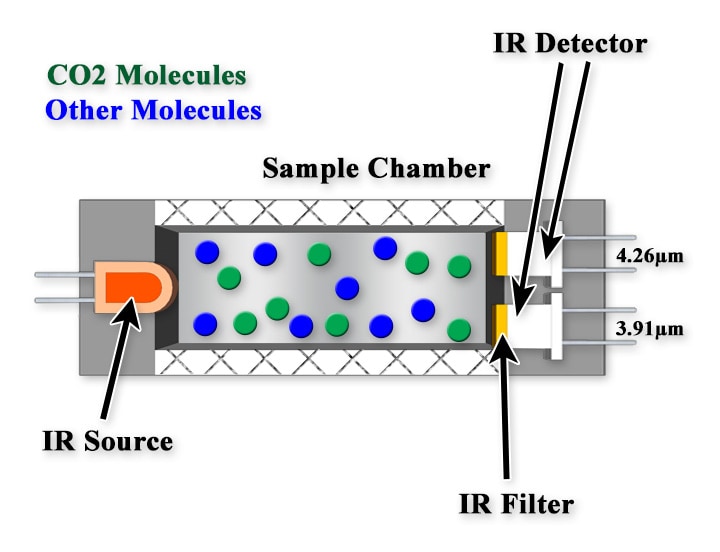
These detectors are tuned to a wavelength of approximately 4.3 microns, which corresponds to the absorption band of carbon dioxide. Other gases in the air do not absorb infrared energy at this wavelength, allowing the sensor to isolate CO₂ specifically.
As CO₂ concentration increases, more infrared energy is absorbed, and less light reaches the detector. By measuring this change in intensity, the sensor determines the amount of carbon dioxide present in the air sample.
Why Pressure Matters in a Fixed-Volume Sample Chamber
In most NDIR sensors, the measurement chamber has a fixed volume and is open to the surrounding environment so that air can freely diffuse in and out. While the chamber volume remains constant, the number of gas molecules inside that volume does not.
According to the Ideal Gas Law, the number of molecules in a given volume is directly affected by temperature and pressure. As barometric pressure decreases—such as at higher elevations—fewer air molecules occupy the same physical space. As pressure increases, more molecules are present.
This distinction is critical:
- CO₂ concentration is expressed in parts per million (ppm), which is a ratio
- But NDIR sensors respond to the actual number of CO₂ molecules present in the chamber
The opposite occurs at higher pressures. More molecules enter the chamber, causing the sensor to report a CO₂ concentration higher than reality.
The Magnitude of the Error
When referenced to ideal conditions of 25 °C (77 °F), 1,000 ppm CO₂, and standard atmospheric pressure at sea level, the measurement error introduced by pressure variation can be substantial. Using the Ideal Gas Law, CO₂ readings can deviate by as much as 349 ppm when barometric pressure is not accounted for. In ventilation systems that adjust outside air based on measured CO₂ concentration, this level of error can materially affect system performance and compliance.
| Altitude (ft) | Barometric Pressure (in Hg) | CO₂ Concentration (ppm) |
|---|---|---|
| -1,000 | 31.02 | 1,037 |
| 0 | 29.92 | 1,000 |
| 1,000 | 28.85 | 964 |
| 2,000 | 27.82 | 930 |
| 3,000 | 26.82 | 896 |
| 4,000 | 25.84 | 864 |
| 5,000 | 24.90 | 832 |
| 6,000 | 23.98 | 801 |
| 7,000 | 23.09 | 772 |
| 8,000 | 22.23 | 743 |
| 9,000 | 21.39 | 715 |
| 10,000 | 20.58 | 688 |
In many HVAC systems that use demand controlled ventilation, CO₂ concentration is used as an indicator of occupancy. If a sensor reports values lower than the true concentration, the system may under ventilate. If it reports values higher than reality, the system may draw in more outside air than necessary and increase energy consumption. Because NDIR sensors respond to the number of CO₂ molecules present within the measurement chamber, changes in barometric pressure can introduce systematic offsets that may go unnoticed when the sensor appears stable and repeatable. In applications where CO₂ directly influences ventilation control, pressure compensation becomes an important factor in maintaining measurement accuracy.
DwyerOmega | Blog | What is a Pressure Gauge?
Written by: Dan Schultz
Updated on: October 30, 2025

DwyerOmega | Blog | What is an Intrinsically Safe Product?
Written by: Dan Schultz
Published on: March 30, 2026