


For organizations and applications that require a higher level of measurement confidence, accredited calibration provides additional assurance that calibration activities are performed within an accredited laboratory and according to a defined technical scope.
Located in Hauppauge, New York, DwyerOmega’s Calibration Laboratory provides commercial calibration services for humidity, temperature, water activity, and differential pressure measurement equipment. The laboratory is accredited by the American Association for Laboratory Accreditation (A2LA) to ISO/IEC 17025:2017 and also meets the requirements of ANSI/NCSL Z540-1-1994.
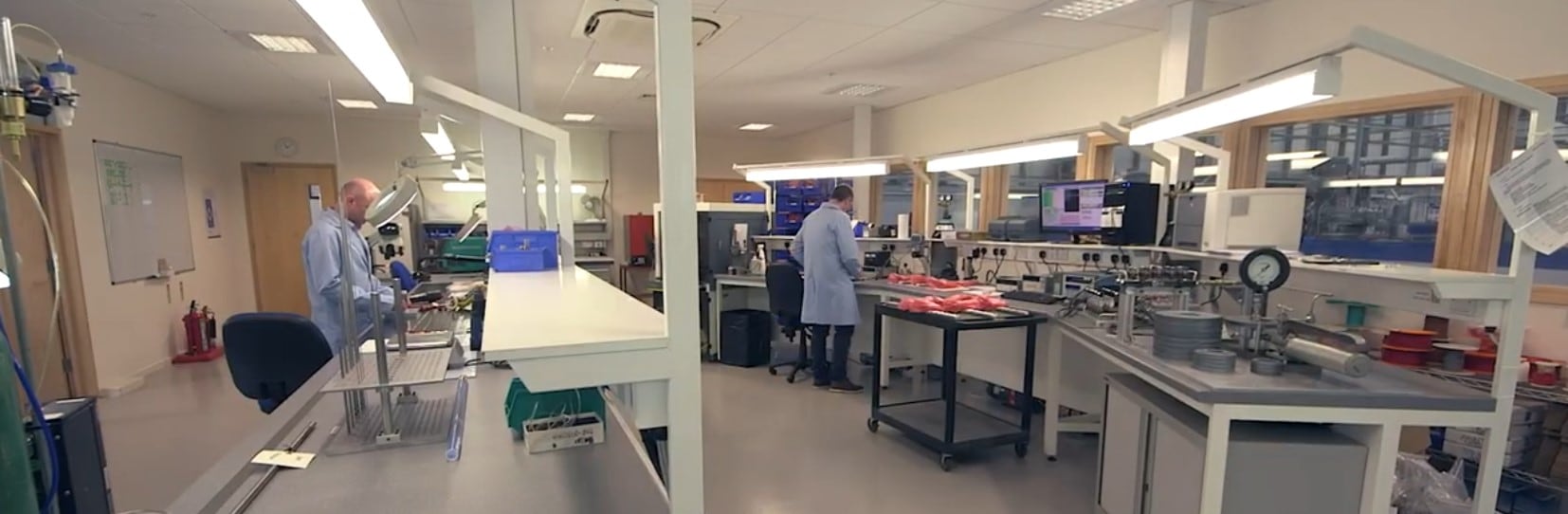
The laboratory operates in a dedicated, climate-controlled environment designed to maintain stable conditions throughout the calibration process. Equipped with advanced calibration equipment and supported by experienced technical personnel, the facility provides the controlled environment, expertise, and measurement capabilities required for reliable calibration results.
What ISO/IEC 17025 Accreditation Means
ISO/IEC 17025 establishes requirements for the competence, impartiality, and consistent operation of testing and calibration laboratories.
Accreditation provides independent recognition that a laboratory has demonstrated technical competence for the specific calibration activities included within its accredited scope.
Hauppauge Laboratory A2LA Certificate No. 5622.01
Why the Scope Matters Accreditation applies to a defined scope, not simply to the laboratory as a whole. The scope identifies the measurement parameters, ranges, Calibration and Measurement Capabilities (CMCs), and reference equipment covered by the accreditation.
Relative Humidity Calibration
Humidity measurement can be particularly sensitive to environmental conditions and the performance of both the device under test and the reference instrumentation. The Hauppauge laboratory uses controlled humidity generation and reference measurement equipment to perform relative humidity calibrations across multiple ranges.
For relative humidity measuring equipment at a nominal temperature of 23°C, the accredited scope includes fixed humidity ranges spanning from extremely dry conditions of 0.1% to 0.8% RH through ranges reaching 79% to 81% RH. These calibrations use fixed humidity tunnels together with equipment including a chilled mirror, transfer hygrometers, and a thermistor probe with a digital thermometer.
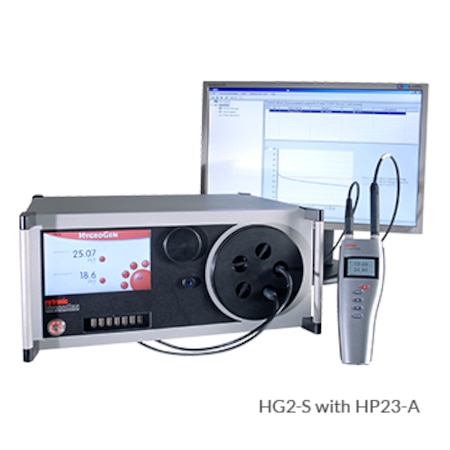
The laboratory also provides selected-point relative humidity calibration using a HygroGen humidity generator. This capability extends from 4.5% to 96% RH and allows instruments to be evaluated at multiple points across a broad humidity range.
Depending on the selected humidity range, the laboratory's accredited CMC ranges from 0.12% RH at the lower end of the selected-point service to 0.74% RH at the highest humidity range.
Together, these capabilities allow the laboratory to support humidity measurement equipment used across dry, ambient, and high-humidity conditions.
Water Activity Calibration
The Hauppauge laboratory's humidity generation capabilities also support the calibration of water activity meters.
Water activity, typically expressed as aw, describes the availability of water within a material rather than simply its total moisture content. This makes water activity measurement particularly useful when evaluating products and materials where available moisture can influence stability, quality, or storage characteristics.
The laboratory's accredited scope covers water activity ranges from 0.045 aw to 0.96 aw. Calibration capabilities are divided into multiple ranges across that span, with corresponding CMCs ranging from 0.0012 aw at the low end to 0.0074 aw at the highest range.
Calibration is supported by equipment including a humidity generator, chilled mirror, thermistor probe, and digital thermometer.
By incorporating water activity into its accredited scope, the Hauppauge laboratory extends its humidity expertise beyond conventional relative humidity instrumentation to equipment designed specifically for moisture-related product and material measurements.
Temperature Calibration
Temperature measurement is another core capability of the Hauppauge calibration laboratory.
For temperature measuring equipment calibrated using a thermistor probe and digital thermometer, the laboratory's accredited scope covers three ranges:
- 9°C to 21°C with a CMC of 0.086°C
- 21°C to 25°C with a CMC of 0.068°C
- 25°C to 46°C with a CMC of 0.094°C
The distinction between these capabilities is important. The 9°C to 46°C service specifically applies to temperature probe calibration in air, while the broader -95°C to 140°C capability identified in the accreditation scope uses a drywell calibration system.
Differential Pressure Calibration
In addition to its thermodynamic measurement capabilities, the Hauppauge laboratory's accredited scope includes differential pressure indicators and gages.
Differential pressure measures the difference between two pressure points and is commonly used in applications where relatively small pressure differences need to be detected and monitored.
The laboratory's accredited differential pressure capabilities include:
- -250 to 250 Pa with a CMC of 0.41 Pa
- -7500 to 7500 Pa with a CMC of 7.9 Pa
The inclusion of differential pressure expands the laboratory's accredited capabilities beyond humidity and temperature and allows the facility to support another important class of environmental and process measurement instrumentation.
Additional Dew Point Calibration Capabilities
Dew point calibration services use Michell calibration equipment to provide traceable calibration under an ISO 9001 quality management system from -100°C to +90°C (-148°F to +194°F) dew point.
These services support applications requiring traceable calibration across a broad range of dew point conditions.
What Is A Stepper Motor & Controllers? – Omega Engineering Introduction to Stepper Motors
