Besoin d'aide? Appelez-nous: 1-800-663-4209



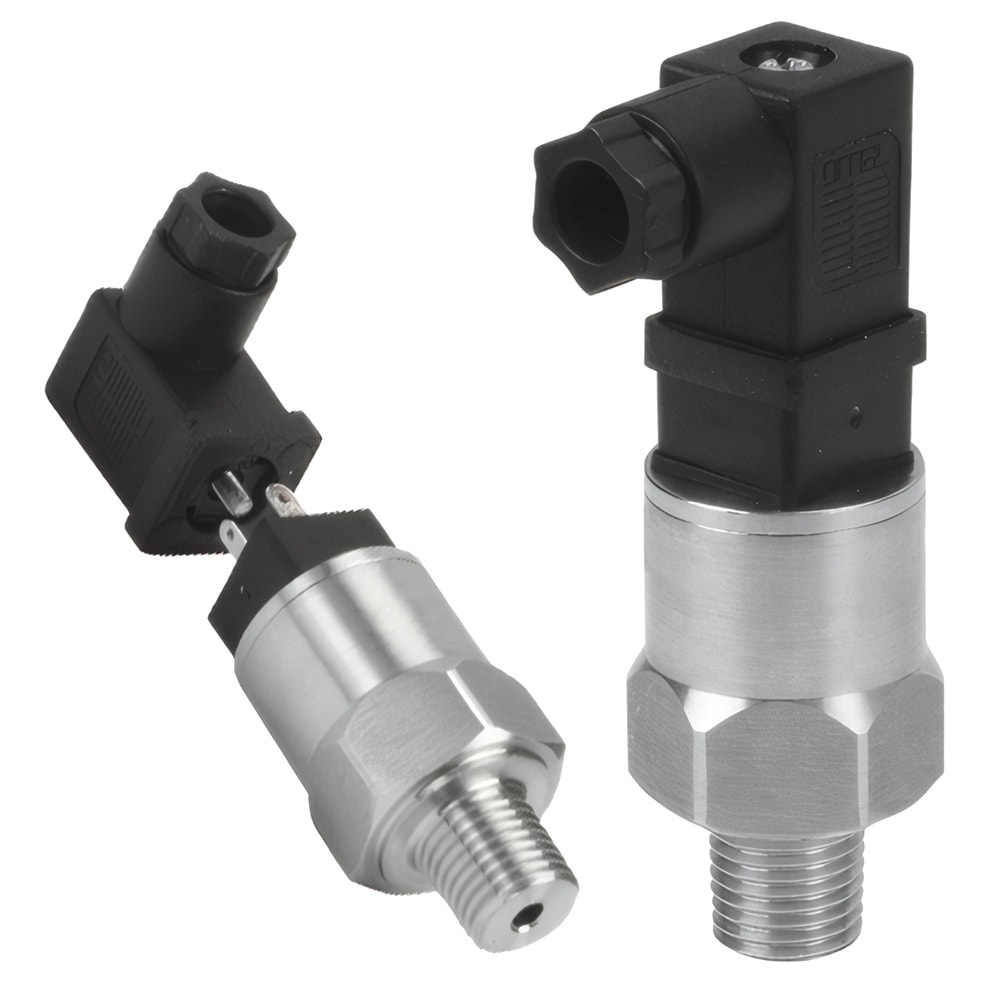
PX119
Transmetteurs de pression compacts de style OEM
Modèles en stock
- Compact et abordable pour les applications OEM
- Facilement configurable, désormais avec des options étendues
- Sorties fiables avec conditionnement du signal
- Boîtier durable en acier inoxydable résistant à la corrosion dans les environnements industriels difficiles
PX119
À partir de
C$
210.42
Modèles en stock


Aperçu du produit
- Précision ± 0.5 %
- Précision Précision de 0,50 % BFSL
- Température compensée, max 85 °C
- Température compensée, min 0 °C
- Matériau du boîtier Acier inoxydable 304
- Caractéristiques nominales du boîtier IP65
- Température de fonctionnement, max 135 °C
- Température de fonctionnement, min -40 °C
- Câblage de sortie (broche 1) Approvisionnement +
- Câblage de sortie (broche 2) Approvisionnement -
- Type de raccordement au process NPT mâle
- Protection Surtension, court-circuit, inversion de polarité
- Temps de réponse 1 ms
- ID de série PX119
- Stabilité <0,3 % FS>
- Tension d'alimentation 8 à 30 Vcc
- Poids 70 g
Applications prises en charge
La série PX119 d'Omega se compose de transmetteurs de pression compacts et robustes conçus pour la manutention de matériaux, les processus industriels et les applications d'équipements mobiles où les contraintes d'espace sont un facteur important. Ces appareils utilisent un capteur piézorésistif en céramique avec conditionnement du signal ASIC pour fournir une sortie compensée thermiquement.
Conditions de fonctionnement et performances
La série PX119 fonctionne dans une plage de température ambiante de -40 à 135 °C (-40 à 257 °F) et une plage de température de procédé de 0 à 85 °C (32 à 185 °F). Les transmetteurs ont un indice de protection IP65 et sont dotés d'un corps monobloc en acier inoxydable usiné. Les spécifications de performance comprennent :
- Précision : 0,50 % BFSL
- Temps de réponse : 1 ms
- Indice de vibration : 10 g (20 à 2 000 Hz) pour les plages ≤ 58 psi (4 bar); 20 g (20 à 500 Hz) pour les plages > 58 psi (4 bar)
La série prend en charge la mesure de la pression de 15 à 5 000 psi (1 à 345 bar). Les matériaux en contact avec le fluide comprennent l’acier inoxydable 304, la céramique Al<sub>2</sub>O<sub>3</sub> et le NBR standard.
Options de configuration
La série PX119 est configurable dans plusieurs dimensions pour répondre à des exigences d'installation spécifiques. Les options suivantes sont disponibles :
- Raccordements électriques : câble, Mini DIN 43650 C (connecteur inclus) ou M12.
- Raccords de procédé : la valeur par défaut est 1/4-18 NPT mâle; un suffixe A en option fournit un raccord 1/8-27 NPT mâle.
- Plages de pression : Disponibles de 0 à 15 psi (0 à 1 bar) jusqu'à 0 à 5 000 psi (0 à 345 bar), avec des paliers spécifiques, notamment 30, 60, 100, 150, 200, 300, 500, 600, 1 000, 1 500, 2 000 et 3 000 psi.
- Types de pression : manométrique (G) ou absolue (A).
- Sorties électriques : 4 à 20 mA (suffixe I) ou 0 à 5 V CC (suffixe 5V). L'alimentation électrique est de 8 à 30 Vcc.
Des accessoires de câbles sont disponibles pour des configurations spécifiques. Un câble ventilé (CA-319-4PC24-XXX-WP) est recommandé pour le PX119 ≤ 100 psig se terminant dans une zone propre et sèche ouverte à l'atmosphère. Les câbles standard (CA-319-4PC24-XXX) sont utilisés pour les plages > 100 psig et toutes les plages absolues, qui nécessitent une terminaison dans un endroit sec ou un environnement scellé.
Principales différences entre les produits
La série comprend des variantes de modèles qui se distinguent par le type de raccordement électrique (câble vs Mini DIN 43650 C vs M12) et par la taille du raccordement de procédé. Les numéros de modèle suivent le format PX1 19 <Raccordement électrique> - <Plage de pression> <Type de pression> <Sortie électrique>. Par exemple, un modèle avec sortie par câble, plage de mesure manométrique de 100 psi et signal de 4 à 20 mA est désigné par PX1 19 A - 100 G I (où « A » désigne l’option de raccordement au procédé dans certaines variantes ou des codes de série spécifiques comme PX159/PX109 qui partagent cette architecture). La documentation indique que toutes les unités sont ventilées par un trou dans le connecteur et le connecteur homologue.


Accessoires
Amortisseurs de pression pour se protéger contre les variations de pression
Depuis C$27.12
0 En stock
accessories
Convertisseur compact de courant ou tension analogique vers IO Link
C$245.46 / each
0 En stock
Afficher les évaluations et les avis
Rated 5 out of
5
by
Accidental Gardener from
The Little Transmitter that could...
I collect rain water in a 1000 L tote tank to use for my Greenhouse & several raised-beds. A small pump is used to recirculate the water not only to prevent stagnation but also for pH treatment to make it ready for use. The pump is then used for water delivery to the Greenhouse & raised-beds to reduce domestic water usage. This transmitter is great to monitor how well the pumping system performs. From bench testing before installation, I was very impressed with the response, repeatability & accuracy of this little unit. This is great as it does not have any zero/span adjustments. The pump has a low pressure, moderate flow delivery & I'm using a 15 psig transmitter (PX119-015GI). The Mini-DIN connector is great for easy disconnection as I will be bringing the pump & transmitter inside for the winter after the grow season is over.
Date published: 2020-08-29
Rated 4 out of
5
by
dlyman from
Awesome
I needed a pressure transmitter and looked everywhere. I found very cheap to very expensive and long ship times. I ordered the Omega. I got it in 2 days and it has worked very well
Date published: 2018-05-14
Rated 4 out of
5
by
Chris at FTS from
Easy to Install and Use
We purchased several of these in three different ranges. The first item is the ease of wiring the connector. Previous transducers used required soldering the wires to the connector terminals. There units have a simple screw lug that you simply insert the lead and screw tight in place. The time involved was less than half to complete connections.
The transducers themselves work very well.
My only minor concern is that the terminals on the transducer are exposed and can be bent easily. However, since there should be minimal need to remove the transducer connector, this is not a big concern.
Date published: 2019-03-06
Rated 5 out of
5
by
Flaco from
Pressure Transmitter
This is a rugged little piece of equipment. I'ts accurate enough for what I'm doing, has held up to sub-optimal conditions and the price is unbeatable.
Date published: 2019-02-05
Rated 2 out of
5
by
PressureSensorChallenged from
Wish it was better - Dwyer/Omega was better
We bought this for use in calibration of a dynamic pressure sensor. We are a research team and could not find documentation for the wire colors on the connector that we bought. (Looks like there are two variations). The pressure sensor itself did not give the correct voltage output. An email to support was sent and we are still waiting for a reply
Date published: 2026-11-06
Rated 5 out of
5
by
Eve B from
great product
everything worked as expected, great product it exceeded my expectations.
Date published: 2026-02-19
Rated 5 out of
5
by
OLSD microgrid from
trouble free performance
compact yet versatile, very accurate measurements. High-quality stainless-steel housing, no adapters, just straight forward performance.
Date published: 2026-02-02
Rated 5 out of
5
by
Vhramirez90 from
Exhaust treatment
I purchased this sensor for use in a biogas engine exhaust treatment system. The sensor works great and shipped in a decent amount of time.
Date published: 2025-10-13
I need to use this pressure sensor to get data from a pneumatics braking system on a small vehicle. We are using an arduino to collect data. Adruinos can measure between 0-5 V DC but it cannot measure current directly. Can it be used for this application?
You can convert the 4 to 20mA of the PX119 to a 1 to 5VDC with the use of a 250 ohm resistor across the input terminals of you readout
Date published: 2021-02-02
Are these National Sanitation Foundation (NSF) certified?
These pressure transducers are not NSF certified
Date published: 2019-12-31
CAD model available?
Hello, Omega's Tech Support has emailed you the PX119 CAD drawing for your review. Thanks for reach out to us and if you need further assistance please contact our Tech Support department.
Date published: 2019-04-17
Can the PX119 be used to measure hydraulic pressure? 2250 psi max
The PX119-3KGI will give a 4 to 20 mA output over a 0 to 3000 psig range. 2250 psi is 75% of this range so the output would be 16 mA. Please contact our Technical Support to discuss your application needs or if you need further assistance.
Date published: 2018-07-20
When we connect pressurized air to a PX119-150AI transducer, air is leaking out the back of the transducer around the electical connector. This is not the behavior we expected. Please explain why air pressure is leaking through the sensor.
The diaphragm has been damaged. Usually caused by overpressure of the sensor.
Date published: 2020-09-18
Is the 3D CAD available? I need info on the threads for the installation setup.
Thank you for your inquire.
We at this time do not have a 3D model.
The PX119 has a standard Process Connection: ¼ NPT male
Hope this was helpful
Date published: 2020-07-21
Can these transducers be install within a test article that is then placed within a pressure chamber; and have the pressure in the pressure chamber is to be increased up to 75 PSIA, while the transducer(s) monitor the pressures within the unit?
Hello, the PX119 will have a 1/8 NPT male threaded fitting at the bottom, which will thread into a Manifold or T fitting etc, the sensing element will be at the end of the orifice in the 1/8 NPT threaded port. The entire unit itself may not be subject to vacuum/pressure.
Your question/application is unclear, I would suggest calling and talking to our application specialists at 1800 622 2378.
Date published: 2024-11-04
For the PX109A-030A5V, which has a cable connection, is the recommended cable accessory (CA-319-4PC24-XXX-WP) necessary?
The CA-319-4PC24-XXX-WP is not necessary for the PX109A-030A5V transducer
Date published: 2024-04-24