Besoin d'aide? Appelez-nous: 1-800-663-4209



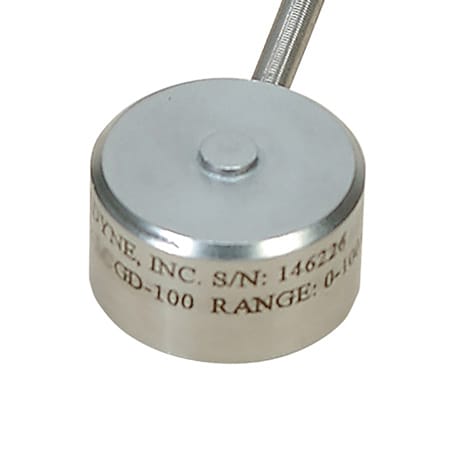
LCGD
Cellule de charge à compression à bouton miniature à haute précision
Modèles en stock
- Calibrage traçable NIST en 5 points inclus
- Haute précision
- Données de calibrage du shunt 59 kOhm incluses
- Profil bas
LCGD
À partir de
C$
1,241.29
Modèles en stock


Aperçu du produit
- Étalonnage en 5 points 0%; 50%; 100%; 50%; 0%
- Résistance du pont 350 Ω
- Longueur du câble 5 ft
- Option d'étalonnage 5 POINTS NIST
- Connexion électrique Câble
- Puissance électrique 2 mV/V
- Caractéristiques nominales du boîtier IP65
- Déviation à pleine échelle 0.003 in
- Hystérésis ± 0,20 %
- Linéarité ± 0,25 %
- Type de cellule de charge Bouton
- Matériaux Acier inoxydable
- Température de fonctionnement, max 121 °C
- Température de fonctionnement, min -54 °C
- Surcharge, max 300 % FS
- Température maximale du processus 71 °C
- Température minimale du processus 16 °C
- Répétabilité ± 0,10 %
- Surcharge sécurisée 150 % FS
- ID de série LCGD
- Tension d'alimentation 10 Vcc
- Effet de la plage thermique ± 0,018 % rdg/°C
- Effet thermique zéro ± 0,009 % FSO/°C
- Tableau de câblage/connecteurs Rouge : (+) Excitation ; Noir : (-) Excitation ; Vert : (-) Sortie ; Blanc : (+) Sortie
- Erreur de zéro/équilibre ± 2 %
Les capteurs de force miniatures à profil bas de la série LCGD sont des capteurs de force à compression offrant une excellente stabilité à long terme. Leur construction entièrement en acier inoxydable garantit leur fiabilité dans les environnements industriels difficiles. Chaque capteur de force est livré avec un étalonnage traçable NIST en 5 points.
Ces appareils sont conçus pour fonctionner lorsqu'ils sont montés sur une surface plane. Ils sont équipés d'un bouton de charge usiné qui fait partie intégrante du capteur de force de base.
La série LCGD est également disponible en configurations métriques, avec des échelles allant de 0 à 100 N à 0 à 200 kN. Veuillez consulter le LCMGD pour plus de détails, ou contacter notre service Pression pour plus d'informations.
Ces appareils sont conçus pour fonctionner lorsqu'ils sont montés sur une surface plane. Ils sont équipés d'un bouton de charge usiné qui fait partie intégrante du capteur de force de base.
La série LCGD est également disponible en configurations métriques, avec des échelles allant de 0 à 100 N à 0 à 200 kN. Veuillez consulter le LCMGD pour plus de détails, ou contacter notre service Pression pour plus d'informations.


Afficher les évaluations et les avis
Rated 5 out of
5
by
Anonymous from
Fast and exactly correct
Very easy to order! Great communication! Part arrived quickly and safely! 10/10 would recommend to a friend!
Date published: 2024-10-25
Rated 5 out of
5
by
Avicos Automation from
Is it Good?
Excellent product, I recommend it, most of the times I use this brand
Date published: 2023-03-17
I need to extend the cable on a LCGD-1K to about 30ft. Accuracy of signal is not all that critical, I just need the DP32PT-330-C24 to be able to close a dry contact (auto door) when it senses a human standing an 8ft entry ramp (maybe a 20 lb delta)
It will depend on a few things, mainly how accurate you need it to be, how many calibration points you are using and whether it is a 4 or 6 wire. If you are going across a really long distance then you may want to look into using a signal conditioner to change it from a bridge output to a current output or even to digital.
Best practice is to put a conditioner basically next to your load cell and send a 4-20ma or other current signal from there. Then you're good for like a quarter mile.
While 10-15ft is nominal for load cell cable length, 30 ft might be pushing it a bit. You could still get away with it but you may see erratic/fluctuation reading and signal will be noisy.
Date published: 2025-04-01
What is the wire gauge?
Wire gage for LCGD load cells is 24AWG
Date published: 2023-01-09
I have a load cell cable length of 3 meters, if I increase this cable length by 4 times, will there be a lot of fluctuation in my sensitivity values ? What can you suggest to solve the problem in this case ? Thanks for help.
You can experience signal lose and/or noise in the signal due to external electrical interference. A typical solution is to keep the cable length short and use a strain gage bridge signal condition to convert the load cells millivolt signal to either a 4 to 20mADC or a 0 to 10VDC signal. Suggest you look at products like our IN-UVI or TXDIN1600S conditioners.
Date published: 2023-02-21
Can you recommned a 5 or 6 digital meter to work with it ? We want to use it to calibrate 1KN~15KN device.
We suggest you look at our DP8EPT Digital Panel Meter.
Date published: 2020-09-10
Hello, can you answer my questions ? We have the omega lcgb 2k load cell. What is the difference between using a shield when connecting and not using it. Thank for help.
The shield is used to dampen the effect of external electrical noise. If used it should be connected to an earth ground. The load cell will function with or without the shield connected.
Date published: 2023-02-17
Is it ok to apply 15V excitation voltage instead of 10V to this LCGD/LCMGD Series?
Applying a higher voltage will result in excessive heat generation and thermal drift in readings. It would be best to apply the max voltage that is listed on the spec sheet or cal cert.
Date published: 2024-07-15
Hello, I have a question. İf we change the cable length, how much does the sensitivity value change at what level because there is no sensitivity line. Thanks for help.
Unless you adding a significant amount of cable there would be a minimal effect on the mV/V sensitivity load cell.
Date published: 2023-02-17
Hello, we have the omega lcgb 2k load cell. What is the difference between using a shield when connecting and not using it. Thanks for help.
Using the shield connect is not absolutely necessary to the correct operation of the load cell. All that is necessary the connect of the excitation power to the read & black leads and measurement of the signal at the green & white leads. If you are experiencing interference of the signal caused by external electrical noise you can connect the shield lead to an earth ground
Date published: 2023-02-21