Need assistance? Call us: 1-800-663-4209



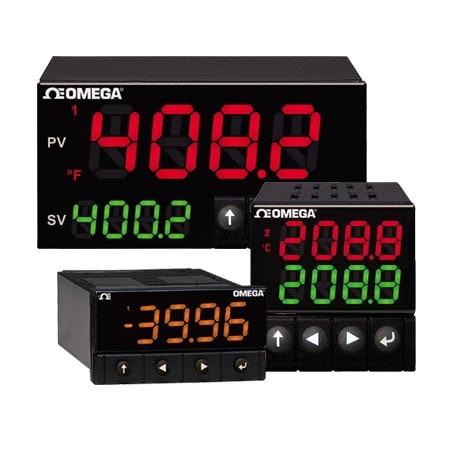
CNPT-Series
1/32, 1/16, and 1/8 DIN Universal High Performance Controllers
Models In Stock
- Strain & Bridge Inputs, 6 Digit Display and Upgraded Platinum Software Now Available
- Industry Leading Performance (20 Samples / Sec), High Accuracy
- Up to 6 Programmable Control/Alarm/Re-transmission/Relay Outputs
- Full Autotune PID with Fuzzy Logic Adaptive Control
CNPT-Series
From
Models In Stock


Product Overview
- A/D Conversion 24-bit sigma delta
- Accuracy Selectable
- Accuracy Detail Process Voltage Accuracy: 0.03% Process Current Accuracy: 0.03% Thermocouple Accuracy: Type J: 0.4°C (0.7°F) Type K: 1.0°C (1.8°F), 0.4°C (0.7°F) Type T: 1.0°C (1.8°F), 0.4°C (0.7°F) Type E: -1.0°C (1.8°F), 0.4°C (0.7°F) Type R: 1.0°C (1.8°F), 0.5°C (0.9°F) Type S: 1.0°C (1.8°F), 0.5°C (0.9°F) Type B: 1.0°C (1.8°F), 0.5°C (0.9°F) Type C: 0.4°C (0.7°F) Type N: 1.0°C (1.8°F), 0.4°C (0.7°F) RTD Accuracy: Pt, 0.00385, 100 Ω, 500 Ω, 1000 Ω: 0.3°C (0.7°F) Pt, 0.003916, 100 Ω: 0.3°C (0.7°F) Pt, 0.00392, 100 Ω: 0.3°C (0.7°F) Thermistor Accuracy: 2252 Ω: 0.2°C (0.35°F) 5K Ω: 0.2°C (0.35°F) 10K Ω: 0.2°C (0.35°F)
- Additional Features 1 Programmable 3 Color Display
- Approvals UL, cUL, CE, UKCA
- CMRR 120 dB
- Control Mode Ramp and Soak, Autotune, Adaptive Tune, PID Control, On-off control, Alarms, Remote Setpoint
- Data Interface Note Connection: USB: Female micro-USB Ethernet: Standard RJ45 USB: USB 2.0 host or device Ethernet Standards Compliance: IEEE 802.3 10/100 Base-T autoswitching, TCP/IP, ARP, HTTPGET
- Digital Filter Programmable
- External Fuse Required External Fuse Required: Time-Delay, UL 248-14 Listed: 100 mA/250 V; 400 mA/250 V (low voltage option) ; Time-Lag, IEC 127-3 Recognized: 100 mA/250 V; 400 mA/250 V (low voltage option)
- Impedance Input Input Impedances: Process/Strain: 10M Ω for ± 100 mV, 1M Ω for other voltage ranges; Process Current: 5 Ω; Thermocouple: 10K Ω max ; Auxiliary Input (Remote Setpoint): 3.5K Ω for 0 to 10V, 50K Ω for 0 to 1V, 50 Ω for current
- Input Configuration Differential
- Input Type Thermocouple, RTD, Thermistor, mA, Voltage, Strain
- Input Voltage -100 to 100 mV, -1 to 1 Vdc, -10 to 10 Vdc
- Isolation ISOLATION Power to Input/Output: 2300 Vac per 1 min test; 1500 Vac per 1 min test (low voltage/power option) Power to Relays/SSR Outputs: 2300 Vac per 1 min test Relays/SSR to Relay/SSR Outputs: 2300 Vac per 1 min test RS232/RS485 to Inputs/Outputs: 500 Vac per 1 min test
- Length 127 mm
- Current, Max 4 to 20 mA, 0 to 24 mA scalable
- Measurement Type Current, Strain, Temperature, Voltage
- Measuring Range Process Voltage: ± 50 mV, ± 100 mV, ± 1, ± 10 Vdc Process Current: Scalable within 0 to 24 mA Thermocouple: Type J: -210 to 1200°C Type K: -270 to -160°C, -160 to 1372°C Type T: -270 to -190°C, -190 to 400°C Type E: -270 to -220°C, -220 to 1000°C Type R: -50 to 40°C, 40 to 1788°C Type S: -50 to 100°C, 100 to 1768°C Type B: 100 to 640°C, 640 to 1820°C Type C: 0 to 2320°C Type N: 250 to -100°C, -100 to 1300°C RTD: Pt, 0.00385, 100 Ω, 500 Ω, 1000 Ω: -200 to 850°C Pt, 0.003916, 100 Ω: -200 to 660°C Pt, 0.00392, 100 Ω: -200 to 660°C Thermistor: 2252 Ω: -40 to 120°C 5K Ω: 30 to 140°C 10K Ω: 20 to 150°C
- Number of Inputs 1
- Operating Temperature, Max 50 °C
- Operating Temperature, Min 0 °C
- Polarity Bipolar
- Ramp and Soak Profiling
- Relative Humidity 90% RH, non-condensing
- Remote Setpoint Current, Voltage
- Resolution 0.1° temperature; 10 µV process
- RTD Type 100/500/1000 Ω Pt sensor, 2-, 3- or 4-wire; α= 0.00385, 0.00392 (100 Ω only), or α=0.003916 (1000 Ω only)
- Sampling Rate 20 Hz (20 updates/second)
- Series ID CNPT-Series
- Set Point Adjustment Menu Configurable
- Temperature Stability Temperature Stability:RTD: 0.04°C/°C;Thermocouple @ 25°C (77°F): 0.05°C/°C (cold junction compensation);Process/Strain: 50 ppm/°C
- Thermistor Type 2252 Ω, 5K Ω, 10K Ω
- Warm-Up to Rated Accuracy 30 min
Supported Applications
The PLATINUM Series is a family of universal, high-performance temperature, process and strain controllers offered in 1/32 DIN, 1/16 DIN and 1/8 DIN panel sizes with single or dual displays. Built for demanding industrial control, they combine high accuracy, broad input support and full programmability in a compact panel-mount package.
A single controller accepts a wide span of sensors and signals, so one platform can be standardized across a plant:
- Thermocouples: types J, K, T, E, R, S, B, C and N.
- RTDs: Pt 100, 500 and 1000 Ω elements on selectable curves.
- Thermistors and process voltage/current inputs, plus strain.
PID, On/Off and manual control modes with autotune, two setpoints and two alarms let the controller handle heating, cooling and general process loops. Front bezels are rated NEMA 4 (IP65) on 1/32 and 1/16 DIN models and NEMA 1 on 1/8 DIN models, and the controllers carry UL, cUL, CE and UKCA marks with a 5 year warranty.
Operating Conditions & Performance
A 24-bit ADC delivers up to 20 samples per second, and temperature resolution is 0.1°C or 0.1°F. Process and strain inputs are accurate to 0.03% FS, while thermocouple and RTD accuracy is specified by type. Representative input ranges and accuracies include:
- Type J: -210 to 1200°C (-346 to 2192°F), accurate to 0.4°C (0.7°F).
- Type K: -160 to 1372°C (-256 to 2502°F), to 0.4°C (0.7°F).
- Type T: -190 to 400°C (-310 to 752°F), to 0.4°C (0.7°F).
- Type E: -220 to 1000°C (-364 to 1832°F), to 0.4°C (0.7°F).
- Type R: 40 to 1788°C (104 to 3250°F), to 0.5°C (0.9°F).
- Type S: 100 to 1768°C (212 to 3214°F), to 0.5°C (0.9°F).
- Type B: 100 to 640°C (212 to 1184°F), to 0.5°C (0.9°F).
- Type C: 0 to 2320°C (32 to 4208°F), to 0.4°C (0.7°F).
- Type N: -100 to 1300°C (-148 to 2372°F), to 0.4°C (0.7°F).
- RTD (Pt, 100 Ω): -200 to 850°C (-328 to 1562°F), to 0.3°C (0.7°F).
Process inputs cover ±50 mV, ±100 mV, ±1 and ±10 Vdc voltage and a scalable 0 to 24 mA current range. The controller operates from 0 to 50°C (32 to 122°F) at 90% RH non-condensing and stores at -20 to 70°C. Input-to-output, input-to-power and output-to-power isolation is 1500 VAC.
Standard power is a universal 90 to 240 Vac ±10%, 50 to 400 Hz or 110 to 375 Vdc supply, with a low-voltage option of 12 to 36 Vdc (20 to 36 Vdc for dual-display or Ethernet builds). Firmware-selectable sensor excitation is available at 5V, 10V, 12V and 24V, and the analog current output drives at least a 500 Ω load.
Configuration Options
The lineup differs by panel size, display and, above all, output configuration. The order code is CN<Size>Pt-<Output Code>, where the numeric output code sets how many outputs are fitted and what type each one is. Output hardware options include:
- SPST and SPDT relays rated 250 Vac or 30 Vdc at 3 A.
- SSR rated 20 to 265 Vac.
- DC pulse at 10 Vdc, and an isolated DC pulse and isolated analog option.
Because outputs are ordered as combinations, a 1/32 DIN CN32Pt-330 fits dual SPDT relays, a CN32Pt-305 pairs an SPDT relay with an analog output, and a CN32Pt-224 adds a third DC-pulse output to twin 0.5 A SSRs. Dual-display CN16DPT models such as the CN16DPT-220 bring the same output flexibility to a two-line display. Not every option is available on the smaller 1/16 and 1/8 DIN models, so the size and output code are chosen together.
Key Product Differences
Base models span the three panel sizes - CN32Pt (1/32 DIN), CN16Pt and dual-display CN16DPT (1/16 DIN), and CN8Pt (1/8 DIN) - each ordered with a numeric output-code suffix. Examples from the ordering table include:
- CN32Pt-330 - 1/32 DIN, dual SPDT relays, single display.
- CN32Pt-304 - 1/32 DIN, SPDT relay plus DC pulse.
- CN32Pt-145 - 1/32 DIN, SPST relay, DC pulse and analog.
- CN16Pt-145 - 1/16 DIN, SPST relay, DC pulse and analog.
- CN16DPT-220 - 1/16 DIN dual display, twin 0.5 A SSRs.
Ordering suffixes add communications and I/O expansion: -EIP for Ethernet with an embedded web server, -C24 for isolated RS232/RS485, and expansion boards such as -006 (isolated analog output), -770 (two isolated DC pulse outputs), -110 (two isolated SPST relays) and -220 (two isolated SSR outputs). The -DC power suffix specifies 12 to 36 Vdc operation.
Physically, CN32Pt, CN16Pt and CN16DPT models are 48 H x 48 W x 127 mm D (1.89 x 1.89 x 5"), the 1/32 DIN cutout is 48 x 24 mm, and the CN8DPT dual display uses 21 mm (0.83") and 10.2 mm (0.40") digit heights, letting the family match panel space and readability to the application.
PDFs & Manuals
Software & Drivers



Accessories
accessories
cables
Show Ratings & Reviews
Rated 5 out of
5
by
no0ne from
Great technical support
We have put this to use. The technical support is what allowed us to put this into use quickly.
Date published: 2017-03-20
Rated 1 out of
5
by
Bcarlton from
Very difficult to use
THS S HW YU PRGM AN OMGA CNTRLR. This is 2017. Why does the 'Platinum' temp controller have a 1980s user interface? The USB port is an afterthought in a terrible location. It would not stay connected to my computer. The software does not run in Windows 10, and is not supported by Omega. Omega makes a lot of good products, but this is not one of them. We sent the unit back.
Date published: 2017-02-19
Rated 1 out of
5
by
quantum from
A nightmare to control from a computer
The device itself might be ok but it was a nightmare to control it from a computer.
Prepare to get head-hakes.
The technical documentations are poorly written, very difficult to understand and filled with errors.
It required a lot of of time and trials/errors to understand which commands and parameters to send. It was more like reverse engineering the communication protocol than using it ! What a lost of time.
For some unknown reason, several "Omega ASCII protocol" commands didn't work. So don't use it.
Their Modbus LabVIEW examples are buggy. Looks like a summer student wrote them. What a joke.
And absolutely no answer from the technical support. Nothing. What a shame.
Date published: 2021-05-21
Rated 3 out of
5
by
ProcEng from
Works, but not without issues
Bought two controllers and ran into issues with both, readings jumped all over the place during testing. Opened up the controller and found that the input board wasn't mounted onto the main board properly for both, wasted a good amount of time trying to troubleshoot.
Once I re-seated the internal board it worked as intended.
Date published: 2018-06-07
Rated 5 out of
5
by
RalphBSz from
Best controller
I have a handful of the older i16 and i32 controllers in use already, and am replacing two of those with pt32 (one done, one in progress). The i32 were already very good, with useful features, although a somewhat clunky setup interface (the 4-button menus could make grown men cry). Reliability has been perfect. Communication was a bit of an issue, required going to the larger 1/16 DIN model in some cases. The pt32 has fixed all that. Even when using the four buttons, the setup is now more logical.
But the sane way to set them up is to connect them to a laptop and configure them with the Platinum program. Being able to upload and download configurations means that I can finally put the configurations under revision control, and check that the device installed in the system is actually configured correctly. I can also modify configurations offline, without taking the control system down, and then quickly upload them in a quick downtime. Once you have a configuration, it can be quickly adjusted by editing the txt file directly. All very very convenient.
With the USB port, the communication problem has been solved. Find something with a USB connector nearby (laptop, industrial controller), either write a few lines of Python or install LabView, and you can chat with the controller. I'm now using the controller as an A-D converter for computer analysis of the process too. Very cool, low cost, convenient.
Speaking of cost: The Newport/Omega controllers have never been cheap, but worth their price. If you need a simple low-feature controller, buy something else.
The few times I've talked to tech support (in Santa Ana), they've been very helpful, patient, and knowledgeable.
My only complaint is: In one case I need four setpoints and four outputs from a single input; while it is theoretically possible to get this many outputs (not clear it can be ordered in a 1/32 DIN, that would be model -444-776), there are not four setpoints available. So this needs to be handled by using two controllers. Expensive, but works great.
Date published: 2017-10-27
Rated 4 out of
5
by
tom L from
temp controlser
included manual does not provide proper info for programing controller. downloading manual has much needed info.
Date published: 2023-03-19
Rated 3 out of
5
by
grumpy engineer from
OK
OK unit. Omega missed ship date by weeks. PC configuration software didn't work without lots of futzing around. LED display is straight out of the 90's. But, works well once configured, build quality looks good, optimistic about reliable performance. Having two PID loops in one controller is nice too.
Date published: 2020-11-25
Rated 4 out of
5
by
Jacky from
Good product. but need to improve usability.
Need better software for monitor and control the controller. we also want there are easier way that we can export process values to further analysis
Date published: 2016-02-11
I want to control an SL heater( basically a wall heater) with 240v 3000/2250W 12.5/108A, What do i need ?
Along with a controller you will also need a solid state relay, heat sink and a thermocouple
Date published: 2020-04-02
Where is the isothermal plate located in the CN32PT for the reference junction?
Is the thermistor within the removable terminal block or inside the controller housing?
Date published: 2022-05-17
What is the equation that calculates the temperature from mV
Hi, if you are using a thermocouple then here are some reference pages on how this is done.
This all goes into detail on the Seebeck voltage. Please contact us if you need anything further. Thanks!
https://www.omega.co.uk/prodinfo/thermocouples.html
https://www.omega.co.uk/techref/
Date published: 2019-05-15
CN16DPT-145. There is limited info on the retransmit function. I'd like to retransmit measured temperature from a thermocouple. How does the scaling work for retransmit?
To set the Analog output range on the Platinum Controllers you need to select the RNGE in the PROG menu then scale it in the RtRN parameter in the PROG menu in your case for ANG1 as well. Please call the temperature department if you need detailed assistance.
Date published: 2022-03-10
I want to drive a 24Vdc 3port/2way solenoid air valve. What output option do I select? I see there is a DC power supply option will that be needed?
Hi Julie,
Thank you for the inquiry. For your device the best option to use is the mechanical relay. You will need a power source suitable for your relay coil. The internal excitation is limited to 25 mA @ 24 VDC.
Best regards
Omega
Date published: 2019-11-13
I recently purchased a Platinum Series DP8PT-330-006-C24-EIP universal controller. The manual doesn't have the communications information in it. Where can I find the information on the Modbus RTU ethernet communications for SCADA connection?
Hi Marek,
Thank you for the inquiry. Following links are for the manuals describing communications;
https://assets.omega.com/manuals/M5458.pdf
https://assets.omega.com/manuals/M5452.pdf
And for the configurator software;
https://assets.omega.com/manuals/M5461.pdf
Best regards
OMEGA
Date published: 2020-12-18
Where can I get connectors for my CN8DPT-305?
Thank you for your inquiry. Terminal Connectors can be found here:
https://www.omega.com/en-us/control-monitoring/controllers/pid-controllers/p/CNI-10PIN-CONN
https://www.omega.com/en-us/control-monitoring/controllers/pid-controllers/p/CNI-8PIN-CONN
Date published: 2023-08-08
What is the mechanical relays fastest switching time?
Thank you for your inquiry. One second (Seven seconds is recommended).
Date published: 2021-12-08