Besoin d'aide? Appelez-nous: 1-800-663-4209



CN7233
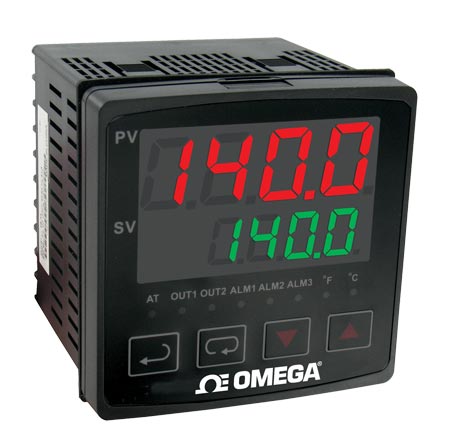
Contrôleurs de température/processus à rampe et palier 1/4 DIN
Choisir une variante
Facteur de forme
Signal de sortie
Ajouté à votre panier
Configuration complète.
Veuillez ajouter au panier pour la conserver ou quitter la configuration
Veuillez ajouter au panier pour la conserver ou quitter la configuration
Échec de l'enregistrement des configurations, cliquez sur le bouton Configurer pour recommencer
Spécifications du produit
<< Voir tous les modèles de produit| Marque |
 |
| Approvisionnement Remarque | 100 à 240 VCA, 50/60 Hz |
| Caractéristiques nominales du boîtier | IP66 |
| Dimensions de la découpe | 45 x 45 mm |
| Détails de la sortie | Relais/Relais;Relais : SPDT, 5 A @ 250 Vac résistif |
| Facteur de forme | 1/4 DIN |
| Fonctions supplémentaires 1 | 2 sorties d'alarme |
| Hauteur | 48 mm |
| ID de série | CN7200-7500-7600-7800 |
| Interface de données | RS485 Modbus |
| Longueur | 15.8 mm |
| Nombre d'entrées | 1 |
| Nombre de sorties de commande | 2 |
| Plage de mesure | Type K : -200 ~ 1300°C, Type J : -100 ~ 1200°C, Type T : -200 ~ 400°C, Type E : 0 ~ 600°C, Type N : -200 ~ 1300°C, Type R : 0 ~ 1700°C, Type S : 0 ~ 1700°C, Type B : 100 ~ 1800°C, Type L : -200 ~ 850°C, Type U : -200 ~ 500°C, Type TXK : -200 ~ 800°C, RTD (JPt100) : -20 ~ 400°C, RTD (Pt100) : -200 ~ 850°C, Résistance (Ni120) : -80 ~ 300°C, Résistance (Cu50) : -50 ~ 150°C, Entrée tension analogique (0~5V) : -999~9999, Entrée tension analogique (0~10V) : -999~9999, Entrée courant analogique (0~20mA) : -999~9999, Entrée courant analogique (4~20mA) : -999~9999, Entrée tension analogique (0~50mV) : -999~9999 |
| Poids | 425 g |
| Profondeur derrière le panneau | 79,2 mm |
| Précision | ± 0,25 % de la plage, ± 1 chiffre le moins significatif |
| Rampe et maintien | 8 programmes de rampe/maintien ; 8 segments chacun |
| Sauvegarde de la mémoire | Non volatil |
| Signal de sortie | Aucun |
| Sortie de commande | Relais SPDT |
| Température de fonctionnement, max | 50 °C |
| Température de fonctionnement, min | 0 °C |
| Tension d'alimentation | 100 à 240 Vca |
| Type d'affichage | LED à 4 chiffres |
| Type d'affichage Remarque | Deux afficheurs à 7 segments, 4 chiffres PV : Rouge, 19 mm (0,75") H SV : Vert, 12,7 mm (0,5") H |
| Type d'approvisionnement électrique | CA |
| Type d'entrée | Thermocouple ; RTD ; mA ; tension |
| Type de mesure | Courant ; température ; tension |
| URL QR de la fiche technique | https://www.dwyeromega.com/en-us/1-4-din-ramp-soak-temperature-process-controllers/CN7200-7500-7600-7800/p/CN7233?guid=701a700000ulrduaaq&utm_source=spec-sheet&utm_medium=qr-code&utm_campaign=prd-sku-spec-sheet&utm_content=auto-generated-sku-level-spec-sheet |
| Valeur brute du poids | 0.75 |
| Pays d'origine | India |
| Voir toutes les spécifications | |
PDF & Manuels
Logiciels & Pilotes



Afficher les évaluations et les avis
Rated 4 out of
5
by
Good Controller from
Good controller.
Good controller.
Good controller.
Good controller.
Date published: 2024-06-17
Rated 2 out of
5
by
Perplexed from
Could be a much more user-friendly instrument
Although the CN7233 temperature controller that I purchased works, I cannot in good conscience award it any more than a 2 out of 5 stars due to inadequate documentation, bizarre display hieroglyphics, and some questionable logic affecting the user interface.
The application is controlling a single-zone pottery kiln - about as simple as it gets. The feature that attracted my attention to the CN7233 is that it can have as many as 8 separate programs (patterns?) in memory with as many as 8 steps in each program (pattern). The documentation in both the Instruction Sheet included with the instrument and the Specifications - Installation and Operating Instructions available on-line fall short in presenting a concise, cogent set of instructions on how to set up, tune, and operate the controller. One item that is missing in the documentation is any detailed description on how to tune the instrument - no examples or other guidance to address this important feature, particularly for the ramp/soak function. The only substantive direction comes from the bold-face warning on page 11 of bulletin E-90-OCN which states: "Do not operate auto-tuning while a ramp function is operating. The ramp function will prevent self tune from operating properly. Make sure that all tuning is set up before operating ramp/soak". And then there is the word "off" found in Link parameter on page 12. What I discovered the hard way is that "Off" really means "On" unless there is an unused step at the end of a pattern. Where is the absolute "end" function? And "SP" doesn't mean set point, but rather where the decimal point goes. The display, IMO, is simply weird. A type K thermocouple is depicted as a reversed lower case "y". "r-S" is where one goes to find the "run" button as well as the "stop" button. The stop button is somewhat important because that is how one selects the program (pattern) to be used for the operation. Is that logical? The CN7233 could be a much better value if both the instructions and the user interface were cleaned up.
Date published: 2020-04-12
Rated 4 out of
5
by
Dog_One from
The Proper Component for the Job at Hand
This controller is a small, cost effective, easy to implement solution, for precise temperature control situations. The only negative aspect I would like to see corrected at some point in the future is the input buttons--they are not very tactile and difficult to use accurately without some sort of stylus.
Date published: 2025-10-17
Rated 5 out of
5
by
Mitch P from
Satisfactory++
Easy to install, convenient outputs and a reasonable price for the quality.
Date published: 2024-07-08
Rated 4 out of
5
by
Anonymous from
Return
Even though the wrong product was ordered returns were handled swiftly
Date published: 2023-01-30
Rated 5 out of
5
by
Sergei Hanukovich from
Controller Works as Expected
Works as expected, circuit diagram easy to read and overall design is standard, but nice. Interface is not immediately straightforward, but manual does good job of breaking all the functions down in a clear way. Technical support was helpful in determining the the PID controller that best suited my application needs.
Date published: 2021-01-13
Rated 4 out of
5
by
Anonymous from
Good for general lab use
Fills my light/medium-duty heating and cooling needs. I use it to control metallurgy furnaces, PVD process heaters, hydrogen furnaces and a coolant bath for electrochemistry synthesis. It takes some time to acclimate to the old shcool user-interface, but it's not a deal-breaker. The auto-tune feature helps to keep the process temperature within one degree C when implemented properly.
Date published: 2020-09-28