한국 1588-8983 | 새로운 웹사이트에 오신 것을 환영합니다. 문제나 버그를 발견하셨나요? 여기에 보고해주세요


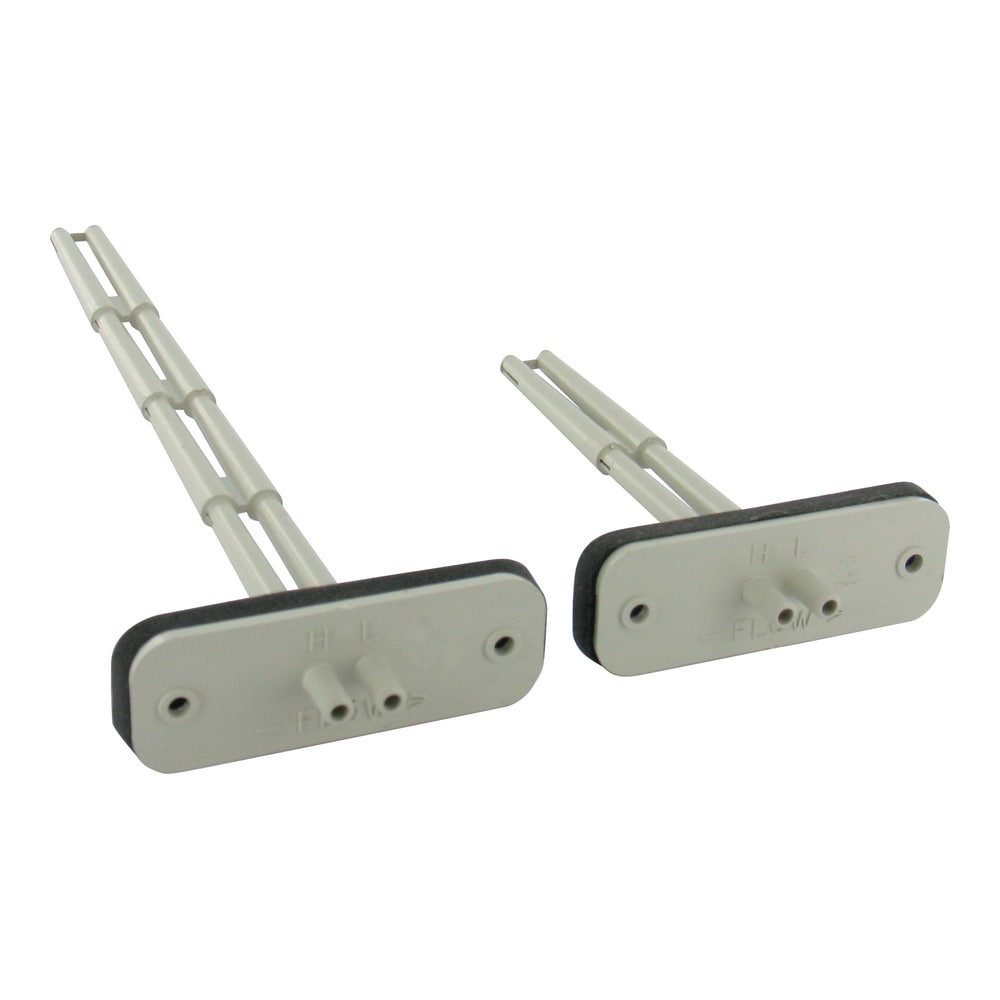
Series-PAFS-1000
HVAC용 평균 유량 센서 – VAV 유닛의 속도 압력 감지
- 간단한 장착 플랜지는 원형 또는 직사각형 덕트 모두에 사용 가능


제품 개요
- 규정 준수 노트 EU 지침 2011/65/EU(RoHS II)의 기술 요구 사항을 충족합니다.
- 접액부 재질 ABS, 폴리카보네이트
- 미디어 호환성 깨끗한 건조 공기 / 불활성 가스, HVAC / 실내 공기, 비활성 가스/비반응성 가스
- 장착 방향 개스킷이 포함된 통합 플랜지
- 작동 온도, 최대 120 °F
- 최소 작동 온도 40 °F
- 포트 1 크기 1/4인치
- 포트 1 유형 스템
- 포트 2 크기 1/4인치
- 포트 2 유형 스템
- 시리즈 ID Series-PAFS-1000
- 저장 온도, 최대 140 °F
- 보관 온도 최소 -40 °F
- 무게 1 oz
Supported Applications
The Series PAFS-1000 Averaging Flow Sensor from Dwyer is designed for sensing velocity pressure in the inlet section of variable air volume (VAV) terminal units and fan terminal units. The sensor measures differential pressure by utilizing an 'H' port to sense total pressure and an 'L' port to sense static pressure; the difference between these signals provides the velocity pressure reading.
Documented applications include:
- Sensing differential pressure in VAV terminal units
- Sensing differential pressure at other locations within main or branch duct systems
- Zone control in HVAC systems
- Retrofit HVAC air flow measurement
The series is intended for service with air and compatible gases.
Operating Conditions & Performance
The Series PAFS-1000 operates within a process temperature range of 40 to 120°F (4 to 49°C). Storage temperatures are specified from -40 to 140°F (-40 to 60°C).
Wetted materials consist of ABS/polycarbonate, rated UL94-5V. The sensor weighs 1 oz (28 g) and features an integral flange with a gasket for mounting.
Maintenance notes indicate that sensing orifices must be kept free of dust accumulation or debris, as occasional cleaning may be required. Upon final installation, no routine maintenance is required, though periodic checks of system calibration are recommended to ensure accurate measurement. The unit is not field serviceable; if repair is needed, the sensor should be returned with a return goods authorization number.
Model-Specific Dimensions and K Factors
The series offers models configured for box sizes ranging from 4" to 30" (10.16 to 76.20 cm), corresponding to sensor lengths of 3-5/32" to 23-29/32" (8.02 to 60.72 cm). Each model features a specific number of sensing points and an approximate K factor:
- PAFS-1002: 1 sensing point, length 3-5/32" (8.02 cm), K Factor 1.32
- PAFS-1003: 2 sensing points, length 5-13/32" (13.73 cm), K Factor 1.39
- PAFS-1004: 3 sensing points, length 7-21/32" (19.55 cm), K Factor 1.46
- PAFS-1005: 4 sensing points, length 9-29/32" (25.26 cm), K Factor 1.46
- PAFS-1006: 5 sensing points, length 12-1/2" (31.75 cm), K Factor 1.58
- PAFS-1007: 6 sensing points, length 14-3/4" (37.47 cm), K Factor 1.67
- PAFS-1008: 7 sensing points, length 17-1/8" (43.50 cm), K Factor 1.78
- PAFS-1009: 8 sensing points, length 19-13/32" (49.29 cm), K Factor 1.88
- PAFS-1010: 9 sensing points, length 21-21/32" (55.01 cm), K Factor 2.01
- PAFS-1011: 10 sensing points, length 23-29/32" (60.72 cm), K Factor 2.14
Configuration Options
The Series PAFS-1000 is available in ten distinct models defined by sensor length and the number of sensing points, accommodating duct box sizes from 4" to 30" (10.16 to 76.20 cm).
Mounting and Connections
The sensors feature a simple mounting flange compatible with both round and rectangular ducts. The integral flange includes a gasket, with overall dimensions of 3-1/2" [88.90] width by 2-3/4" [69.85] height (excluding the variable sensor length). Mounting holes are specified as 2x Ø3/16 [Ø4.76].
Process connections utilize push-on fittings for tubing with a 1/4" (6 mm) ID and 3/8" (10 mm) OD.
Key Product Differences
Variation within the Series PAFS-1000 is determined by the model suffix, which dictates the sensor length and the number of averaging sensing points. As the model number increases from -1002 to -1011, both the physical insertion depth and the count of pressure taps increase linearly.
The approximate K factor also varies with each model configuration, ranging from 1.32 for the shortest sensor (PAFS-1002) to 2.14 for the longest (PAFS-1011). These factors are provided as reference values associated with specific lengths and sensing point counts.


