日本 +81 3 6822 0370 | 新しいウェブサイトへようこそ。問題やバグを見つけましたか?こちらからご報告ください


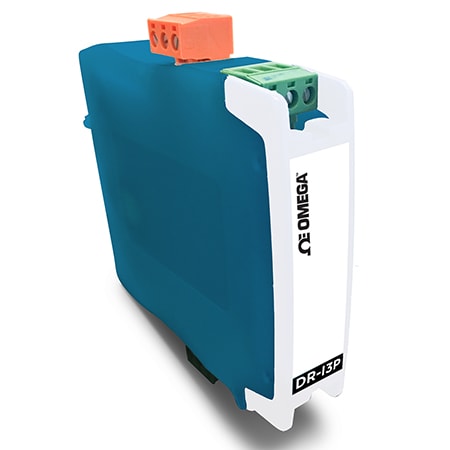
DR-I3P-Signal-Converter
絶縁型ユニバーサル信号トランスミッター
- ユニバーサル入力 - TC、RTD、mA、V、Ω、ポテンショメータ、NTC
- 4-20mAまたは0-10Vdcの設定可能な出力
- ユニバーサル電源 18-265V ac/dc
- 簡単設定 - 追加の設定ツール不要


製品の概要
- 承認 CE、RoHS
- 表示タイプ 2桁LCD
- 電気接続 ネジ端子
- 電気出力 0~20 mA
- エンクロージャーの定格 IP30
- 高さ 108 mm
- 絶縁 2300 Veff
- 長さ 106 mm
- 材料 ポリアミドV0
- 取付 DINレール 35 mm 標準
- 動作温度(最高) 50 °C
- 動作温度(最低) 0 °C
- 消費電力 最大1.5W
- シリーズID DR-I3P-Signal-Converter
- 最大保管温度 70 °C
- 保管温度(最低) -20 °C
- 電源タイプ AC / DC
- 温度安定性 150ppm/°C
- ウォームアップ時間 15分
- 重量 150 g
- 幅 22.5 mm
- 線径 17から14 AWGまで
Supported Applications
The Omega DR-I3P Isolated Universal Signal Transmitter is an economical signal converter designed for process and temperature applications. The series supports assembly line, control panel, and laboratory environments. It accepts universal inputs including mA and Vdc process signals (providing +15Vdc excitation voltage), temperature signals from Pt100, Pt500, Pt1000, Ni100, Ni1000, NTC sensors, and thermocouples J, K, N, E, T, R, and S. The unit also conditions resistance and potentiometer signals.
Operating Conditions & Performance
The DR-I3P operates within an ambient temperature range of 0 to +50 ºC (32 to 122 ºF) with a storage temperature capability from -20 to +70 ºC (-4 to 158 ºF). A warm-up time of 15 minutes is required before operation. The step response is specified as 300 mSec (0% to 99% of signal), and thermal stability is rated at 150 ppm/ºC.
Accuracy at 25 ºC varies by input type and range, with total error ranging from <0.3 % FS (process) to <4.0 % FS depending on the configuration; cold junction error is included for thermocouples. The unit provides 3-way isolation: input-output, power-input, and power-output are each isolated at 2300 Veff (60 seconds). It meets Overvoltage category 2 requirements.
Configuration Options
The series is configured for DIN rail mounting on a standard 35 x 7.5 mm rail within an enclosure rated IP30 with impact protection IK06. The housing material is Polyamide V0, and the overall dimensions are 106 x 108 mm x 22.5 mm (4.17″ x 4.25″ x 0.89″).
Input signal capabilities include:
- Process signals: 4/20 mA (active and passive, max 25 mA, Vterm<1.2 Vdc) or 0/10 Vdc (max. 25 Vdc, Zin=1 MOhm).
- Thermocouples: J, K, N, E, T, R, and S with automatic cold junction compensation.
- RTDs: Pt100 (2 and 3 wires), Pt500, Pt1000, Ni100, and Ni1000. Pt100 supports automatic cable compensation up to 30 Ohm.
- NTC Sensors: NTC with R25=10K (Beta=3500) and NTC 44006.
- Resistance & Potentiometer: Resistance ranges up to 100 KOhm; potentiometers from nominal 500 Ohm up to 20 KOhm.
The configurable output signal options are:
- 4/20 mA active: max. 22 mA, min. 1.5 mA, load < 400 Ohm.
- 4/20 mA passive: max. 30 Vdc on terminals.
- 0/10 Vdc: max. 11 Vdc, min. -1 Vdc, load > 1 KOhm.
The unit features a 2-digit, 7-segment red display (5 mm height) and a 2-key keypad for configuration via programming codes 00 to 99. It includes built-in 'Force Low' and 'Force High' functions to generate 4/20 mA or 0/10 Vdc output signals for validating connections to remote instruments such as PLCs, along with password protection (configuration code 95). Electrical connection is made via plug-in screw terminals (pitch 5.08 mm) supporting power wires from 1 mm² to 2.5 mm² (AWG17 to AWG14).
Key Product Differences
The DR-I3P model number designates an isolated signal converter with a universal AC/DC power supply rated at 85/265 Vac/dc in the To Order table, while specifications list the range as 18 to 265 Vac/dc (isolated 2500 Veff) or 20 to 240 Vac/dc ±10%. The AC frequency is 45 to 65 Hz with consumption <1.5 W.
Input connection configurations vary by sensor type as defined in the terminal mapping: Thermocouples utilize terminals for tc- and tc+; Pt100 (3 wires) uses three distinct connections including a third wire, while Pt100 (2 wires) requires shortcircuiting terminals 1 and 2. Ni100, Ni500, and Ni1000 sensors connect via Ni- and Ni+ terminals.

