1-800-663-4209 | Bienvenue sur notre nouveau site Web, vous avez rencontré un problème ou un bug? Veuillez le signaler ici



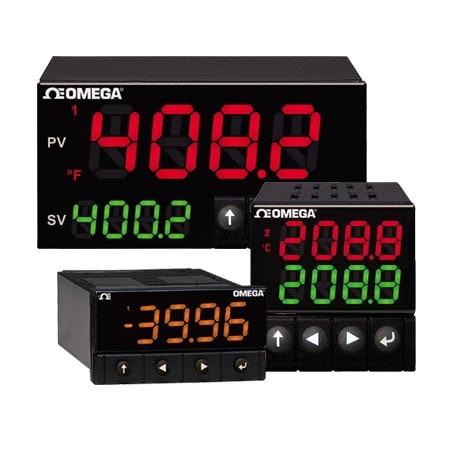
CNPT-Series
Contrôleurs universels haute performance DIN 1/32, 1/16 et 1/8
Modèles en stock
- Entrées de jauge de contrainte et pont, affichage 6 chiffres et logiciel Platinum amélioré désormais disponible
- Performance de pointe dans l'industrie (20 échantillons/sec), haute précision
- Jusqu'à 6 sorties programmables de contrôle/alarme/re-transmission/relais
- PID entièrement autotuné avec contrôle adaptatif à logique floue
CNPT-Series
À partir de
C$
438.82
Modèles en stock


Aperçu du produit
- Conversion A/N sigma-delta 24 bits
- Précision Sélectionnable
- Précision Précision de la tension de processus : 0,03 % Précision du courant de processus : 0,03 % Précision des thermocouples : Type J : 0,4°C (0,7°F) Type K : 1,0°C (1,8°F), 0,4°C (0,7°F) Type T : 1,0°C (1,8°F), 0,4°C (0,7°F) Type E : -1,0°C (1,8°F), 0,4°C (0,7°F) Type R : 1,0°C (1,8°F), 0,5°C (0,9°F) Type S : 1,0°C (1,8°F), 0,5°C (0,9°F) Type B : 1,0°C (1,8°F), 0,5°C (0,9°F) Type C : 0,4°C (0,7°F) Type N : 1,0°C (1,8°F), 0,4°C (0,7°F) Précision des RTD : Pt, 0,00385, 100 Ω, 500 Ω, 1000 Ω : 0,3°C (0,7°F) Pt, 0,003916, 100 Ω : 0,3°C (0,7°F) Pt, 0,00392, 100 Ω : 0,3°C (0,7°F) Précision des thermistances : 2252 Ω : 0,2°C (0,35°F) 5K Ω : 0,2°C (0,35°F) 10K Ω : 0,2°C (0,35°F)
- Fonctions supplémentaires 1 Écran couleur programmable à 3 couleurs
- Homologations UL, cUL, CE, UKCA
- CMRR 120 dB
- Mode de contrôle Rampe et maintien ; réglage automatique ; réglage adaptatif ; contrôle PID ; contrôle marche/arrêt ; Alarmes ; point de consigne à distance
- Remarque sur l'interface de données Connection : USB : micro-USB femelle Ethernet : RJ45 standard USB : hôte ou périphérique USB 2.0 Conformité aux normes Ethernet : IEEE 802.3 10/100 Base-T autoswitching, TCP/IP, ARP, HTTPGET
- Filtre numérique Programmable
- Fusible externe requis Fusible externe requis : temporisé, homologué UL 248-14 : 100 mA/250 V ; 400 mA/250 V (option basse tension) ; temporisé, reconnu IEC 127-3 : 100 mA/250 V ; 400 mA/250 V (option basse tension)
- Impédance d'entrée Impédances d’entrée : Processus/Déformation : 10 MΩ (±100 mV), 1 MΩ autres tensions ; Courant : 5 Ω ; Thermocouple : ≤10 kΩ ; Auxiliaire : 3,5 kΩ (0-10 V), 50 kΩ (0-1 V), 50 Ω (courant).
- Configuration d'entrée Différentiel
- Type d'entrée Thermocouple ; RTD ; Thermistance ; mA ; Tension ; Déformation
- Tension d'entrée -100 à 100 mV ; -1 à 1 Vcc ; -10 à 10 Vcc
- Isolation ISOLATION Alimentation vers Entrée/Sortie : 2300 VCA pendant 1 min de test ; 1500 VCA pendant 1 min de test (option basse tension/alimentation) Alimentation vers Sorties Relais/SSR : 2300 VCA pendant 1 min de test Relais/SSR vers Sorties Relais/SSR : 2300 VCA pendant 1 min de test RS232/RS485 vers Entrées/Sorties : 500 VCA pendant 1 min de test
- Longueur 127 mm
- Courant, max 4 à 20 mA, 0 à 24 mA évolutif
- Type de mesure Courant ; contrainte ; température ; tension
- Plage de mesure Tension de processus : ± 50 mV, ± 100 mV, ± 1, ± 10 Vcc Courant de processus : Échelonnable de 0 à 24 mA Thermocouple : Type J : -210 à 1200°C Type K : -270 à -160°C, -160 à 1372°C Type T : -270 à -190°C, -190 à 400°C Type E : -270 à -220°C, -220 à 1000°C Type R : -50 à 40°C, 40 à 1788°C Type S : -50 à 100°C, 100 à 1768°C Type B : 100 à 640°C, 640 à 1820°C Type C : 0 à 2320°C Type N : 250 à -100°C, -100 à 1300°C RTD : Pt, 0.00385, 100 Ω, 500 Ω, 1000 Ω : -200 à 850°C Pt, 0.003916, 100 Ω : -200 à 660°C Pt, 0.00392, 100 Ω : -200 à 660°C Thermistance : 2252 Ω : -40 à 120°C 5K Ω : 30 à 140°C 10K Ω : 20 à 150°C
- Nombre d'entrées 1
- Température de fonctionnement, max 50 °C
- Température de fonctionnement, min 0 °C
- Polarité Bipolaire
- Rampe et maintien Profilage
- Humidité relative 90 % HR, sans condensation
- Point de consigne à distance Courant ; tension
- Résolution 0,1° température ; 10 µV processus
- Type RTD Capteur Pt 100/500/1000 Ω ; 2, 3 ou 4 fils ; α = 0,00385 ; 0,00392 (100 Ω uniquement) ; ou α = 0,003916 (1000 Ω uniquement)
- Fréquence d'échantillonnage 20 Hz (20 mises à jour/seconde)
- ID de série CNPT-Series
- Réglage du point de consigne Menu configurable
- Stabilité de la température Stabilité de la température : RTD : 0,04°C/°C ; Thermocouple à 25°C (77°F) : 0,05°C/°C (compensation de jonction froide) ; Processus/Contraintes : 50 ppm/°C
- Type de thermistance 2 252 Ω ; 5 kΩ ; 10 kΩ
- Préchauffage jusqu'à la précision nominale 30 min
La série DwyerOmega CNPT propose un contrôleur universel haute performance conçu pour offrir précision, flexibilité et facilité d'utilisation dans les environnements de contrôle de processus exigeants. Disponible en formats DIN compacts (1/32, 1/16, 1/8), ce contrôleur universel haute performance accepte une grande variété de types d'entrées, notamment les thermocouples, RTD, thermistances, tension, courant, contrainte et pont, ce qui le rend idéal pour les laboratoires, les systèmes OEM et l'automatisation industrielle où diverses sources de mesure sont impliquées.
Conçu pour la précision, le CNPT traite jusqu'à 20 échantillons/seconde et offre une haute précision sélectionnable sur toutes ses entrées. Il dispose de multiples sorties programmables (alarmes, relais, retransmission analogique) et inclut un contrôle PID avancé avec logique floue pour un contrôle stable et réactif de la température, de la pression, du débit ou d'autres variables de processus. Avec ses deux écrans, son interface USB et sa connectivité Ethernet / Modbus en option, ce contrôleur répond aux besoins modernes en matière de surveillance et d'intégration sans sacrifier les performances.
Fort de la réputation de DwyerOmega en matière de fiabilité de conception, de conformité et d'assistance, le contrôleur universel haute performance de la série CNPT offre aux opérateurs un contrôle plus précis des processus, une réduction des temps d'arrêt et une adaptabilité aux exigences évolutives des systèmes. Qu'il s'agisse de remplacer d'anciens contrôleurs ou de concevoir de nouveaux systèmes de contrôle, la série CNPT offre à la fois puissance et précision.
Logiciel téléchargeable gratuitementConfigurateur téléchargeable gratuitement Logiciel d'application Windows®
- Configuration complète de toutes les fonctions/paramètres PLATINUM
- Connexion automatique via le canal USB
- Chargez/enregistrez les fichiers de configuration PLATINUM
- Suivi des performances (graphiques) avec capture de données
Un séquenceur avancé à plusieurs étapes de rampe et de maintien prend en charge jusqu'à 99 profils de séquences de rampe/maintien à 8 segments. Les profils peuvent être liés pour fournir des séquences étendues et des sorties auxiliaires peuvent être déclenchées en fonction des états individuels de rampe ou de maintien afin de permettre un contrôle externe des soufflantes, des mélangeurs ou d'autres fonctions de contrôle auxiliaires.
Communications Ethernet et série intégrées
L'option " Ethernet intégré " sur les modèles 1⁄16 et 1⁄8 DIN permet aux appareils de se connecter directement à un réseau Ethernet et de transmettre des données dans des paquets TCP/IP standard, ou de servir des pages Web sur un réseau local ou Internet. Des communications série optionnelles sont également disponibles, configurables en RS232 ou RS485, avec des commandes ASCII simples ou MODBUS®. Les trois types d'interfaces de communication peuvent être installés et actifs simultanément.
Pilote LabVIEW
Le pilote Platinum LabVIEW est le pilote de périphérique National Instrument permettant de communiquer avec les contrôleurs Omega Platinum via les protocoles Modbus RTU/ASCII et Modbus TCP. Le pilote permet d'accéder facilement aux données internes, aux paramètres de configuration et aux fonctions de fonctionnement de la gamme de produits Platinum.
Le pilote d'instrument LabVIEW réduit le temps de développement des applications et simplifie le contrôle des instruments. Grâce au pilote Platinum LabVIEW, les clients peuvent communiquer rapidement avec l'instrument et développer des applications de test et des logiciels robustes.
DasyLab
La prise en charge du logiciel facile à utiliser DasyLab permet de résoudre des problèmes complexes d'acquisition et de contrôle des données en vous permettant de travailler avec des organigrammes directement sur l'écran de votre PC. La haute précision d'entrée, le contrôle avancé des processus, la capacité de séquençage étendue et les options de sortie flexibles d'un contrôleur Platinum peuvent être facilement intégrés à l'ensemble complet de modules fonctionnels fournis par le logiciel DasyLab. Le logiciel DasyLab peut être intégré via les connexions série, Ethernet ou USB du Platinum.
PDF & Manuels
Logiciels & Pilotes



Accessories
accessories
cables
Afficher les évaluations et les avis
Rated 5 out of
5
by
no0ne from
Great technical support
We have put this to use. The technical support is what allowed us to put this into use quickly.
Date published: 2017-03-20
Rated 1 out of
5
by
Bcarlton from
Very difficult to use
THS S HW YU PRGM AN OMGA CNTRLR. This is 2017. Why does the 'Platinum' temp controller have a 1980s user interface? The USB port is an afterthought in a terrible location. It would not stay connected to my computer. The software does not run in Windows 10, and is not supported by Omega. Omega makes a lot of good products, but this is not one of them. We sent the unit back.
Date published: 2017-02-19
Rated 1 out of
5
by
quantum from
A nightmare to control from a computer
The device itself might be ok but it was a nightmare to control it from a computer.
Prepare to get head-hakes.
The technical documentations are poorly written, very difficult to understand and filled with errors.
It required a lot of of time and trials/errors to understand which commands and parameters to send. It was more like reverse engineering the communication protocol than using it ! What a lost of time.
For some unknown reason, several "Omega ASCII protocol" commands didn't work. So don't use it.
Their Modbus LabVIEW examples are buggy. Looks like a summer student wrote them. What a joke.
And absolutely no answer from the technical support. Nothing. What a shame.
Date published: 2021-05-21
Rated 3 out of
5
by
ProcEng from
Works, but not without issues
Bought two controllers and ran into issues with both, readings jumped all over the place during testing. Opened up the controller and found that the input board wasn't mounted onto the main board properly for both, wasted a good amount of time trying to troubleshoot.
Once I re-seated the internal board it worked as intended.
Date published: 2018-06-07
Rated 5 out of
5
by
RalphBSz from
Best controller
I have a handful of the older i16 and i32 controllers in use already, and am replacing two of those with pt32 (one done, one in progress). The i32 were already very good, with useful features, although a somewhat clunky setup interface (the 4-button menus could make grown men cry). Reliability has been perfect. Communication was a bit of an issue, required going to the larger 1/16 DIN model in some cases. The pt32 has fixed all that. Even when using the four buttons, the setup is now more logical.
But the sane way to set them up is to connect them to a laptop and configure them with the Platinum program. Being able to upload and download configurations means that I can finally put the configurations under revision control, and check that the device installed in the system is actually configured correctly. I can also modify configurations offline, without taking the control system down, and then quickly upload them in a quick downtime. Once you have a configuration, it can be quickly adjusted by editing the txt file directly. All very very convenient.
With the USB port, the communication problem has been solved. Find something with a USB connector nearby (laptop, industrial controller), either write a few lines of Python or install LabView, and you can chat with the controller. I'm now using the controller as an A-D converter for computer analysis of the process too. Very cool, low cost, convenient.
Speaking of cost: The Newport/Omega controllers have never been cheap, but worth their price. If you need a simple low-feature controller, buy something else.
The few times I've talked to tech support (in Santa Ana), they've been very helpful, patient, and knowledgeable.
My only complaint is: In one case I need four setpoints and four outputs from a single input; while it is theoretically possible to get this many outputs (not clear it can be ordered in a 1/32 DIN, that would be model -444-776), there are not four setpoints available. So this needs to be handled by using two controllers. Expensive, but works great.
Date published: 2017-10-27
Rated 3 out of
5
by
grumpy engineer from
OK
OK unit. Omega missed ship date by weeks. PC configuration software didn't work without lots of futzing around. LED display is straight out of the 90's. But, works well once configured, build quality looks good, optimistic about reliable performance. Having two PID loops in one controller is nice too.
Date published: 2020-11-25
Rated 4 out of
5
by
Jacky from
Good product. but need to improve usability.
Need better software for monitor and control the controller. we also want there are easier way that we can export process values to further analysis
Date published: 2016-02-11
Rated 5 out of
5
by
M Schneider from
Can't Stop Working
I ordered an Omega CNI Temperature Controller, everything worked great, shipped with care, and best of all shipping was super quick. Will definitely be ordering from here again.
Date published: 2026-02-20
I want to control an SL heater( basically a wall heater) with 240v 3000/2250W 12.5/108A, What do i need ?
Along with this controller you will need a solid state relay rated to the current draw of the heater and a thermocouple probe
Reference controller p/n: CN16DPT-144 relay p/n: SSRL240DC25 heatsink p/n: FHS-1 and probe p/n: TJ36-CPSS-14U-6
Date published: 2020-04-02
Where is the isothermal plate located in the CN32PT for the reference junction?
Is the thermistor within the removable terminal block or inside the controller housing?
Date published: 2022-05-17
What is the equation that calculates the temperature from mV
Hi, if you are using a thermocouple then here are some reference pages on how this is done.
This all goes into detail on the Seebeck voltage. Please contact us if you need anything further. Thanks!
https://www.omega.co.uk/prodinfo/thermocouples.html
https://www.omega.co.uk/techref/
Date published: 2019-05-15
CN16DPT-145. There is limited info on the retransmit function. I'd like to retransmit measured temperature from a thermocouple. How does the scaling work for retransmit?
To set the Analog output range on the Platinum Controllers you need to select the RNGE in the PROG menu then scale it in the RtRN parameter in the PROG menu in your case for ANG1 as well. Please call the temperature department if you need detailed assistance.
Date published: 2022-03-10
I want to drive a 24Vdc 3port/2way solenoid air valve. What output option do I select? I see there is a DC power supply option will that be needed?
Hi Julie,
Thank you for the inquiry. For your device the best option to use is the mechanical relay. You will need a power source suitable for your relay coil. The internal excitation is limited to 25 mA @ 24 VDC.
Best regards
Omega
Date published: 2019-11-13
I recently purchased a Platinum Series DP8PT-330-006-C24-EIP universal controller. The manual doesn't have the communications information in it. Where can I find the information on the Modbus RTU ethernet communications for SCADA connection?
Hi Marek,
Thank you for the inquiry. Following links are for the manuals describing communications;
https://assets.omega.com/manuals/M5458.pdf
https://assets.omega.com/manuals/M5452.pdf
And for the configurator software;
https://assets.omega.com/manuals/M5461.pdf
Best regards
OMEGA
Date published: 2020-12-18
Where can I get connectors for my CN8DPT-305?
Thank you for your inquiry. Terminal Connectors can be found here:
https://www.omega.com/en-us/control-monitoring/controllers/pid-controllers/p/CNI-10PIN-CONN
https://www.omega.com/en-us/control-monitoring/controllers/pid-controllers/p/CNI-8PIN-CONN
Date published: 2023-08-08
What is the mechanical relays fastest switching time?
Thank you for your inquiry. One second (Seven seconds is recommended).
Date published: 2021-12-08