



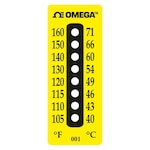
For applications that require confirmation of whether a specific temperature has been reached, heat-sensitive materials such as temperature labels, crayons, paints, and pellets offer a simple and effective solution. These tools can provide reliable, cost-effective, and sufficiently accurate temperature indication for a broad range of industrial processes.
These heat-sensitive, fusible materials consist of crystalline solids. When heated, a specific temperature is reached, at which the solid changes sharply into a liquid. This melting point is highly reproducible and is virtually unaffected by ambient conditions that may introduce errors in other temperature measurement methods.
Innovative Solutions from DwyerOmega
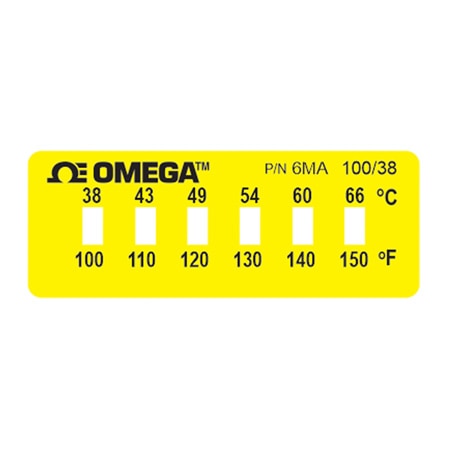

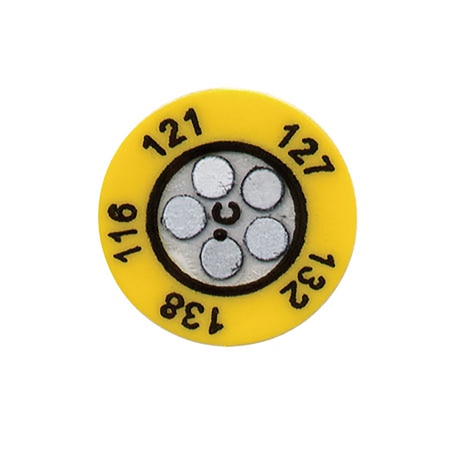
Non-Reversible vs. Reversible Temperature Labels
Temperature labels are generally categorized into two types: non-reversible and reversible. Each serves a distinct purpose depending on the monitoring requirements.
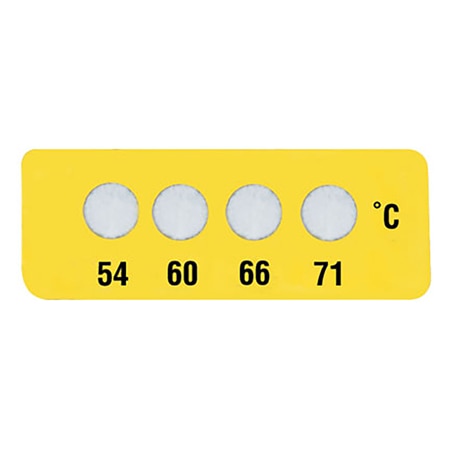
Non-Reversible Temperature Labels
Non-reversible temperature labels accurately indicate when a specific temperature is reached in a single process. Once activated, the change is permanent, making them ideal for one-time use applications where confirmation of a temperature event is required.
Non-reversible labels are especially useful in situations where an operator is not available or does not have access to the label attached to a product under test. At any future time, the label may be examined to determine whether the specified temperature had been obtained.
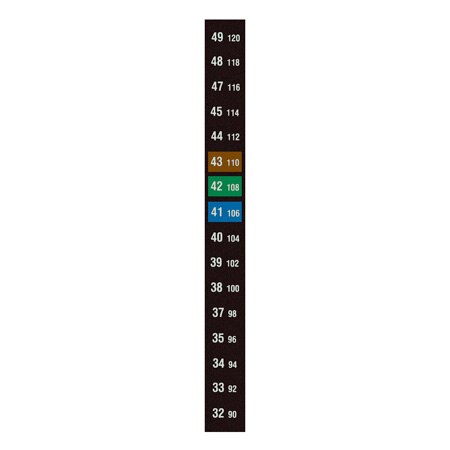
Reversible Temperature Labels
Reversible temperature labels provide quick, visible temperature monitoring through instant color changes. They respond to current temperature conditions and can change back and forth as needed.
Because of this, reversible labels can be used repeatedly and are ideal for applications requiring continuous or ongoing temperature monitoring. Their clear visual response allows for efficient temperature tracking at a glance in both industrial and laboratory environments.
What is the Difference Between Non-Reversible and Reversible Temperature Labels?
The primary difference lies in how the temperature indication behaves over time:
- Reversible temperature labels can change back and forth to indicate the present temperature and can be reused multiple times
- Non-reversible temperature labels provide a one-time indication that a specified temperature has been reached
Advantages Over Electronic Temperature Measurement Devices
This family of fusible temperature indicators has several advantages over other methods of determining surface temperature:

- Direct Surface Measurement
- Immediate Response
- Simplicity and Cost-Effectiveness
The temperature indications obtained are unquestionably those of the surface being tested. The temperature-sensitive material is applied directly to the surface and therefore changes state in direct response to that surface, and only that surface.
There is no delay in obtaining a signal. Since a mark left by a crayon or a lacquer has an extremely small mass, it attains rapid equilibrium with the surface. The use of a massive probe tends to prolong response time and could result in an erroneously low reading.
With fusible temperature indicators, there is no conduction of heat away from the surface, nor is there any dependence on the duration of heating.
The technique for using fusible temperature indicators is simple and economical. Determining surface temperatures by most other means requires technical competence, skill, and often sophisticated instrumentation.
Surface temperature readings can be obtained from fusible indicators with little effort, minimal training, and low cost.
What is a Calibrator and why is it an important device? Introduction to Instrument Calibration
DwyerOmega | Blog | Proper Temperature Sensor Calibration Calibrator Simulators vs. Physical Calibration Devices