


Thermocouples and RTDs are two of the most widely used temperature sensors in industrial, commercial, and laboratory applications. Both are proven technologies, but they operate on different principles and are suited to different operating conditions.
Selecting between a thermocouple and an RTD depends on factors such as temperature range, accuracy, response time, stability, and cost.
Innovative Solutions from DwyerOmega
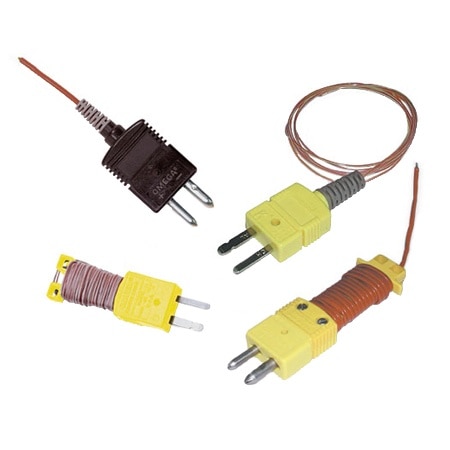
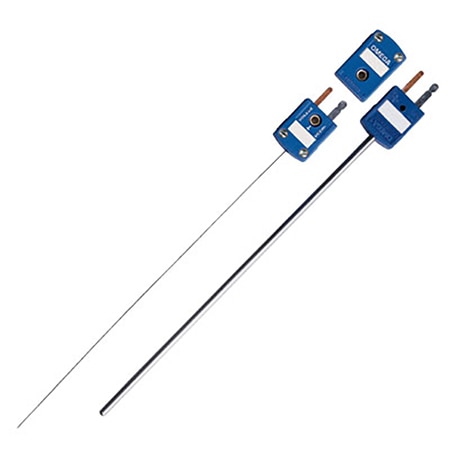
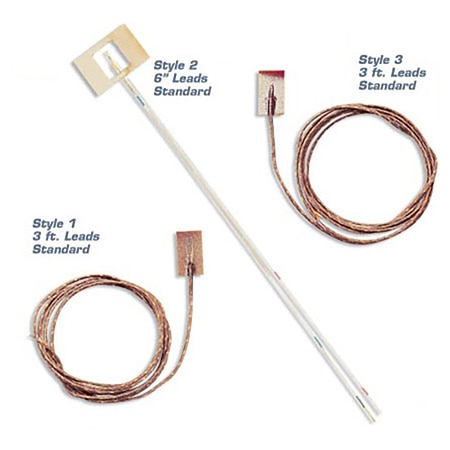
How Thermocouples Work
A thermocouple measures temperature using the Seebeck effect, which occurs when two dissimilar metals are joined together to form a junction.
A typical thermocouple consists of:
- A hot junction , placed at the measurement point
- A reference (cold) junction, maintained at a known temperature or compensated electronically
Thermocouples are defined by standardized type designations such as J, K, T, E, and N, each with a specific metal combination and temperature range.
How RTDs Work
A Resistance Temperature Detector (RTD) measures temperature by correlating it to changes in electrical resistance.
RTDs use a precision metal element, typically platinum. As temperature increases, the electrical resistance of the element increases in a highly predictable manner. By measuring this resistance, temperature can be accurately calculated.
RTD elements are manufactured to standardized resistance curves and tolerances. The most common RTD is the PT100, which has a resistance of 100 ohms at 0°C. Other common variants include PT500 and PT1000 sensors.
RTDs are available in a wide range of constructions, temperature ratings, accuracy classes, and physical sizes to suit different applications.
Temperature-to-Output Characteristics
One of the fundamental differences between thermocouples and RTDs is how their output relates to temperature.
RTDs exhibit an almost linear temperature-resistance relationship over their operating range. This linearity simplifies signal conditioning and improves measurement accuracy.
Thermocouples, by contrast, have a nonlinear temperature-voltage relationship that resembles an “S-shaped” curve. While nonlinear, thermocouple outputs are standardized and well characterized, allowing modern instrumentation to compensate accurately for this behavior.
Thermocouples vs RTDs: Key Differences
| Selection Factor | Thermocouples | RTDs |
|---|---|---|
| Sensing element and principle | Two dissimilar metals form a junction and generate a small voltage (Seebeck effect) related to the temperature difference between measurement and reference junctions. | A resistive metal element changes resistance with temperature. Temperature is calculated from measured resistance. |
| Output type | Low-level millivolt signal. Requires reference junction compensation and appropriate input conditioning. | Resistance (ohms), commonly measured via 2-wire, 3-wire, or 4-wire circuits. Lead-wire effects depend on wiring configuration. |
| Temperature-to-output relation | Nonlinear temperature-voltage relationship, standardized by thermocouple type. | Nearly linear temperature-resistance relationship over typical sensor ranges. |
| Standardization | Defined by standardized type designations (e.g., J, K, T, E, N) with published conversion curves. | Defined by standardized resistance curves and tolerances (commonly platinum PT100, PT1000). |
| Typical temperature range | Suitable for high-temperature measurements. Some types can be used up to approximately 2,500 °C (4,532 °F), depending on construction and environment. | Commonly used below about 400 °C (752 °F), depending on element type and construction. |
| Accuracy | Typical accuracy is lower than RTDs for many general-purpose assemblies. Calibration and higher-grade wire can improve accuracy in some applications. | Typically higher accuracy, often around ±0.1 °C depending on element class and measurement method. |
| Long-term stability and drift | More prone to drift over time due to metallurgical and chemical changes (e.g., oxidation, contamination), especially at elevated temperatures. | Generally more stable and repeatable over time with lower drift under comparable conditions. |
| Response time | Often faster, especially with grounded junction constructions. Construction and sheath style strongly affect response time. | Often slower than thermocouples with comparable probe geometry. Thin-film elements can improve response in some assemblies. |
| Typical cost | Typically lower cost for comparable probe style and temperature class. | Often higher cost, commonly two to three times more than comparable thermocouple assemblies. |
| Best-fit use cases | High-temperature processes, rugged industrial environments, fast-changing temperatures, and cost-sensitive applications. | Applications requiring higher accuracy, good repeatability, and long-term stability at moderate temperatures. |
Selecting the Right Temperature Sensor
Selecting between a thermocouple and an RTD depends on the specific requirements of your application.
Temperature Range
Thermocouples are the clear choice for high-temperature measurements. While most RTDs are designed for temperatures below 400 °C (752 °F), certain thermocouple types can operate at temperatures as high as 2,500 °C (4,532 °F).
Cost
Thermocouples are generally less expensive than RTDs. In many cases, an RTD can cost two to three times more than a thermocouple of similar construction and temperature rating.
Response Time
Both sensor types respond quickly to temperature changes, but thermocouples typically react faster. A grounded thermocouple junction can respond nearly three times faster than a standard PT100 RTD, making thermocouples better suited for rapidly changing processes.
Accuracy
RTDs are generally more accurate than thermocouples. Typical RTD accuracies are around ±0.1 °C, while many thermocouples have accuracies closer to ±1 °C. In some applications, high-quality thermocouples with appropriate calibration and signal conditioning can approach RTD-level accuracy.
Stability and Long-Term Performance
RTDs offer superior long-term stability and repeatability. Their resistance characteristics remain consistent over time, resulting in minimal drift.
Thermocouples, on the other hand, can experience drift due to chemical and metallurgical changes in the sensing wires, such as oxidation or contamination. For applications requiring long-term measurement stability, RTDs are often the better choice.

What Is A Stepper Motor & Controllers? – Omega Engineering Introduction to Stepper Motors
